Winning Guaranteed Deals in AdX: A Guide for Premium Publishers
Publishers save 57 percent more time on Programmatic Guaranteed deals than on traditional reservations, and agencies and advertisers save 29 percent more, according to a Boston Consulting Group study of more than 40 advertisers, agencies and publishers across 12 countries published February 7, 2018. Those hours explain why premium publishers keep guaranteed deals at the center of direct sales: one negotiated price, one set of terms, inventory held for a single buyer. The format also carries the strictest delivery economics in the programmatic stack. Starting November 2, 2026, Google extends its Programmatic Guaranteed (PG) overdelivery reconciliation process to PG deals with Display and Video 360, and publishers earn nothing for the overdelivered impressions the process identifies.
Winning this business is an operations exercise before it is a sales exercise. We run Google Ad Manager, AdX and MCM for thousands of publishers, each above one million monthly pageviews, and the guaranteed budgets consistently land on the properties that document audience, forecast delivery and control pacing. Taxonomy, packaging, Deal IDs, pacing, pricing and reconciliation decide who collects that budget and who watches it leave.
What a guaranteed deal actually commits
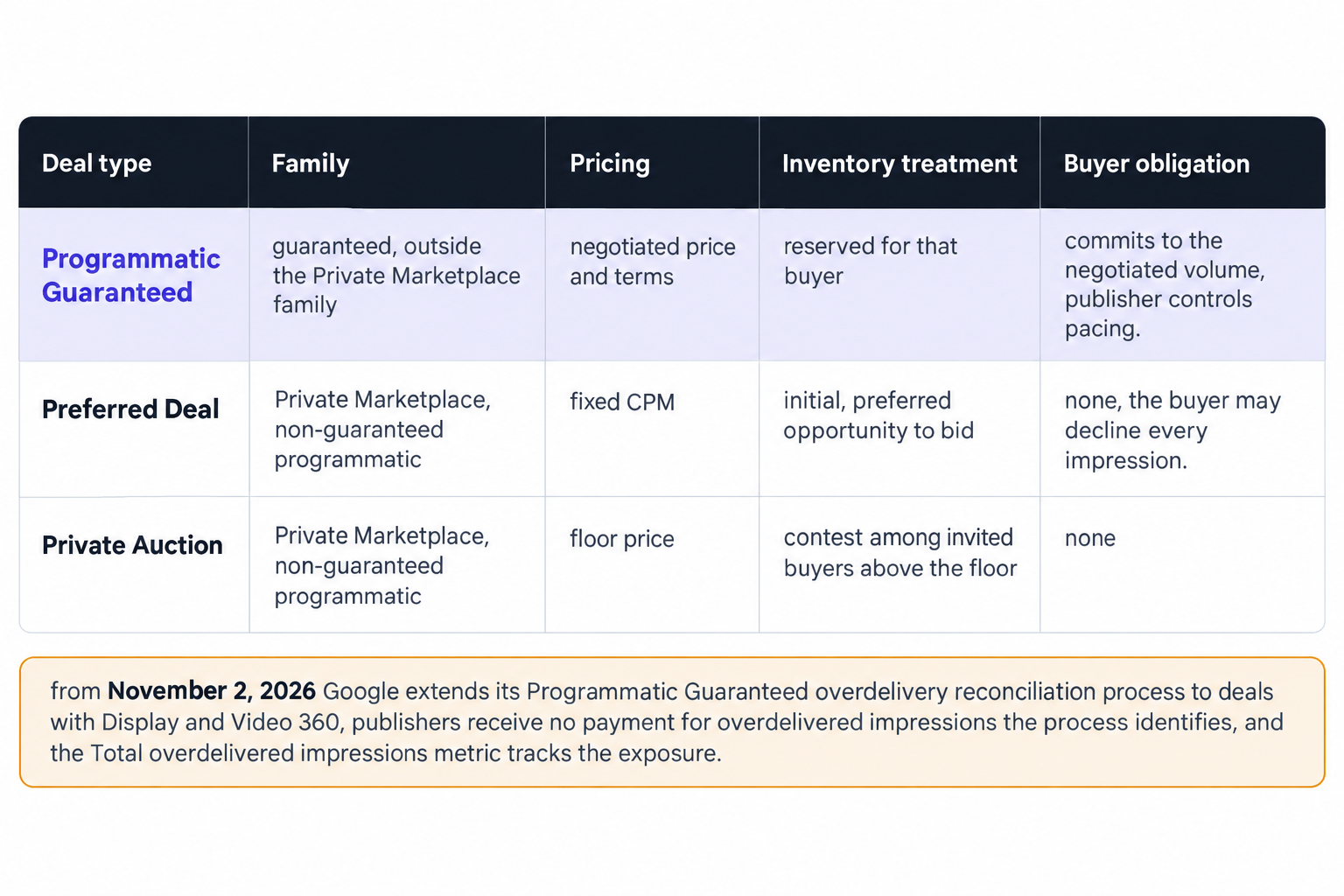
Google splits programmatic deals into two families. Private Marketplace deals form the non-guaranteed programmatic family, which divides into Preferred Deals at a fixed CPM and Private Auctions with a floor price. Programmatic Guaranteed sits outside that family because it reserves inventory. The open auction sits beneath everything as the clearing layer, and each deal family exists to price access above it. Study the official deal taxonomy before you draft a single offer, because buyers quote it back at you in every negotiation.
The negotiation mechanics follow the family split. In a Programmatic Guaranteed deal, the publisher and the buyer negotiate a price and terms for inventory reserved for that buyer. In a Preferred Deal, the buyer holds an initial, preferred opportunity to bid at the negotiated price, and the buyer carries no obligation to purchase. Google's publisher-side negotiation definitions draw the line in exactly those terms.
That single distinction, obligation, drives every downstream decision. A Preferred Deal behaves like priority access: the buyer bids first at the agreed CPM, and if the buyer passes, the impression falls through to the next demand tier. A Private Auction behaves like an invitation-only contest above a floor. A Programmatic Guaranteed deal behaves like a reservation: one buyer holds the inventory for the flight, the negotiated price holds, and your ad server owes delivery. Sell the wrong structure and you either give away priority you could have auctioned or accept delivery risk you cannot support. Premium inventory deserves that precision, because the spread between a guaranteed CPM and an open auction clearing price is where the margin lives.
The inventory you can actually guarantee
Buyers pay guaranteed rates for inventory they can forecast, not inventory they hope appears. Forecastable inventory has three ingredients: stable traffic patterns, first-party audience segments you can describe without vague adjectives, and invalid traffic low enough that verification tools confirm your numbers instead of disputing them. Properties short on any ingredient should sell Preferred Deals and Private Auctions first, then graduate to guarantees once a sustained delivery history supports the forecast.
Four documents decide whether a buyer will guarantee against you. Prepare them once and reuse them in every negotiation:
- Delivery history by unit and geography, including the seasonal trough, not just the average.
- Audience definitions sized in monthly uniques, mapped to the buyer's own planning language.
- Viewability and invalid traffic figures from a verifier the buyer already trusts.
- A pacing plan that names who sets the delivery curve, who watches it daily and who can throttle it mid-flight.
Hand those over before the buyer asks, and the negotiation starts from competence. Packaging should mirror how buyers shop: our advertiser-side conversations run on demand side reach, verified audiences and OpenRTB 2.6 buying and curated supply paths, so the publishers who win guarantees package audience slices, not just placements: a segment, a geography, a unit mix, a viewability commitment. A publisher with strong weekend traffic should package weekend delivery as a product with its own forecast, not as an afterthought inside a weekly average. Name the audience in the buyer's language and the price conversation starts at a premium CPM instead of a placement discussion.
If you reach AdX through MCM, add one step. Your managing partner runs the deal machinery, so agree in writing on who controls pacing, who reports the Total overdelivered impressions metric and who settles payment before you commit a date to a buyer. Ambiguity inside an MCM hierarchy turns into delivery misses at the worst moment of the flight, its final week.
Deal IDs, product rows and the pacing lever
Programmatic Guaranteed offers are made, received, negotiated and accepted through Ad Manager 360, but the buyer experiences your packaging inside Display and Video 360. Each product row there carries an individual Deal ID you provide, so your packaging decisions become the buyer's product grid. One Deal ID per product row means every slice you define becomes a separately negotiable, separately paced product: a homepage package for one audience, a run-of-site offer for another, a video bundle for a third. Define twenty overlapping rows and the buyer faces a fragmented grid that stalls the negotiation instead of focusing it.
Name rows so both sides can parse them without a call: property, segment, unit mix, flight. Deal IDs also anchor mid-flight conversations; when delivery drifts, both sides reference the row, not a vague campaign name.
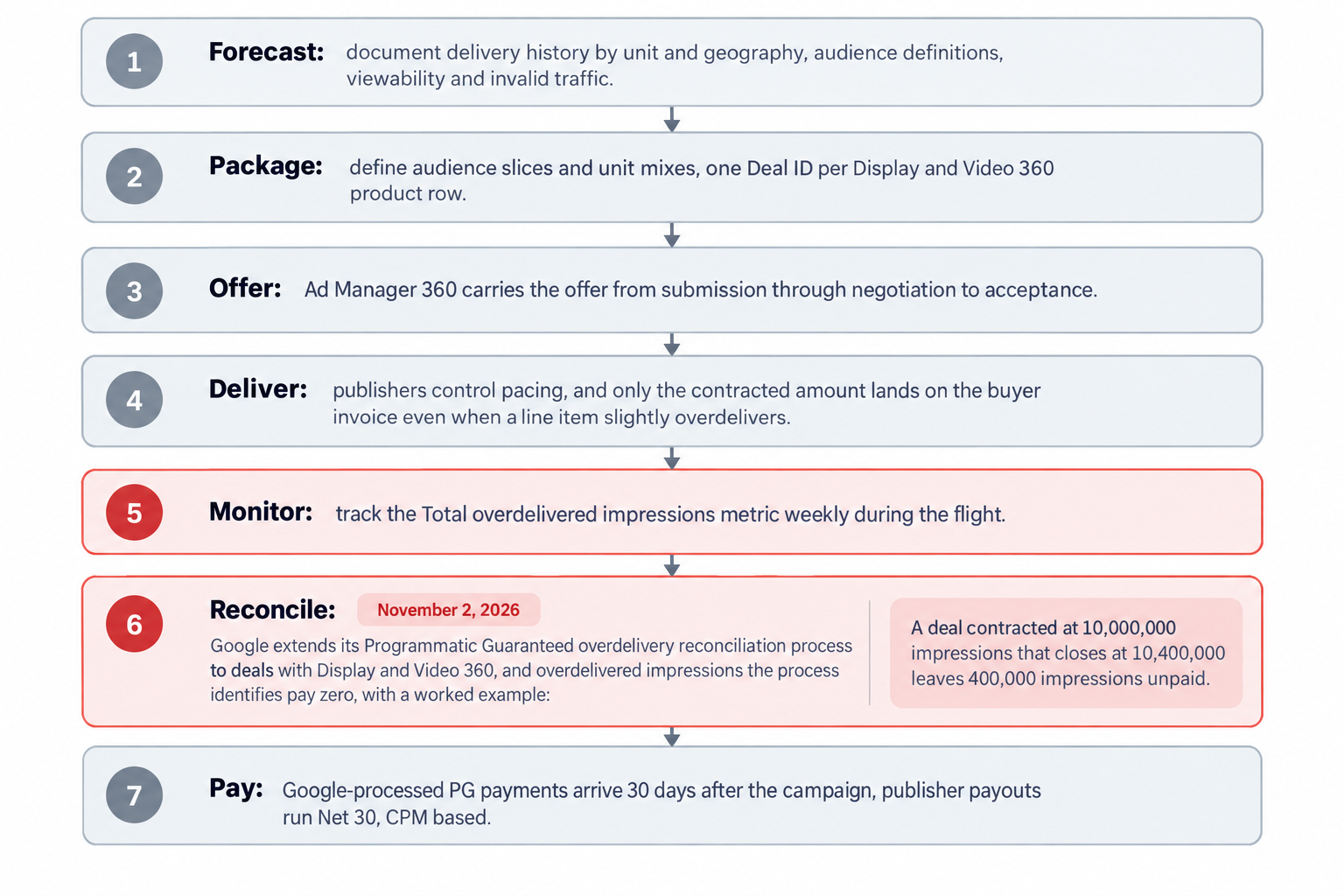
Pacing ownership is the part publishers underestimate. Publishers control pacing for Programmatic Guaranteed deals: you set the delivery curve, the buyer trusts it, and only the contracted amount of impressions lands on the buyer invoice even when a line item slightly overdelivers. The buyer's money follows your forecast discipline. Pace flat and you protect both sides. Pace to a steep end-of-flight catch-up curve and you manufacture the overdelivery the reconciliation process now identifies.
Price the guarantee against your own auction
A guaranteed deal competes with your own stack even though the buyer never sees the contest. Google Ad Manager compares the reserved line item against AdX demand in dynamic allocation, so the negotiated CPM must clear the expected value of the same impression everywhere else, net of fees and shading. We integrate OpenRTB 2.6 seats and Prebid for header and server-side demand, and we rank bids by expected value: first price with bid shading, reserve prices, goal-based pacing. The details of auction mechanics and expected-value ranking decide whether a guaranteed deal adds revenue or quietly trades premium impressions at a discount.
Bid shading matters more here than most publishers admit. The clearing prices you observe in the open auction understate what buyers would pay without shading, so a guaranteed CPM set at the observed clearing price can still lose money on the exact impressions you reserved. Price above the shaded net, then add the certainty premium: the buyer pays for forecast reliability, and you charge for the delivery risk you absorb, a risk that grows once overdelivery stops paying.
Reserve prices behave differently in each family. In a Private Auction the floor sets the contest minimum. In a Preferred Deal the fixed CPM buys priority access. In a guaranteed deal the negotiated CPM should sit above the expected value your reserves and shading produce on equivalent inventory. If it does not, shrink the reservation or walk away, because every served impression below that bar costs you the difference.
Hold firm on delivery, trade on audience
A guaranteed negotiation has three fixed points. The CPM must clear expected value, the contracted volume must sit inside your weakest forecast weeks, and the flight dates must match inventory you can actually deliver. Everything else can move: the width of the audience definition, the share of a segment the buyer can claim, data usage rights, the option to extend the flight at the same CPM. Publishers who trade on the fixed points sign deals that lose money on every impression; publishers who trade on the flexible points protect margin and still close.
Ask for the buyer's product structure early. Each product row in Display and Video 360 carries an individual Deal ID you provide, so the buyer's campaign plan tells you how many offers to prepare and how granular the packaging must become. A buyer planning three product rows needs three clean offers. A buyer planning twelve needs a packaging session before anyone discusses price.
Price the certainty explicitly. The buyer pays a fixed CPM for inventory reserved for that buyer and for a delivery profile you control, and from November 2, 2026 you also carry the cost of any overdelivery the reconciliation process identifies. A negotiation that treats the guaranteed CPM as a discount from rate card, rather than a premium over the shaded net, leaves that risk sitting on your side of the table.
The November 2026 reconciliation change
Starting November 2, 2026, Google extends its Programmatic Guaranteed overdelivery reconciliation process to Programmatic Guaranteed deals with Display and Video 360. The process identifies overdelivered impressions, publishers receive no payment for them, and you can track the exposure with the Total overdelivered impressions metric. The Ad Manager release notes carrying the change give you the three facts that matter operationally: the date, the metric and the scope.
Run the arithmetic before you sign. A deal contracted at 10,000,000 impressions that closes at 10,400,000 puts 10,000,000 on the buyer invoice, because only the contracted amount lands on the invoice even when a line item slightly overdelivers. The 400,000 impression overshoot has always sat outside the buyer's invoice. From November 2, 2026, the reconciliation process also keeps it out of your payment once it identifies those impressions as overdelivered.
Four habits protect the margin. Each one costs a weekly review, not a platform migration:
- Watch the Total overdelivered impressions metric weekly during the flight, not after the campaign closes.
- Pace flat: no front-loading, no end-of-flight surges.
- Contract volume against your weakest forecast weeks, never your peak.
- Reconcile during delivery, because publishers control pacing and you can still throttle a line item while the campaign runs.
None of the habits require new tooling. They require an owner, a weekly review and the discipline to slow a campaign down before it overshoots the contract.
Two payment clocks
Guaranteed money moves on fixed schedules, and the schedules differ by path. Google-processed PG payments arrive 30 days after the campaign, so a deal that flights in March settles in April on Google's clock. OnlyMedia pays publishers Net 30, CPM based, with no chasing and no sliding terms, and publishers above one million monthly pageviews can route guaranteed deals through our curated programmatic demand network alongside the rest of their stack. Both clocks run roughly a month, which means a quarter heavy on guarantees should not open a receivables gap if you invoice on time and the deals deliver on contract.
What agencies should verify before recommending a guaranteed strategy
Advising a publisher into guarantees without an operations audit sets up both sides for a failed flight. The same BCG study found that agencies and advertisers save 29 percent more time on Programmatic Guaranteed deals than on traditional reservations, and the time savings hold only when the publisher's delivery machinery works. Six checks cover the risk:
- Forecast integrity: seasonal history, traffic concentration and the share of volume any single referrer controls.
- Deal ID architecture: product rows the buyer can evaluate at a glance.
- Pacing capability: who owns the delivery curve, and whether the ad operations team reviews it daily.
- Reconciliation exposure: how the property will track the Total overdelivered impressions metric after November 2, 2026.
- Price adequacy: the guaranteed CPM measured against the expected value of the same impressions in open demand.
- Payment mapping: how Google's 30 day cycle lines up with the publisher's cash needs.
Because OnlyMedia runs an ad network, an SSP and an agency in one company, our agency side brings direct budgets and guaranteed deals to the same inventory our network monetizes. Partners plug into DSP seats and agency direct lines, SSP pathways and measurement studies, so the audit above draws on live deal data rather than theory. An agency that cannot see delivery data should demand it before the offer goes out, because from November 2, 2026 the cost of ignoring it stops being theoretical.
Failure modes we see repeatedly
The same handful of mistakes sinks otherwise winnable guaranteed revenue. We see six of them over and over:
- Overdelivery beyond contract: from November 2, 2026, the reconciliation process identifies those impressions and they pay zero.
- Deal ID sprawl: overlapping product rows fragment the buyer's grid and stall the negotiation.
- A CPM set at the observed clearing price, which ignores bid shading and sells premium impressions below expected value.
- Pacing neglect after launch: the publisher owns the curve, and an unattended curve drifts into end-of-flight surges.
- Forecast optimism: contracting peak season volume as if it ran year-round.
- Unreserved inventory left without floors: the impressions outside the reservation should still meet a price floor in a Private Auction or the open exchange.
None of these demand new technology. They demand a forecast you can defend, a product structure a buyer can read, a pacing plan someone owns daily, and a price that clears your own auction's expected value.
Guaranteed deals reward operations, not charisma. Build offers on inventory you can forecast, structure Deal IDs the buyer can parse at a glance, pace flat, price above the shaded net, and start tracking the Total overdelivered impressions metric now, because from November 2, 2026 the impressions it counts pay nothing. Publishers who run that discipline convert premium inventory from auction volatility into contracted revenue, and the buyers across the table pay the certainty premium for exactly that reason.