SPO (Supply Path Optimization): Why Media Buyers Are Consolidating SSPs
The top 20 publishers in the open web integrate an average of 24.5 supply-side platforms, and a single impression can reach one buyer through as many as 600 distinct paths. The Trade Desk published both figures in its trader guide to SPO, and together they explain why media buyers are consolidating their supply-side vendor lists instead of adding to them. Supply path optimization, or SPO, is the buyer-side discipline of mapping every route a bid request can take from a publisher to a DSP, scoring each route on cost, performance and transparency, and cutting the routes that fail. For a publisher above one million monthly pageviews, SPO is not background noise in the trade press. It decides which of your demand paths keeps budget next quarter and which one gets a termination email.
What buyers actually do when they run SPO
An SPO program runs in four steps: map, dedupe, score, cut. Mapping reconstructs every path that carries a publisher's inventory into the buyer's DSP, including header wrapper integrations, server-side connections, reseller agreements and agency direct lines. Deduplication flags paths that resell the same impression, because a resold bid request arrives twice at the DSP with two margins attached. Scoring ranks each surviving path against a fixed set of criteria, and cutting removes the bottom of that ranking.
Buyers weight the criteria differently, but the list itself stays stable across teams:
- Take rate: what the intermediary charges relative to the clearing price the buyer pays.
- Win rate: how often bids on that path convert, and at what bid shading level.
- Transparency: a complete, current sellers.json and a valid SupplyChain object in every bid request.
- Media quality: viewability and invalid traffic rates on the path's inventory.
- Data access: whether log-level data or path-level reporting reaches the buyer.
- Identity support: whether the path carries the buyer's identifiers without breakage.
The economics behind the exercise are blunt. The ANA's programmatic study found that only 36 percent of every dollar invested by an advertiser that enters a DSP effectively reaches the consumer, while 29 percent goes to DSP and SSP fees. The same study sizes the opportunity at 22 billion dollars in efficiency gains across the 88 billion dollar open web, and it recommends that buyers select 75 to 100 trusted programmatic media sellers. That last number is the one publishers should underline. It pushes buyers from hundreds of integrations to a shortlist, and every shortlist has a cut line.
How a publisher ends up with 24.5 integrations
Path sprawl is rarely a decision, it is an inheritance. Each integration arrived with a reason: a video demand partner that filled a format gap, a regional exchange that lifted CPMs in one market, an agency direct line that came with a campaign commitment, a reseller that promised reach none of your direct seats could match. Header bidding rewarded the accumulation for years, because parallel paths competed on every request and the publisher kept the delta.
First-price auctions and bid shading changed the math. A resold impression that arrives late and shaded twice now costs the buyer money, and buyers responded by auditing paths instead of adding them. The result is the average in the Trade Desk figures: 24.5 integrations per top publisher, up to 600 paths to a single impression. Nobody chose that topology, one integration at a time it grew, and buyers now bill for it. The publisher pays in leverage, in transparency and in fees.
The transparency layer: sellers.json and SupplyChain
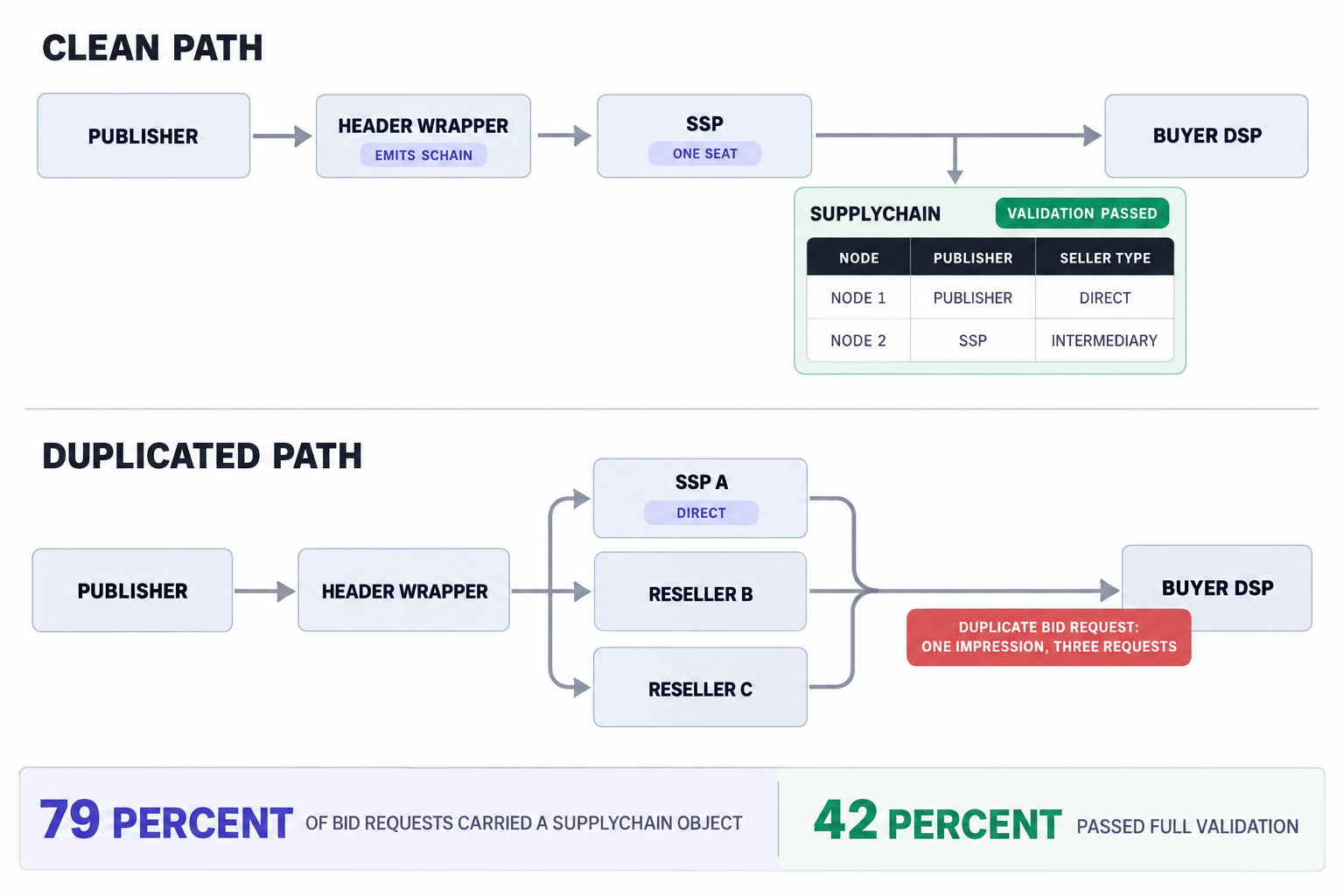
Buyers cannot score a path they cannot see, so the audit starts with two IAB Tech Lab standards. The first is sellers.json, which the sellers.json specification defines as a mechanism for buyers to discover who the entities are that are either direct sellers of or intermediaries in selling digital advertising. The second is the SupplyChain object, which travels inside the bid request itself. Each node in the object represents a specific entity that participates in the selling of that bid request, and the entire chain represents all sellers who were paid for an individual bid request. A buyer reading a valid chain knows exactly which hands touched the impression before the chain reached its DSP.
Full validation means the chain's nodes resolve against the seller's published sellers.json, the seller IDs match the published records, and the declared relationship types hold up against the file. A buyer's platform runs those checks automatically at the bid stream level, which makes the gap operational rather than academic. Fixing a failing chain sits with the seller, and a publisher whose partners fail validation inherits the exclusion.
Coverage of the new best practices cited HUMAN Security measurement: 79 percent of bid requests carried a SupplyChain object, but only 42 percent passed full validation. A chain that fails sends a buyer one of two signals: the seller could not build the object correctly, or the seller did not want to disclose something. Both readings route budget toward a different path, and nobody outside the seller can repair a malformed object.
The 2026 best practices raise the floor
The September 2026 best practices from the IAB Tech Lab's Programmatic Governance Council arrived on September 16, 2026, and stayed open for comment through October 16, 2026. Programmatic Best Practices version 1.0 covers four problem areas: duplicate bid requests, bid caching, ad refresh and schain gaps. Two recommendations matter most for publishers. The first says platforms should support schain. The second says every bid request should include an schain object.
The consequences land inside your header wrapper and your server-side connections. A demand path in your stack that cannot emit a valid SupplyChain object now contradicts a published industry recommendation, and buyers hold a documented reason to exclude it. Duplicate bid requests receive the same treatment: a path that resells your impressions into a DSP twice creates precisely the noise the document targets, and the fix belongs on the publisher side as much as the buyer side, because the publisher controls which integrations enter the wrapper in the first place.
Buyer-side controls that reroute your revenue
DV360 exposes buyer-side supply path controls, including the ability to target only authorized sellers that directly own the inventory, as indicated by DIRECT declarations in ads.txt. The mechanic matters to every publisher with an ads.txt file. A DIRECT line states that the named seller owns the inventory relationship. A RESELLER line states that the named seller can sell the inventory but sits downstream of you. When a buyer switches on authorized sellers targeting, every RESELLER line in your file becomes a path the buyer can exclude with a single setting, with no negotiation involved. Keep the file current in Ad Manager as well, so your ad server's authorized sellers list and your published ads.txt never disagree, because buyers compare both.
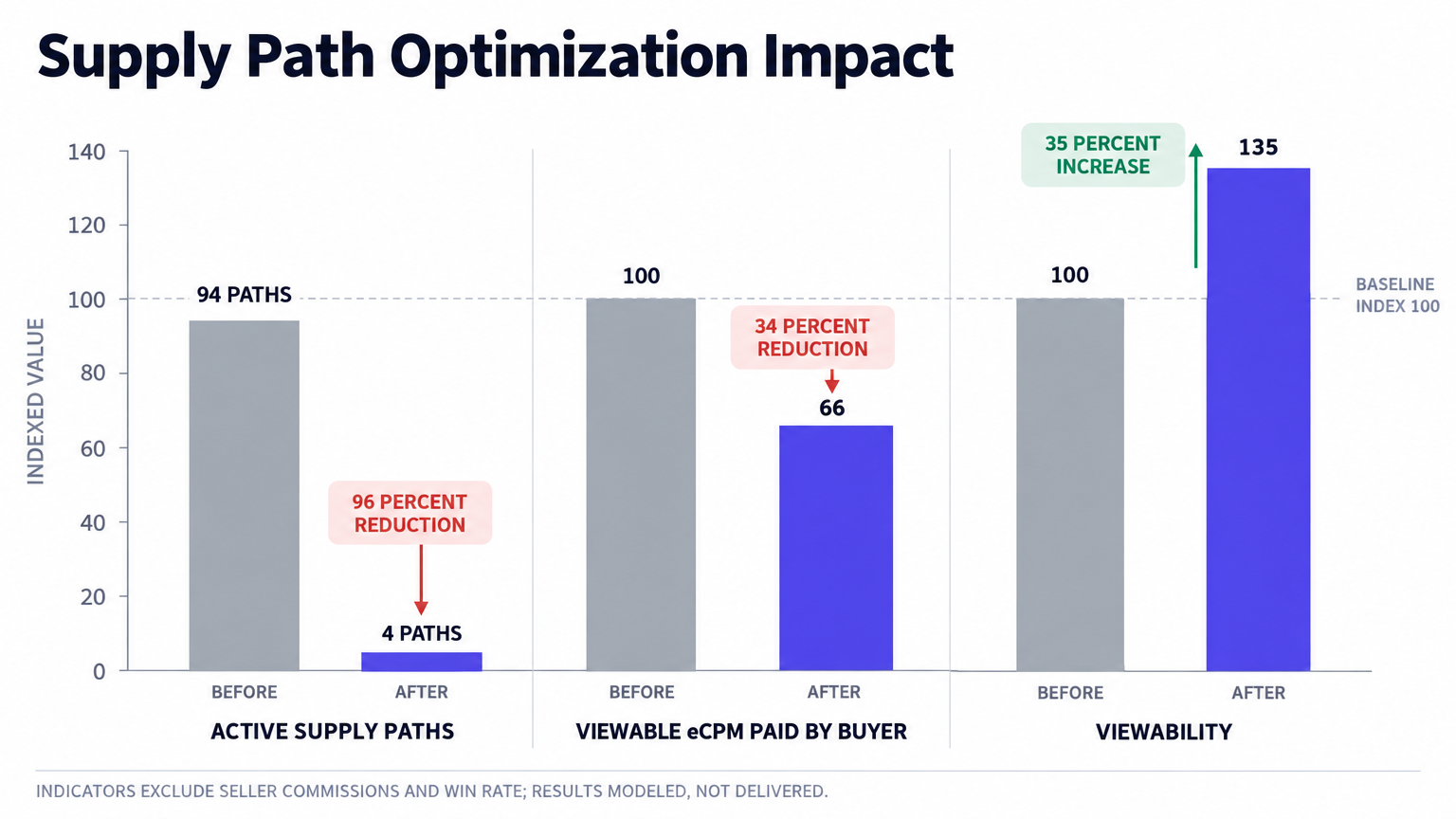
One agency case study running through DV360 quantifies what exclusion looks like from the buyer's chair. The analysts took a domain with 94 distinct supply paths and modeled concentrating budget on the paths that generate performance. The model would have produced a 96 percent reduction in paths, a 34 percent reduction in viewable eCPM, and a 35 percent increase in viewability. The indicators exclude seller commissions and win rate, so the figures isolate path concentration itself rather than pricing wins. From the buyer's side the trade works: fewer paths, cheaper viewable impressions, more viewable inventory. From the publisher's side the reading is subtler. The domain kept the paths that performed and lost the rest, which means its revenue now flows through fewer doors, and the doors that remain hold more leverage at renewal.
When a buyer enables authorized sellers targeting against your domain, your reporting shows it as a bid rate drop on every RESELLER path, not as a named exclusion. Most publishers discover they lost a path at renewal, when the buyer's team lists what they cut. Ask your account teams directly which authorized sellers settings applied to your domain last campaign, because the answer tells you which of your paths already lost.
What consolidation does to publisher revenue
Cut from 94 paths to roughly four, and the surviving paths transact most of the volume. Concentration cuts both ways. The surviving sellers see their share of your revenue rise, and they bring that share to the next rate negotiation. The buyer gains leverage too, because a threat to route around a named seller carries more weight when you hold few alternatives. Revenue does not automatically fall in the buyer's model, but your bargaining position weakens with every path you lose.
Path duplication compounds the damage before anyone consolidates. When two intermediaries resell the same impression, you see two clearing events and cannot reconstruct the final price the buyer paid. First-price auctions punish that uncertainty, because bid shading logic depends on estimating what the clearing price would have been on a clean, single-path request. Every duplicate path degrades the information your auction runs on, and SPO is the buyer-side mirror of the same cleanup.
The counterweight: buyers do not want one path
Consolidation has a stated limit. The same Trade Desk guidance that quantifies 24.5 platforms per top publisher also warns that cutting supply paths too aggressively can limit optimization. The reason is structural rather than sentimental. Paths differ by format, by deal type, by region and by entry point: a video specialist, a regional exchange, a private marketplace seat and a header wrapper can each reach demand the others cannot. A buyer that collapses to a single path per publisher forfeits the demand that only the excluded paths carried.
The realistic end state for most publishers is a handful of paths, each justifiable, each transparent, each carrying demand the others cannot. That nuance changes your job. You are not fighting SPO, you are competing to be one of the handful.
Deals migrate into the surviving paths
Consolidation also moves deal money. Buyers running SPO prefer private marketplace deals with named sellers over open auction buys, because a deal ID pins the path, the seller and the floor price, and removes guesswork from post-campaign analysis. A publisher with clean paths negotiates from strength here: propose deals to the buyers auditing you, attach the deals to the paths that validate, and you convert an audit into a rate conversation. A publisher with five undifferentiated reseller paths has nothing to propose, because the buyer cannot tell the deals apart.
Where we sit, and how we run the paths we keep
OnlyMedia runs an ad network, an SSP and an agency inside one company, so we see SPO from both directions daily. On the sell side we integrate OpenRTB 2.6 seats and Prebid for header and server-side demand, and we work with thousands of publishers, each above one million monthly pageviews. We pay Net 30, CPM based, no chasing, no sliding terms, and the terms our demand network publishes are the terms we honor. On the buy side the same standards apply in reverse: our DSP seats and measurement studies depend on the same schain and sellers.json hygiene this article describes.
Our auction ranks bids by expected value: first-price with bid shading, reserve prices and goal-based pacing, and we document the full auction mechanics and bid shading logic in public. Expected-value scoring doubles as an SPO posture. A resold bid competes on the value it can deliver, not on the number of times it arrives, so duplicate requests do not double count into the ranking the way raw price sorting would let them. For buyers, our curated supply paths and verified audiences remove the guesswork that triggers most audits in the first place: when the chain validates and the path count is deliberate, there is little left to prune.
Before buyers audit you: the publisher checklist
A buyer-side SPO audit takes weeks. Publisher-side preparation takes days, and you control every item on this list:
- Pull your own sellers.json and the sellers.json of every intermediary that sells your inventory, then count the nodes. Every node you cannot explain to a buyer is a node a buyer will not trust.
- Reconcile your ads.txt against reality. Every RESELLER line you publish is a path a DV360 buyer can exclude with one checkbox, so confirm each line still carries demand worth the leverage it costs you.
- Require an schain object in every bid request your wrapper emits, including the server-side connections. The 2026 best practices make this explicit, and validation failures cost you visibility you cannot buy back.
- Deduplicate demand yourself. If two intermediaries sell the same impression, keep the one with the higher expected value and terminate the other on your schedule, before a buyer terminates both on theirs.
- Offer your top buyers path-level or log-level reporting. A buyer with visibility prunes less, because every excluded path then carries a measurable opportunity cost.
- Take the concentration argument to your buyers first. Propose deals against the paths that validate, price them against the paths a buyer would keep after an audit, and you sit on the surviving side of the cut line with a rate conversation instead of an exit.
SPO rewards the traits that make inventory easy to buy: a clean chain, a current ads.txt, a deliberate path count and an auction a buyer can model without calling you. Publishers lose revenue to SPO when they sell through paths they cannot describe. The ones who gain sell through paths that need no description, because the record describes itself.