What to Do Immediately When Your AdX Account Gets Suspended
When Google disables an ad account over invalid traffic, it withholds all unpaid revenue in that account, and once it reaches a decision on your appeal, that decision is final and it accepts no further appeals. Those two mechanics set the strategy for the first hours after a suspension notice: you get exactly one decision, so the property has to be clean before you ask for it. We walk publishers through this sequence before anyone touches an appeal form, and it applies to a single flagship site as much as to a large portfolio.
Read the enforcement state before you touch anything
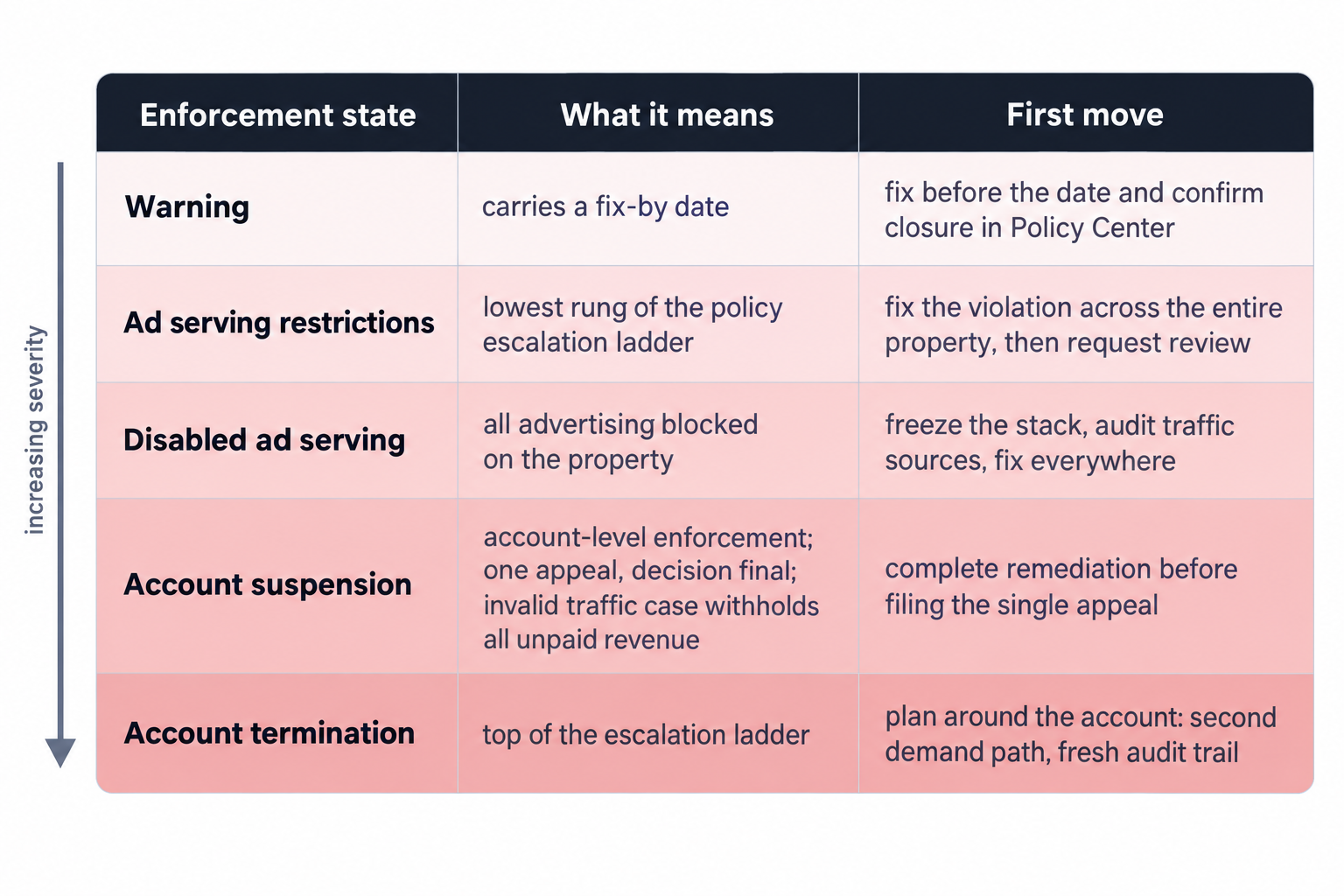
For a publisher above a million pageviews, the AdX account usually means the monetization account inside Google Ad Manager, and every enforcement mechanic you will deal with lives in two places: the Policy Center and the Ad Traffic Quality hub. Google escalates program policy violations along a fixed ladder: ad serving restrictions, then disabled ad serving, then account suspension, then account termination. Where your account sits on that ladder determines what you can still salvage, and the ladder also prices the stakes, because every rung you climb costs more revenue, and the invalid traffic track adds the withholding on top.
A warning still leaves the account serving, and it carries a fix-by date, which makes it the cheapest state on the ladder. Disabled ad serving blocks all advertising on the property, which stops revenue immediately even though the account still exists. A suspension sits one rung below termination, and when the enforcement rests on invalid traffic, the unpaid revenue in the account stays with Google. One classification matters more than the rest for this response: invalid traffic enforcement, because that is the track where revenue stays behind and where the appeal lives in the Ad Traffic Quality hub, while content policy violations run the same ladder with a different remediation playbook.
Read the Policy Center, not the email. The email paraphrases the enforcement; the Policy Center statuses tell you where you stand, and the difference between a warning with a fix-by date and disabled ad serving changes everything downstream. Google publishes its position plainly: it may suspend or disable an account to protect advertisers and users when it observes high levels of invalid traffic, and it treats the validity of the traffic on your ads as ultimately your responsibility, whatever third party sourced it. Read the invalid traffic policy before you form a theory about what happened, because your appeal has to speak that document's language.
Then freeze the property. Stop every paid traffic line, pause syndication and newsletter swaps, hold code releases and header bidding experiments, and change nothing in the ad stack unless the change removes a violating element. Every impression the property serves while an invalid traffic problem remains open extends the record you will eventually have to explain. Screenshot the Policy Center state, the notice, and the linked policy pages as they exist today. And leave the appeal button alone for now, for one reason: the appeal is single-use.
Audit traffic against the prohibited behaviors
Work from Google's own list of prohibited traffic sources, because these patterns trigger enforcement: automated bots imitating user behavior, unrelated traffic bought from unknown networks, pay-to-click programs, and traffic arriving from unwanted email or software applications. The Ad Traffic Quality publisher hub publishes the current list and hosts the appeal forms, so work from that page rather than from memory. Pin the list to the audit, because every finding needs to map back to a named behavior.
Then pull the property apart in analytics. Sixty days is the minimum useful lookback, because the traffic that triggers enforcement rarely shows up in the aggregate view, and the audit needs cuts, not dashboards:
- Referral sources: sort by growth rather than volume, and open every unfamiliar domain.
- Geography: flag countries whose traffic stepped up against your historic baseline and content language.
- Devices and browsers: clusters of outdated browser builds and identical device profiles point at automation.
- Paid lines: inventory everything you pay for, including email lists, push subscriptions, and desktop or mobile software bundles.
- Ratios: compare analytics sessions against ad server and exchange impressions; a drifting ratio signals non-human activity even when other metrics look normal.
- Tag sprawl: confirm your ad tags run only on domains you control.
Split the findings the way the IAB standards split invalid traffic: known bots and crawlers on one side, sophisticated imitations of human behavior on the other. Known bots are a reporting hygiene problem, the kind bot filtering already removes. Sophisticated invalid traffic is what account-level enforcement feeds on, and it hides inside numbers that look organic, which is why the ratio and clustering cuts matter more than headline traffic totals.
Compare each cut against a clean baseline period from before the anomaly rather than against the monthly average, because an average that includes the bad traffic hides it. Anything that maps onto the prohibited list dies, and you document each cut with a date: vendor terminated, placement paused, domain blocked. Keep the analytics exports alongside the changelog, because the audit trail does double duty later as the evidence section of the appeal and the onboarding file for a new demand partner.
Give incentive mechanics their own pass across your properties. Sweep for anything that rewards views, clicks, or time on page: loyalty programs, gamification, internal promotions that push ad-heavy pages. Google's list names pay-to-click programs, and a homegrown version belongs in the same bucket.
Fix the entire property, then file one review per property
Google flags examples, not exhaustive inventories, and it expects the fix to cover the entire site or app, not just the flagged example. Treat every flagged URL as one instance of a class. If the violation is a layout, fix every template that shares it; if it is a traffic source, sever it everywhere it touches you; if it is a content pattern, sweep the whole archive, not just the URL in the notice.
Split the work explicitly: one owner inventories templates and traffic lines, one owner pulls the analytics cuts, one owner keeps the changelog. Solo operators should still write the three roles down, because a suspension week is exactly when tasks fall between chairs.
Portfolios need per-property mechanics, and this is where multi-site publishers lose time. Each site or app carrying an enforcement needs its own review request through the Policy Center, and one cleared review does not cascade to sibling properties. Bundle every fix for a given property into one complete submission instead of dripping partial corrections.
Pace the submissions, because the system punishes impatience. The review button deactivates after several recent rejections, so a rushed, half-fixed request does not just fail, it also removes your ability to request another review for a while. Read the Policy Center review workflow before you file anything, follow it literally, and count your submissions against it.
Documentation carries the review. Keep a dated changelog: what changed, who changed it, when it went live, and what evidence proves each item. A precise record reads very differently from a paragraph of assurances, and the review decision draws on what you submit.
Define done before you request review. Re-crawl the templates you changed, click through the placements on a phone and a desktop, and have someone outside the fix team verify each item against the changelog. A review request that says fixed should survive an independent walk of the property.
Spend the appeal like it is the only one, because it is
An appeal does not guarantee reinstatement. When Google reaches a decision, that decision is final and Google accepts no further appeals, so treat the appeal as a single-use instrument rather than a ticket in a queue, and treat a rejection as the end of the conversation.
Structure the appeal around three parts. Root cause: which traffic, from which source, over what window, and how it reached your ads. Remediation: every fix with its date, matching the changelog you kept. Prevention: the controls now in place, from procurement rules to monitoring cadence to per-property review discipline. Attach the analytics exports and the vendor termination notices, because assertions without artifacts persuade nobody.
Skip denial, and skip pure blame narratives. Traffic validity sits with the account holder, so a story that ends at a vendor's name and no fix convinces nobody.
Set cash expectations at the same time. When the enforcement rests on invalid traffic, all unpaid revenue in the account stays with Google, and Google publishes no reinstatement timeline for account suspensions, so nobody can honestly quote a date. Plan payroll, hosting, and content costs around zero from that account, put the plan in writing on day one, and brief the client against that document. Agencies earn their keep at this step more than anywhere else in the engagement.
While a review runs, hold the property in its cleaned state: no new traffic sources, no layout experiments, no new ad products. A property that changes shape mid-review makes your submitted evidence stale.
The corollary belongs in your vendor policy: anyone selling guaranteed reinstatement, or a fixed number of days to restoration, sells a service that cannot exist as described. The decision channel is the appeal, and the outcomes are reinstated or final.
If the decision arrives against you, treat it as what it is: final. The account path closes, the second demand path becomes the primary one, and the audit controls stay in force on whatever partner picks up the inventory. The evidence file you built for the appeal becomes the onboarding file, so none of that work goes to waste.
Keep a second demand path, and sequence it honestly
A suspension also exposes a structural problem that predates it: an account that carries all of a property's revenue leaves the publisher nothing to negotiate with and nothing to pay bills from while a review runs. Diversification is the long-term answer, and the sequencing matters more than the intent.
Fix and document first, onboard second. Every serious exchange screens for invalid traffic, and a property that fails one screen will fail others, so shopping unscreened inventory merely relocates the problem. Do not open a shadow account to route the same traffic around the enforcement: the invalid traffic travels with the inventory, and any partner that knowingly assists inherits the risk.
We are OnlyMedia: an ad network, an SSP and an agency in one company. We work with thousands of publishers, each above one million monthly pageviews, and our curated programmatic demand network pays Net 30, CPM based, with no chasing and no sliding terms. Those payment terms matter most when a Google account holds revenue in review. Two questions separate serious partners from opportunistic ones during an enforcement event: when do you pay, and what sits in front of your auction. Terms that slide under stress, or a bid stream with no filtering, tell you what the next crisis looks like.
A curation layer sits in front of our auction: managed floors, demand mapping, whitelists, pre-bid brand safety filtering, and MFA filtering aligned with the IAB Content Taxonomy. Those controls target the failure mode behind invalid traffic enforcement: questionable inventory and misclassified supply stay out of the bid stream before they reach buyers, which keeps the demand path clean when a publisher needs it most.
Monitoring cadence decides whether you catch the next problem or read about it in an email. Our publisher monetization stack pairs curated demand with a ten-minute reporting console and Net 30 payments, so a traffic anomaly surfaces in hours rather than at month end, and hours are the unit of time that matters during enforcement.
Build the controls that prevent the next suspension
Procurement is where prevention starts, so write the prohibited list into your contracts. No pay-to-click inventory, no incentive traffic, no email or software distribution you cannot inspect, no buys from networks that refuse to name their sources. Add an invalid traffic clause with the right to withhold payment when screening fails, and re-vet sources on a schedule instead of at renewal time.
Then monitor like an investigator. Watch the ratio of analytics sessions to ad impressions, referrer concentration, and geographic mix week over week, and alert on step changes rather than absolute thresholds, because the traffic that triggers enforcement tends to arrive as a step, not a slope. Give the monitoring an owner and a cadence, weekly at minimum, with the export scheduled and the alert rules written down. Dashboards nobody opens are decoration.
Content hygiene closes the loop. Declare categories accurately against the IAB Content Taxonomy, keep navigation functional and content original, and hold ad density at a level a human reader would accept. Buyers filter made-for-advertising supply hard, and a property drifting toward that pattern loses demand quality long before it draws enforcement.
Agencies advising publishers at this scale should put the enforcement protocol in the engagement letter: who freezes the stack, who runs the audit, who signs the review requests, and the rule that nobody files an appeal without a completed remediation log. Decide all of it before the notice arrives, because nobody sequences well on the day the revenue stops.
The response, in order
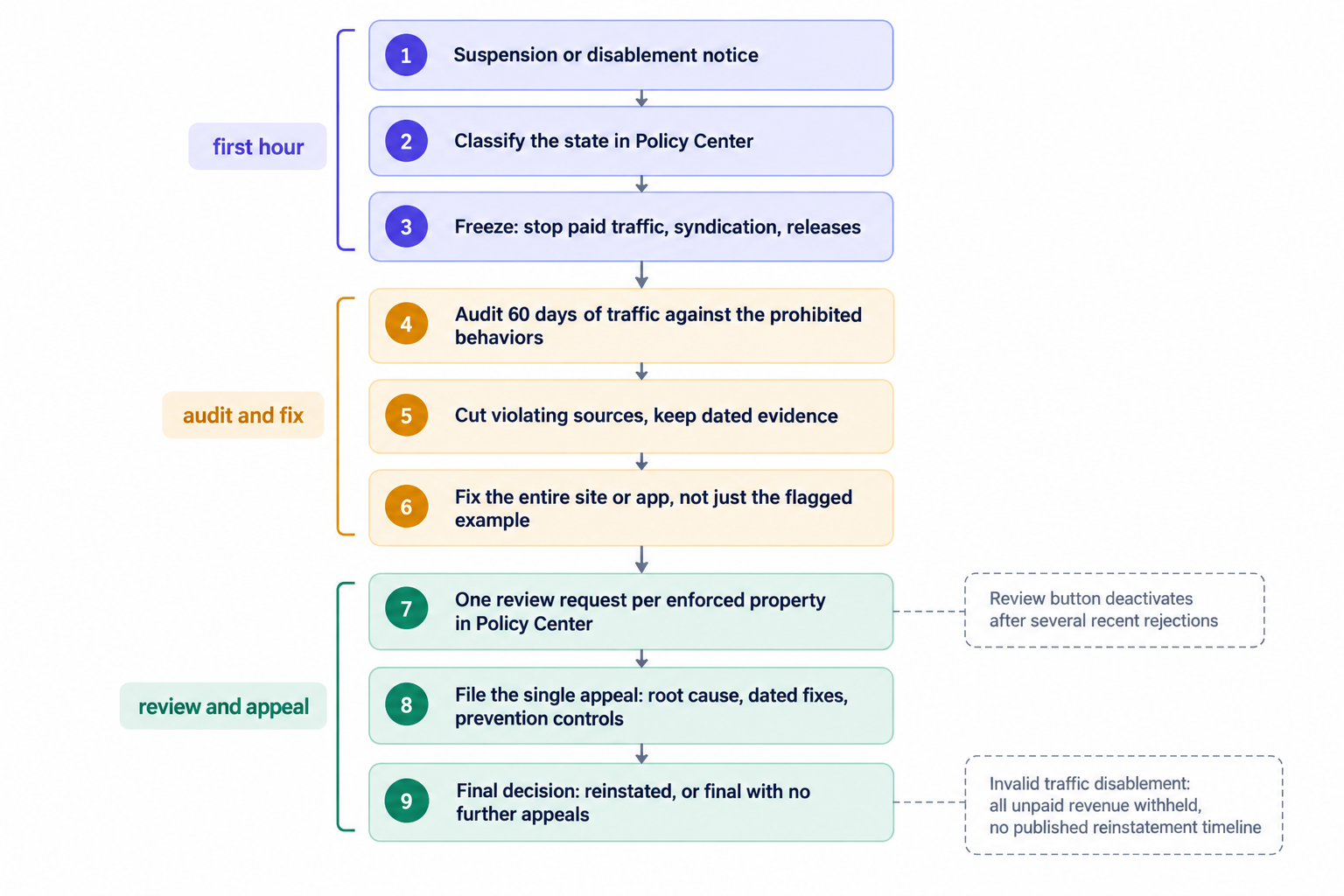
Compressed into a checklist, the response to a suspension runs like this, and the order matters as much as the items: classification before freezing, freezing before auditing, auditing before fixing, fixing before any review or appeal. Each step protects the one after it, and the expensive mistakes happen when someone reaches for step six during step one.
- Confirm the enforcement state in Policy Center; treat the email as a paraphrase.
- Freeze the stack: paid traffic, syndication, releases, experiments.
- Audit sixty days of traffic against the prohibited behaviors, cut what fails, document everything.
- Fix every property end to end, not just the flagged example.
- File one review request per enforced site or app, and pace the submissions.
- Appeal once, fully remediated, with evidence attached.
- Plan cash around withheld revenue and no published timeline.
- Open the second demand path conversation with the audit trail in hand.
If enforcement lands on a property we manage, publisher and partner support starts with the same sequence and the same discipline about the single appeal. Agencies scoping a second demand path for a client can talk to the demand desk about what onboarding requires and which evidence travels well. The whole response compresses to one operational rule: Google issues one decision per appeal, so spend it on a property you have already fixed, and use the waiting period to build the controls that keep the next decision from ever arriving.