What is Invalid Traffic (IVT) and How to Protect Your AdX Account
Google withholds all unpaid revenue from an AdX account it disables for invalid traffic. The policy does not carve out the fraudulent slice of inventory: it takes the entire unpaid balance, including revenue earned on legitimate impressions. For a site monetizing above one million monthly pageviews, one withheld payment cycle turns a traffic hygiene problem into a cash flow problem. Every control below exists to prevent that outcome.
How Google defines invalid traffic
Google defines invalid traffic as any clicks or impressions that may artificially inflate an advertiser's costs or a publisher's earnings. The definition covers both sides of the trade, and that is the part publishers underestimate. Traffic that inflates your revenue is the same traffic that inflates a buyer's invoice, and the buyer's verification vendors flag it long before you notice anything in your own reporting. With high levels of invalid traffic, Google may suspend or disable the account, and Ad Manager's invalid traffic policy assigns the responsibility plainly: it is ultimately the publisher's responsibility to ensure traffic is valid.
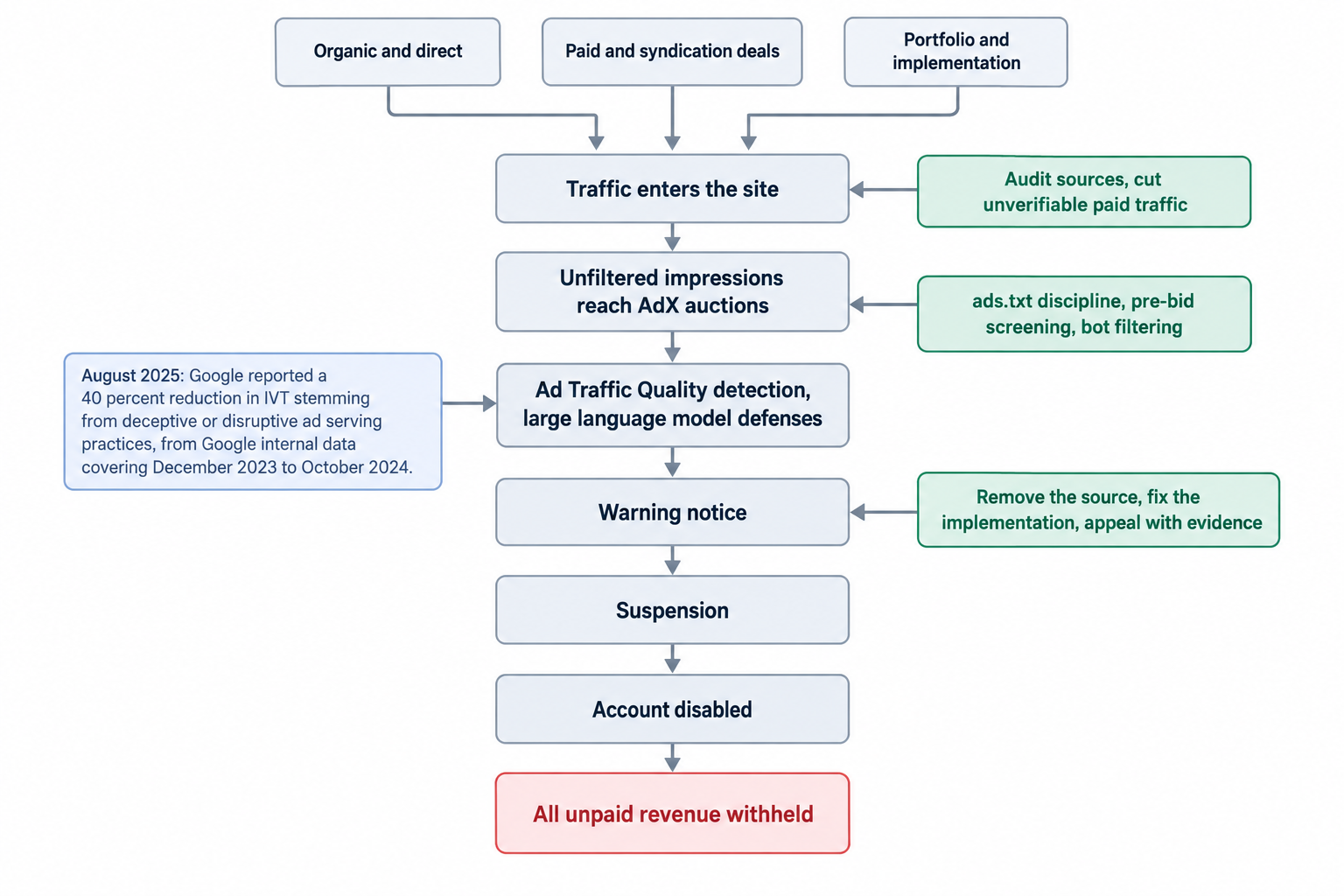
The enforcement environment tightened in August 2025. Google reported a 40 percent reduction in IVT stemming from deceptive or disruptive ad serving practices, from Google internal data covering December 2023 to October 2024. The company credits large language model defenses that its Ad Traffic Quality team built together with Google Research and DeepMind. Two consequences follow for publishers. Detection now generalizes across patterns, so tactics that slipped past rule-based checks in earlier years no longer clear the auction. And the categories of deceptive or disruptive behavior keep widening, which raises the odds that a marginal traffic source signed in one quarter falls inside a violation class in the next.
The two tiers: GIVT and SIVT
Buyers, exchanges and detection vendors classify invalid traffic with the same two-tier model, and the industry abbreviation IVT covers both tiers. The MRC's Invalid Traffic Detection and Filtration Standards, updated in June 2020, draw the boundary by detection difficulty rather than by intent, because detection difficulty determines both the cost of finding the traffic and the damage it does before anyone finds it.
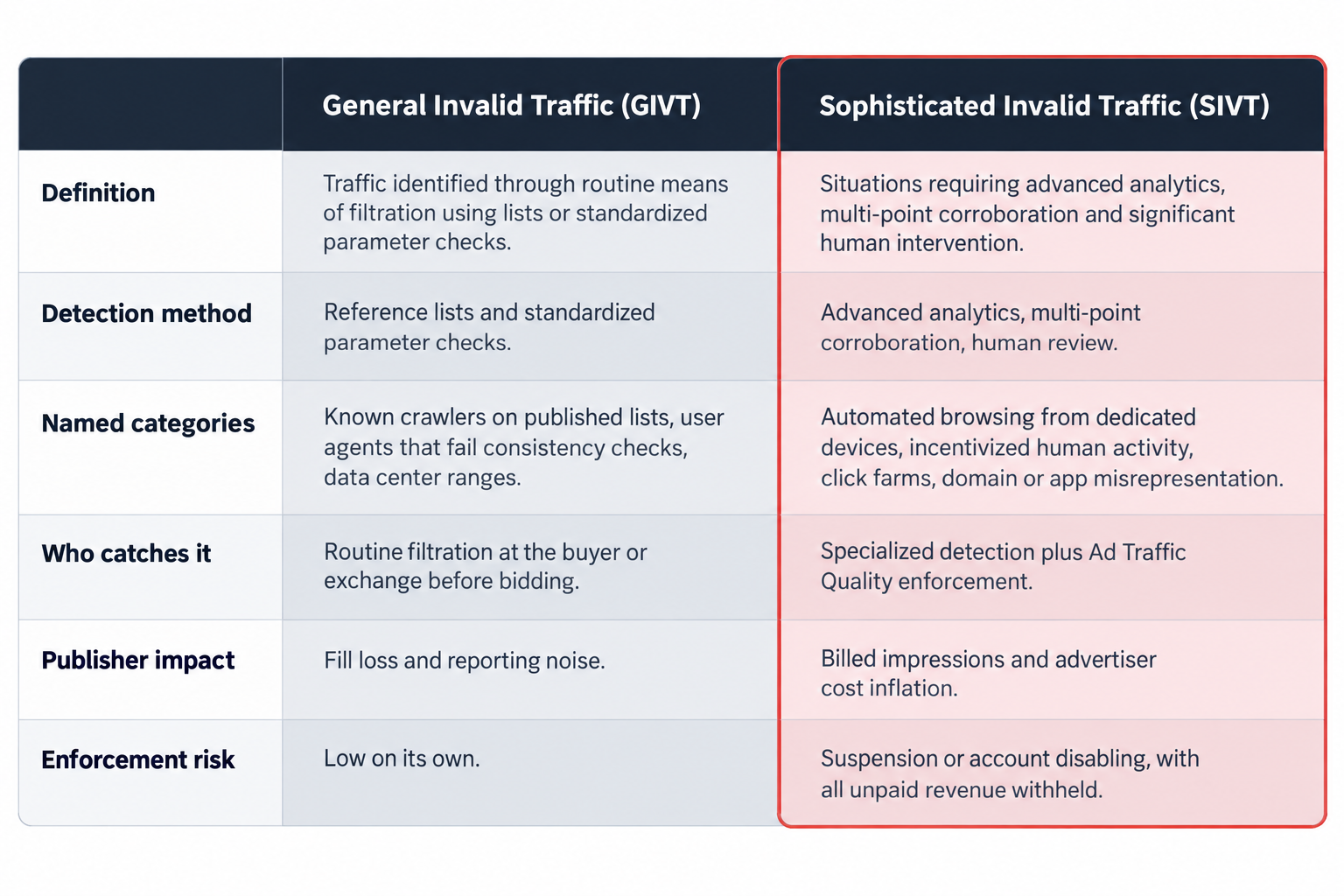
General Invalid Traffic (GIVT) covers traffic identified through routine means of filtration using lists or standardized parameter checks. Known crawlers on published lists, user agents that fail consistency checks, requests from recognized data center ranges: a reference table catches all of it, because the pattern already exists somewhere in list form. In daily operations GIVT shows up as fill loss and reporting noise. Buyers screen it before bidding, so it drags on CPMs and on measurement without carrying much enforcement risk on its own.
Sophisticated Invalid Traffic (SIVT) is the tier that ends accounts. The MRC defines it as situations requiring advanced analytics, multi-point corroboration and significant human intervention, and names the categories: automated browsing from dedicated devices, incentivized human activity, click farms, and domain or app misrepresentation. SIVT impersonates a real user or a real publisher well enough to pass routine checks, which is precisely why it bills. That is also why Google treats it as a policy violation rather than a measurement inconvenience, and why a miss on your side costs the account rather than a line in a report.
SIVT operators read the same lists you filter with, and that is the operational problem in one sentence: dedicated devices on residential connections pass every list-based check, and click farms pass any single-signal humanity check. Multi-point corroboration exists because no single signal survives adversarial traffic.
The traffic Google prohibits
Google's Ad Traffic Quality pages for publishers name the behaviors that put an account at risk. The four named sources read like a price list of the cheapest traffic products on the open market:
- Automated bots imitating users.
- Buying unrelated traffic from unknown networks.
- Participating in pay-to-click programs.
- Receiving traffic from unwanted email or software applications.
The word doing the heaviest lifting is "unrelated". Buying traffic is not itself the violation; buying traffic with no connection to your content is, because that traffic converts into short, bounce-heavy, non-human sessions by design. Pay-to-click programs inject incentivized human activity, which the MRC classifies as SIVT, so the participants pass every humanity check while still billing the buyer for worthless impressions. Traffic from unwanted email and software applications arrives as links in spam campaigns, push notifications and browser extensions, which means it carries real user agents, and only behavioral analysis catches it. Google's guidance is to regularly review traffic and ad implementations, and the four sources above are exactly what that review should hunt.
How invalid traffic enters a large site
Publishers above one million monthly pageviews rarely buy bots deliberately. Invalid traffic arrives through channels that look defensible in a budget spreadsheet, and four channels produce most of what Google eventually flags:
- Performance traffic buys. Cheap CPC or CPV deals from networks you have not vetted, push notification subscriptions and incentivized install campaigns deliver precisely the traffic on the prohibited list. The seller gets paid on volume, the cheapest volume to generate is automated, and the typical trigger is a traffic buy made to hit a session target ahead of a direct deal renewal.
- Syndication and traffic swaps. Reciprocal traffic deals and widget exchanges send sessions with no referral depth and no engagement, and counterparties rarely accept clawbacks once the traffic proves junk.
- Domain and app misrepresentation. Someone clones your domain or spoofs your app bundle, and their inventory claims your demand and your reputation. Your ads.txt and app-ads.txt discipline determines whether that claim can succeed.
- Your own portfolio. Templated pages with thin or scraped content, aggressive auto-refresh and accidental-click layouts generate the patterns Ad Traffic Quality files under deceptive or disruptive ad serving, and enforcement covers the whole account, not only the offending property.
The fourth channel deserves emphasis for portfolio owners. A single low quality property inside the same AdX account can pull enforcement onto properties that never violated anything, because Google holds the account, not the page, responsible. Treat every property you add as a liability until its traffic pattern proves otherwise.
Implementation problems that manufacture IVT
Some invalid traffic is not bought at all: the ad implementation creates it. Four patterns appear repeatedly in account reviews:
- Auto-refresh without viewability or engagement conditions, which bills impressions on sessions that stopped scrolling.
- Placements that generate accidental clicks, such as units flush against navigation buttons or directly under a "next article" control.
- Hidden, stacked or off-screen units that serve impressions no human can see.
- Any mechanic that rewards users for interaction, which turns ordinary users into incentivized human activity, an SIVT category.
These patterns matter because they produce the same downstream signals as bought bot traffic: CTR that no real audience produces, collapsed viewability, session metrics that fail any sanity check. Fixing them costs engineering hours. Leaving them in place costs the account.
Detection: the signals that matter
Detection starts from baselines, not absolute numbers, because every site has its own normal. Build a trailing four-week baseline for each metric, then compare weekly:
- Display CTR against baseline: a spike with no creative or placement change points to accidental clicks or a bot wave, not to better monetization.
- Session depth, bounce rate and time on page by traffic source, which separates a real referral audience from paid filler.
- Geography and carrier mix by source: traffic that concentrates in a handful of countries and carriers right after a new buy is a flag.
- Operating system and browser mix against your audience profile.
- Data center ASN share in server logs, which no human audience produces.
- The ad server versus analytics session gap, tracked every week.
Cadence matters more than tooling. Google tells publishers to regularly review traffic and ad implementations, and in practice that means a standing weekly review plus a fresh pass on every new traffic contract, because new sources carry the risk, not old stable ones. Most large publishers also run an independent, MRC-accredited IVT measurement on their traffic for the same reason buyers do: an outside read on what survives corroboration. Treat that report as the source of truth for portfolio reviews, and treat your own logs as the evidence base for appeals.
Speed matters as much as cadence. Our ten-minute reporting console exists so that an anomaly that appears midweek dies before the weekly review, not after the monthly reconciliation. The alternative is discovering it inside a policy notice.
The controls that keep the account clean
Protection is a sequence of filters, and the order matters because each layer removes work from the next. The sequence below is the one we run, in order:
- Audit every traffic source. Terminate any paid channel that cannot show referrer-level logs, and write clawback terms into every traffic contract before the first invoice.
- Rewrite ads.txt from scratch. IAB Tech Lab positions ads.txt as a tool to reduce fraud in buying and selling advertisements on websites, mobile apps and connected TV, and the standard pays off only when the file is exact. Publish only accounts you own, verify every RESELLER line against a live seller, and remove stale entries when tests end. Extend the same discipline to app-ads.txt and to any connected TV surface that carries your content.
- Demand transparency. Check the sellers.json entry for every reseller in the chain and require the SupplyChain object on programmatic deals, so buyers can trace each impression back to you.
- Filter pre-bid. At OnlyMedia we run a curation layer in front of the auction: managed floors, demand mapping, whitelists, pre-bid brand safety filtering and MFA filtering aligned with the IAB Content Taxonomy. That layer applies pre-bid screening on every impression, which keeps made-for-advertising inventory and misrepresented supply out of the bid stream before a buyer ever complains.
- Harden the infrastructure. Put bot management and rate limits on login, search, comment and pagination endpoints, and admit known search crawlers only from their verified ranges.
- Fix the implementation. Kill accidental-click placements, cap auto-refresh, and make every unit viewable before it counts.
- Review the portfolio quarterly. Audit every property in the account for thin content, templated page structures and layout patterns that read as made for advertising, then fix or remove what fails. Enforcement operates at account level, so a weak property is never a local problem.
- Keep evidence. Retain raw logs, traffic contracts and before-and-after snapshots for every source, because a flagged window you cannot reconstruct becomes an appeal you cannot file.
None of this is a one-time project. Sources change behavior, implementations drift and enforcement classes widen, so the playbook runs on a schedule rather than on a crisis.
If Google flags the account
The sequence after a notice is short, and the order matters. Work it as a checklist, not as a debate:
- Match the notice to a specific behavior. Map the flagged window onto your traffic logs and the four prohibited sources, and find the source or implementation that explains it.
- Stop the source the same day. Remove the channel, kill the placement, and record exactly what changed.
- Document everything. Assemble the logs, the change and the before-and-after metrics, because the appeal argues with evidence, not assurances.
- Submit the appeal through the Ad Traffic Quality route, with the fix already live. Appeals that show a removed root cause carry the case; appeals that argue innocence do not.
- Plan around the hold. If enforcement escalates to a disablement, Google withholds all unpaid revenue, so the appeal fights for money already earned.
For agencies advising publishers, build this sequence into the retainer: traffic-source veto rights, a weekly IVT review and a pre-agreed incident owner mean the first response takes hours instead of days. That difference decides whether a notice stays a notice. Our publisher and partner support desk runs this sequence alongside publishers when enforcement notices arrive, from log forensics through the appeal itself.
Why prevention wins on the economics
Prevention costs engineering time and some fill: made-for-advertising pages stop billing, junk sources stop delivering volume, thin properties leave the account. A disablement costs the entire unpaid balance at once, plus the re-approval process, plus the months of buyer caution that follow a returned account. That trade shaped our own model: we run an ad network, an SSP and an agency in one company, and at OnlyMedia we work with thousands of publishers, each above one million monthly pageviews. Our curated programmatic demand network pays Net 30, CPM based, with no chasing and no sliding terms, and a withheld upstream balance would break that promise inside one cycle. So we filter before impressions reach demand; the curation layer's brand safety and MFA screens protect the buyer's invoice and the publisher's account at once.
Where to start
Start narrow and start now. Three moves this week remove most of the risk:
- Pull one full month of traffic sources and terminate anything you cannot verify at referrer level.
- Rebuild ads.txt from live seller records rather than editing the existing file in place.
- Stand up the weekly review: CTR, session depth, geo and carrier mix, and the ad server versus analytics gap, each against a trailing baseline.
Google runs the detection, and Google still holds the publisher responsible for what the detection misses. The publisher who owns the filter keeps the account, and with the account, the revenue.