Traffic Arbitrage in 2026: Risks, Rewards, and Strict AdSense Policies
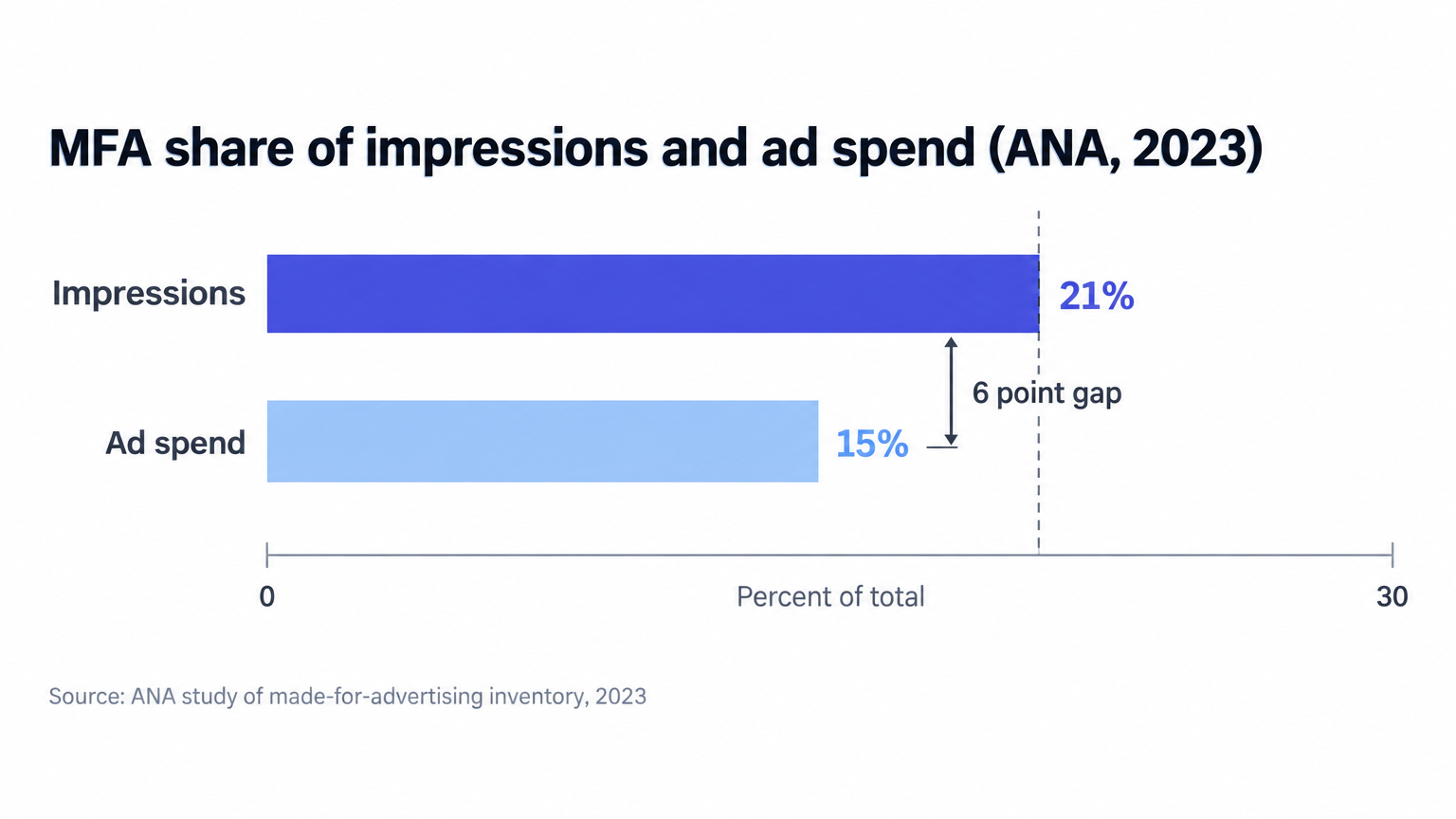
Traffic arbitrage is a spread trade: buy a visit for less than the visit earns in ad revenue, then repeat the exchange at scale. The arithmetic takes one line, and the compliance exposure can take the whole business. Google's AdSense program policies prohibit ads on pages that receive traffic from paid-to-click, autosurf and click-exchange programs, and when Google disables an account for invalid traffic it withholds the entire unpaid balance. Buyers reached the same verdict independently: the ANA's 2023 study found that made-for-advertising sites comprised 21 percent of impressions and 15 percent of ad spend, and buy-side filtering against that inventory has tightened since. In 2026 the trade still exists, the spread still tempts, and the penalty for crossing the line remains a terminated account.
The arithmetic of the spread
Every arbitrage operation reduces to one equation: session revenue minus visit cost, multiplied by volume. Costs sit on the acquisition side, click price, redirect fees, vendor margins. Revenue sits on the monetization side, impressions per session, viewability, CPM, fill. Two levers do most of the revenue work in practice, ad units per page and refresh interval, and both reappear later as classification markers. Nothing in the equation prices content quality, reader retention or policy compliance, and that omission is where the model breaks.
Treat the following as arithmetic, not as benchmarks. A paid click costs $0.30 and the average landing session earns $0.45 in ad revenue, so the operator banks $0.15 per visit, a 33 percent margin on revenue. Scale that to one million bought visits a month and gross profit reaches $150,000 before anyone asks a compliance question. Now discount the number: vendor fees and payment terms take the first slice, invalid traffic deductions take the second, and the terminal risk, an account closed with all unpaid revenue withheld, sits on top as an unpriced liability. A spread business that ignores its largest liability is not a business, it is a slow-motion default.
What a visit nets is never fixed, because the auction decides. In first-price auctions with bid shading, a $1.20 headline bid clears for less, expected-value ranking determines which bid actually wins the impression, and reserve prices determine whether the impression sells at all. We cover auction mechanics and reserve prices in a dedicated guide, because an operator who models CPM as a constant has already mispriced the trade.
What the policies prohibit
Google publishes the prohibited traffic sources in its AdSense program policies, and the list reads like a catalog of arbitrage supply. Placing ads on pages that receive traffic from paid-to-click, paid-to-surf, autosurf and click-exchange programs violates policy. So does traffic from unsolicited mass emails, and so does software that forces ad displays on users. Google does not ban bought traffic wholesale: it restricts traffic from online ads unless the landing pages meet its quality guidelines. That restriction is where the entire legitimate version of the model lives, which makes landing page quality a compliance control rather than an aesthetic preference.
Google's policy guidance also names behaviors that lead to account closure, and they map directly onto arbitrage practice. Generating or receiving automated or bot traffic closes accounts. Using incentivized traffic sources closes accounts. Ad placements that deceive users or generate accidental clicks close accounts. Note the word receiving: a publisher does not have to buy the bots personally. A vendor that spikes a premium batch with automated traffic exposes the publisher's account, not the vendor's.
What a violation costs
Google's Ad Traffic Quality guidance tells publishers to be very careful when purchasing traffic, because some services send artificial traffic despite reputable appearances. The guidance adds that an egregious traffic source generating invalid clicks may disable the account. Disabled means what it says, and the financial mechanics are specific: when Google disables an account for invalid traffic, it withholds all unpaid revenue and credits the money, including Google's own share, to the affected advertisers. The publisher simply does not receive that balance.
The timing compounds the loss. Traffic vendors bill on short cycles while ad revenue accrues across a payment cycle, so the withheld balance covers exactly the window in which the operator has already paid for the clicks. Reviews land after the spend, not during it, so the operator has usually reinvested the margin by the time the balance disappears. An operation running thin margins can lose a quarter of profit in a single enforcement action.
Ad Manager publishers face the terminal version. Deactivation for invalid activity ends the relationship permanently: deactivated publishers may not open new accounts and may not receive further payment. No version of the arbitrage trade survives that outcome, which is why the unpaid balance understates the exposure. The real loss is the annuity value of the account itself.
The route from arbitrage to MFA
On September 26, 2023, ANA, the 4A's, WFA and ISBA published a joint industry MFA definition that describes made-for-advertising sites as existing for the singular purpose of simultaneously buying and selling advertising inventory. The definition lists the operational markers: ad-to-content ratios usually at least twice the internet average, rapidly auto-refreshing ad slots, and heavy reliance on paid clickbait traffic. Read that list next to the arbitrage playbook and the overlap is total. Every lever that widens the spread, more ad units per page, faster refresh, cheaper clicks, appears by name in the definition. An operator who optimizes the spread far enough optimizes straight into the MFA classification.
The ANA study then measured prevalence: MFA sites comprised 21 percent of impressions and 15 percent of ad spend. A larger share of impressions than of spend means the inventory cleared below the market's average rate before serious filtering even began. Buyers did not need a policy reason to act, the economics supplied one.
Density has hard ceilings as well. The Better Ads Standards prohibit mobile ad density above 30 percent, desktop density above 50 percent, and desktop density above 30 percent combined with a sticky video ad. The maximum-density layouts that make per-visit math work sit above all three thresholds, and browsers filter ads on sites that breach the standards. Density is not a tuning knob. Past the ceilings it becomes a classification event.
Why the buy side closed the loop
From the buyer's seat, MFA inventory is a straightforward bad deal: spend lands on pages built to display ads rather than to be read. The response is now standard practice. Buyers on platforms such as The Trade Desk and DV360 exclude or downweight domains through MFA avoidance lists, pre-bid segments and supply path audits, and agencies write MFA exclusion requirements into insertion orders. Curated supply, where the seller filters inventory before the auction, grew as the structural answer: the buyer delegates the filtering and pays for the cleanliness.
Classification is economic, not legal. Google does not issue an MFA strike the way it issues a policy violation: the market reprices the inventory. Exclusion lists remove bids, pre-bid segments suppress them, and surviving demand shades harder in a first-price auction, since buyers who cannot verify attention assume the worst. The operator experiences this as unexplained CPM decay month over month, and the standard response, buying more traffic to hold revenue flat, accelerates the loop.
From the publisher's seat the loop runs like this. Bought clickbait traffic suppresses engagement signals, and engagement feeds bid strategies, so CPMs fall. The operator compensates with more density and faster refresh, which moves the site closer to the MFA definition, which triggers more filtering, which drops CPMs again. The operator then buys cheaper traffic to restore margin, and cheaper traffic raises invalid traffic risk. The loop terminates in one of two states: the account ends, or the margin does.
When buying traffic is legitimate
Google's restriction on traffic from online ads carries a condition rather than a ban: the landing pages must meet its quality guidelines. Inside that condition sits a legitimate practice that no policy discourages, buying users rather than impressions. Three tests separate it from arbitrage.
- Does the traffic return without payment? Newsletter signups, repeat visits and branded search indicate acquired readers rather than acquired impressions.
- Would the landing page justify its existence without ads? Original reporting, tools and data pull their own audience, ad frames bolted onto thin text do not.
- Is cost measured against lifetime reader value rather than first-session revenue? A publisher who pays $0.30 for a visit that returns weekly for a year runs acquisition, not arbitrage.
Measurement makes the tests operational. Tag paid sessions by source before the campaign starts, then read returning visitor share, page depth and revenue per cohort after two weeks. A source that posts a strong first-session RPM but never produces a second visit fails the tests regardless of what the vendor's deck claims, and cutting it becomes a dashboard action rather than a judgment call.
The same surface activity, paid traffic landing on monetized pages, produces opposite outcomes depending on those tests. Arbitrage fails all three and leans on volume, acquisition passes them and leans on retention. Agencies advising publishers should write the tests into acquisition contracts before spend scales, not after a policy email arrives.
Guardrails for teams above one million pageviews
At this scale the question stops being philosophical. Traffic decisions run through logs, contracts and consoles, and each guardrail below maps to a specific policy or classification risk. Run every new source through a triage tree before the first dollar leaves the account.
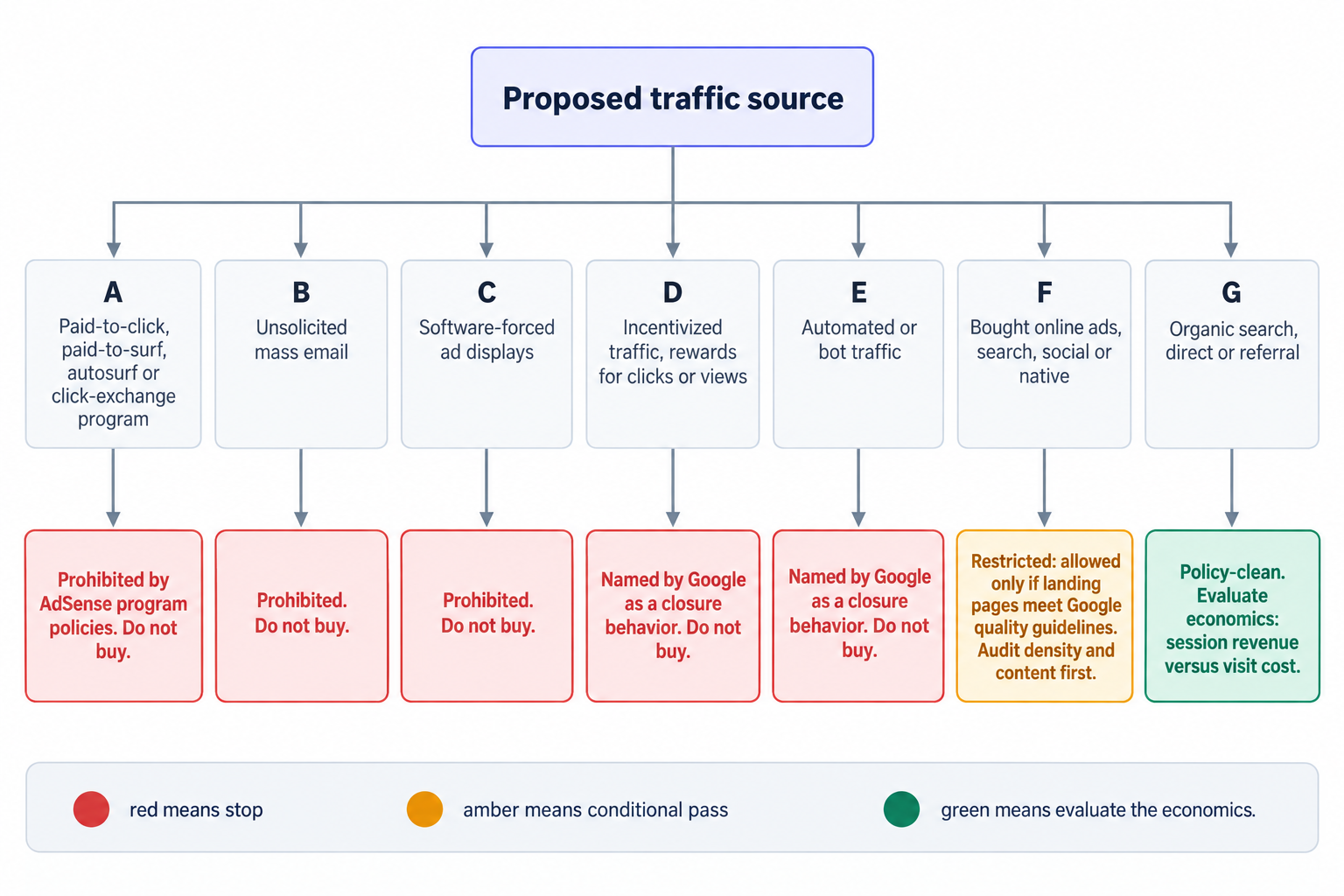
Once the triage clears a source, the operating list is short:
- Keep density under the Better Ads ceilings: below 30 percent on mobile, below 50 percent on desktop, and below 30 percent on desktop when a sticky video ad runs.
- Audit referrer logs weekly. Single-ASN concentration, sudden geo shifts and session durations that cluster at one value all flag artificial traffic.
- Write clawbacks into every traffic contract: refunds for invalid traffic and the right to inspect where placements ran.
- Cap auto-refresh, because refresh inflates impressions per session and rapidly auto-refreshing slots appear by name in the MFA definition.
- Segregate bought-traffic inventory from curated and premium deals, or keep it out of them entirely.
- Keep remediation records with a named owner, since a documented response shortens the path back if Google flags invalid activity.
- Spread revenue across demand channels so one enforcement action cannot zero the business.
None of these steps costs much, and all of them target the same failure modes: prohibited sources, invalid traffic and MFA classification. A team that runs them weekly keeps its largest liability under observation. A team that skips them carries a terminal liability at an unknown price.
How we run the other side of the trade
We are OnlyMedia: an ad network, an SSP and an agency in one company. Through our curated programmatic demand network we work with thousands of publishers, each above one million monthly pageviews, and we pay Net 30, CPM based, with no chasing and no sliding terms. Predictable payment matters in this discussion specifically, because working capital gaps push operators toward cheap traffic in the first place. A partner that pays on schedule removes one excuse for buying it.
A curation layer sits in front of our auction: managed floors, demand mapping, whitelists, and pre-bid brand safety filtering on every impression, including MFA filtering aligned with the IAB Content Taxonomy. The filtering serves the buyer and the clean publisher at the same time, since inventory that matches the MFA markers never reaches the bid stream and demand concentrates on pages that pass. Publishers carry the mirror obligation on the traffic side: we filter the inventory, you filter the visitors.
Speed of information matters as much as speed of payment. On the publisher monetization side we pair curated demand with a ten minute reporting console and Net 30 payments, so a traffic anomaly surfaces the day it starts rather than at month end. An operator who can see a bad source on day one stops it on day one.
The 2026 outlook
Three pressures compress the arbitrage spread from both ends. Compliant traffic costs more, because quality guidelines gate what landing pages may carry and buyers reward pages that hold readers. Non-compliant inventory earns less, because MFA filtering is standing infrastructure on the buy side rather than a special project. Signal loss compounds both: as Privacy Sandbox proposals and browser limits shrink the identity data available at bid time, buyers lean harder on curated, verifiable supply and discount anonymous bought traffic.
Generative content raises the supply side of the problem. Cheap text makes MFA-style sites cheap to build, which floods the open exchange with pages that look like content and behave like ad frames. Buyers answer with stricter curation, and the cycle tightens. The net effect for anyone trading traffic in 2026: the spread between cheap clicks and thin monetization narrows toward the cost of the risk.
The operators who still profit run the model in reverse. They buy traffic that survives the triage tree, land it on pages that would exist without ads, keep density under the Better Ads ceilings, and monetize through demand that pays on time. The spread is thinner there. The account survives the quarter, and in this trade the account is the business.