The True Cost of Latency in Client-Side Header Bidding
A header bidding wrapper bets against the user's remaining attention. It holds the ad server call for as long as its auction timeout allows, on every pageview, even when the marginal bidder never responds. Google's mobile speed benchmarks, from an analysis of 11 million mobile page loads with 90 percent prediction accuracy, put a number on the stake: as page load time goes from one second to ten seconds, the probability of a mobile site visitor bouncing increases 123 percent. Client-side bidding pays that cost twice, once through wrapper weight and bidder requests competing with content during load, and once through the timeout holding the ad server call after the content has arrived.
Two forces pull against each other in every client-side setup. More demand partners in the auction mean more competition and higher clearing prices, but every added partner ships more code, opens more browser requests, and stretches the auction window. Fewer, faster partners protect the page, but they leave revenue behind whenever a slower source consistently outbids the field. Every timeout value attempts to price that tension, and most teams inherit one by habit instead of measuring it.
What the wrapper is trading
Prebid's timeout documentation states the tradeoff plainly: set the auction window too short and header bidding does not have enough time to take place; set it too long and revenue may go down because the wrapper delays the ad server call to the point where users have left the page. The guidance behind that sentence is specific. Keep the internal auction timeout at 1,000 milliseconds or less, and the overall failsafe timeout at 3,000 milliseconds or less. When the internal timeout expires, Prebid proceeds with whichever bidders have responded, so a bidder that answers late contributes nothing while its request still costs the page. The failsafe covers the failure case: if a callback hangs before the ad server call, it caps the total delay instead of letting a stalled wrapper hold the slot open.
Treat both numbers as ceilings, not as defaults to grow into. If wrapper analytics show most responses arriving well before the internal timeout, extending the window buys silence: the page waits longer and the extra bids rarely materialize. If a meaningful share of net revenue consistently lands in the final stretch of the window, the answer is still not a longer timeout. The answer is a faster demand list, or a server-side seat for the partners that cannot keep pace.
Three ways the wait costs money
The first cost is attention. Client-side bidding inflates load through script weight, connection contention and main-thread work, even when the wrapper loads asynchronously, and the timeout adds a second delay after load: the ad server call waits for the auction, so the first ad renders late on an otherwise fast page. Users respond to both delays by leaving, and a user who leaves before the ad server call fires produces zero impressions no matter how many bids the auction collected. The bounce also ends the session, and session depth, not impression count, decides how much inventory each visit produces.
The second cost is the impression you never collect. Header bidding dashboards count bid responses and auction wins, but revenue only exists when the ad server call fires, the creative renders, and the impression lands somewhere a human can see it. An ad that renders after the user has scrolled past the slot still fills a report row while delivering nothing a buyer would pay a premium to repeat. Viewability feeds back into price: buyers bid on the expectation of a viewable impression, so chronic late rendering suppresses future clearing prices across the inventory, not just the late slots.
The third cost compounds over weeks, and it lands in search. Google's ranking systems use Core Web Vitals as one of a variety of signals that align with overall page experience, as the page experience documentation spells out. The good thresholds are concrete: LCP within 2.5 seconds of page load start, INP under 200 milliseconds, CLS under 0.1. Google assesses all three at the 75th percentile of page loads, split by mobile and desktop, which means the slowest quarter of visits decides whether a page earns the good rating. Client-side bidding pushes every metric in the wrong direction: wrapper execution and auction callbacks compete with input handling and push INP up, bidder scripts and creative payloads contend with the LCP resource for bandwidth, and a late ad that resizes its container drives CLS.
Where the milliseconds go
Start the clock at 0 milliseconds, at navigation. The first charge is the wrapper itself: a full build downloads, parses and executes before the first auction can run, and every adapter, size module and analytics integration adds to that weight. Modular builds exist because this charge is real. A wrapper carrying adapters that rarely bid taxes every pageview for nothing.
The second charge is the fan-out. For each configured slot, the browser opens a request to every bidder endpoint, each on its own host, so DNS resolution, connection setup and each partner's targeting computation all run before a single bid returns. Mobile radios and congested networks spread that parallelism thin, and the slowest responding bidder sets the pace the user feels. The timeout converts that tail risk into a fixed ceiling, and somebody on the team should own that number.
The third charge is the handoff. At the internal timeout the auction closes with whichever bidders responded, key-values pass into the ad server call, and Ad Manager runs a second auction before it even selects a creative. The creative then downloads and renders, and for video a VAST tag can add a chain of redirects before playback starts. If the arriving ad resizes its container, layout shift lands on everything beneath it.
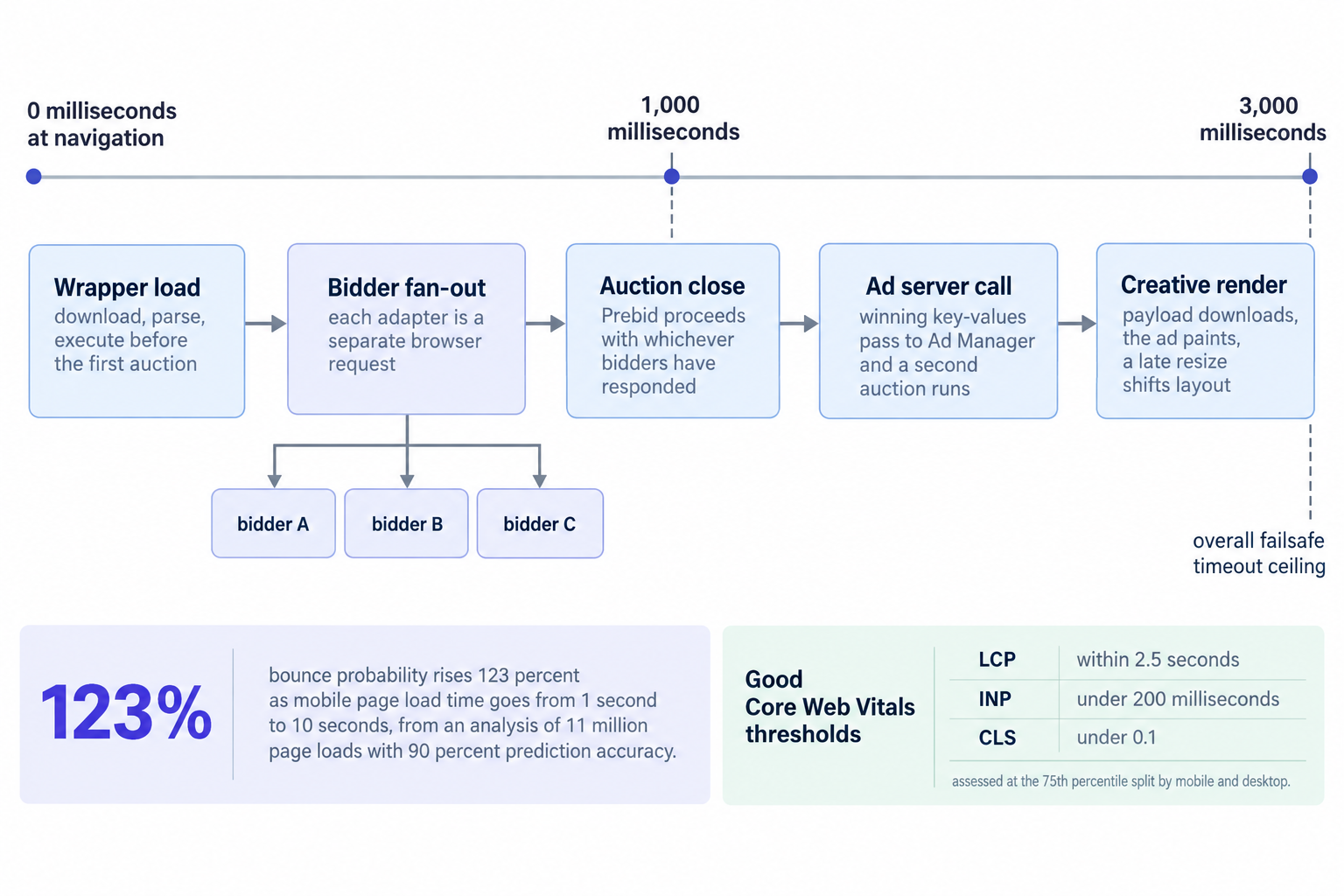
Two lines in that waterfall come from policy rather than engineering: the internal auction timeout and the failsafe. You can compress wrapper weight, prune the fan-out and slim the creative chain, but the timeout is the one term a single number controls, and it caps the user-facing delay for every impression on the page.
The measurement trap
Timeout changes fool standard dashboards because the metrics most teams watch sit at the impression level and inside a short horizon. Take a simple change: moving an internal timeout from 800 to 1,500 milliseconds. The auction genuinely captures more demand, so bids, auction wins and header bidding revenue per impression all move up. The bill arrives elsewhere: in pages per session, in viewability, and in organic search sessions, which move over weeks and never appear in the auction report.
Price the change in attention instead. A site with 10 million monthly pageviews that holds the ad server call for 500 extra milliseconds on every page spends 5,000,000 seconds of user attention per month, roughly 58 days of continuous user time. That expenditure buys only the bids that arrive inside the added window, on the fraction of impressions where those bids also win the ad server auction and beat the next best demand. When the marginal bids return less revenue per pageview than the attention they burn, the change loses money while every auction report calls it a success.
Expected value holds the whole trade in one line. The value of a longer window equals the probability that a marginal bid arrives inside the added stretch, times the probability that bid wins the ad server auction, times the net revenue it adds, minus the delay cost applied to every pageview. We run that arithmetic on our side as well: our auction mechanics rank demand by expected value in a first-price auction with bid shading under enforced reserve prices, because a bid's speed changes its true value. A late bid has to clear a higher bar than a fast one, and your timeout policy should force the same discipline on your demand list.
Tuning that pays for itself
Timeout tuning is an audit exercise, not a settings tweak. The goal is a demand list where every partner earns its own latency: fast enough to land inside the auction window, dense enough to win, and clean enough not to tax pageviews where it never transacts. This is the sequence we run when a wrapper shows timeout pressure:
- Set the ceilings. Hold the internal auction timeout at 1,000 milliseconds or less and the overall failsafe at 3,000 milliseconds or less, then measure what share of winning bids arrives in the final third of the window.
- Audit per adapter, not in aggregate. Pull response times per bidder from wrapper analytics, score each partner on net revenue per 1,000 pageviews against its median and tail latency, and separate the partners that bid inside the window from those that answer after it. A bidder that consistently responds after the internal timeout earns nothing in page while its code, request and cookie sync still load everywhere.
- Prune by context. Run each adapter only in the geographies, devices and slot sizes where it actually transacts. An adapter that bids on out-stream video has no business riding along on every 728x90 display request.
- Slim the build. Include only the modules in active use, drop experimental adapters, and re-weigh the wrapper after every partner addition. Wrapper weight is the tax you pay before the auction even starts.
- Reserve the slot. Fixed-height containers and size mapping keep a late ad from shoving content down the page, which protects CLS even on pages where the auction runs long.
- Lazy load below the fold. Request bids as a slot approaches the viewport instead of at page load, so the auction competes with scroll speed rather than first paint. Fetch too late and the user beats the ad to the slot, so tune the fetch margin per slot.
- Consolidate wrappers. Two competing header bidding scripts double the fan-out and the hold, and they split the auction. One wrapper, one auction, one ad server call.
None of this sacrifices demand density. In the audits we run across our network, a handful of adapters usually produce most of the net revenue, and the long tail costs more in page weight and window time than it returns in clearing prices. Cutting the tail shortens the critical path for every impression and leaves the auctions that actually transact with more room.
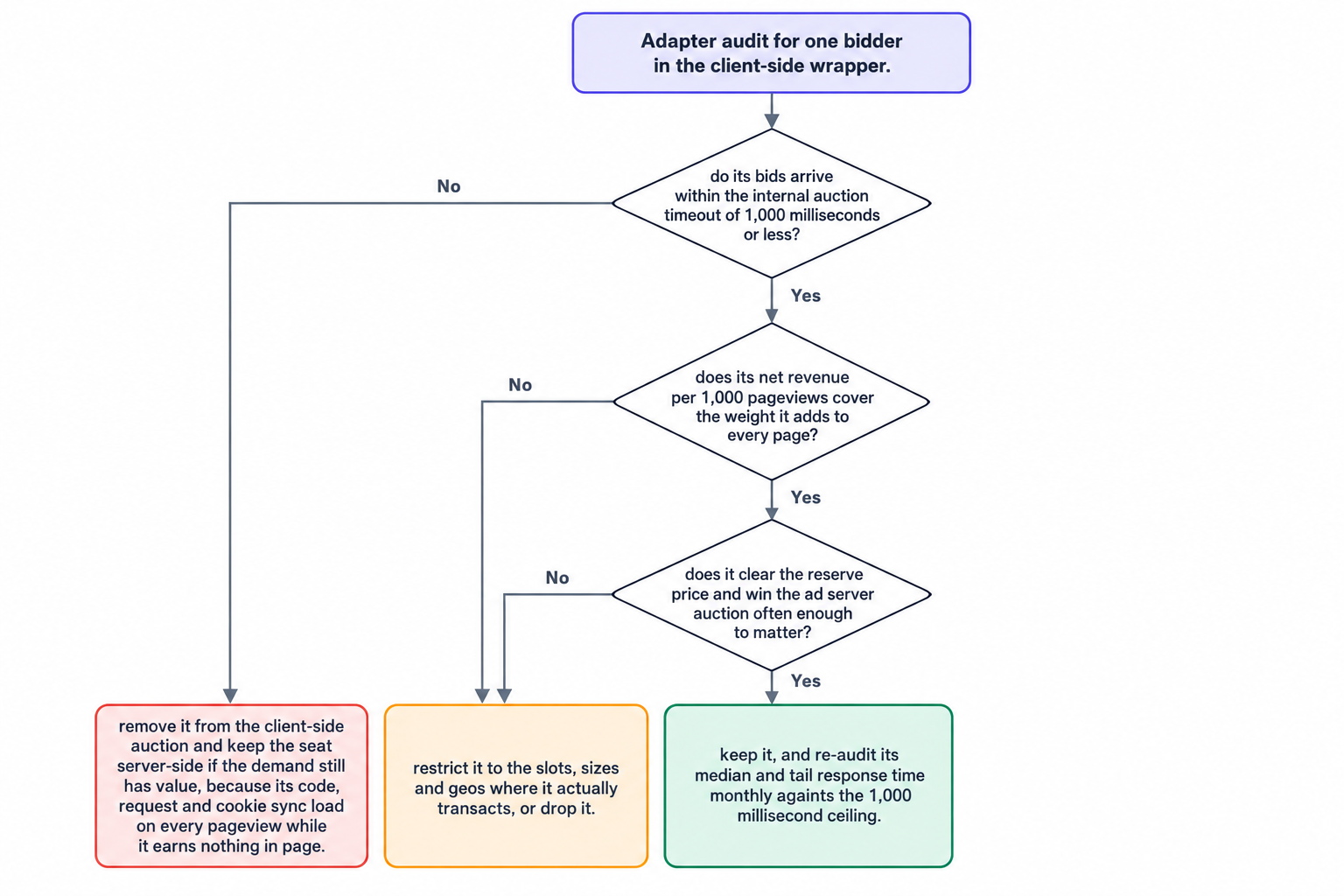
That tree has three exits: keep with monthly monitoring, restrict to the contexts where the partner transacts, or remove from the client-side auction and keep the seat server-side. Every exit either shortens the critical path or makes the same path earn more, and none of them requires waiting longer.
Move the auction off the page
Server-side header bidding changes where the fan-out happens, not whether the page waits. The browser sends one request to a server endpoint, the server fans out to demand partners across its own fast connections, and the winner set returns to the page before the ad server call. Page weight drops because per-adapter JavaScript leaves the browser, and the fan-out parallelizes over pipes faster than a phone's radio. The round trip still sits on the critical path, so timeout discipline carries over intact.
The tradeoffs deserve honesty. Server-side demand sees fewer first-party identifiers, so some partners thin their bids, which is why hybrid setups keep a small set of high-value client-side adapters running alongside the server auction. At OnlyMedia, we integrate OpenRTB 2.6 seats and Prebid for header and server-side demand, and our SSP runs one unified auction per impression, with AdX accessed via MCM, Prebid demand and managed floors. The unified auction matters for latency as much as for price: one clearing per impression means no second sequential auction re-delays the ad server call.
Managed floors do part of the work a long timeout attempts. A publisher extends the window hoping a slow premium bidder shows up; a floor enforces the price that bidder would have paid without holding the page hostage. When we tune floors per slot and per geo, the timeout can stay short, because the auction no longer depends on a lottery ticket arriving in the final stretch of the window.
What we hold ourselves to
We are an ad network, an SSP and an agency in one company, and we work with thousands of publishers, each above one million monthly pageviews. That position forces honesty about latency: an advisor who recommends a wider timeout without measuring session revenue ships the bill to someone else's dashboard. At OnlyMedia we pay Net 30, CPM based, through our curated programmatic demand network, with no chasing and no sliding terms, because predictable payment and predictable page speed come from the same discipline: measure the whole system, pay for what it returns, cut what it does not.
Publishers evaluating that setup can check the same discipline in the reporting layer. Our publisher monetization offer includes curated demand, a reporting console refreshed every ten minutes, and Net 30 payments, so latency, viewability and revenue sit in one place with no reconciliation lag to hide regressions.
Measure the change, not the bid
Every change above is testable, and the test design decides whether you learn anything. Change one variable at a time, roll out to a staged share of traffic, and hold a control group for at least a full revenue cycle. Judge the result on session-level economics: pages per session, session RPM, viewability and organic sessions, next to the auction metrics. A timeout cut that lowers per-impression CPM while lifting session RPM is a win, and the reverse is a quiet loss that impression dashboards never show.
The instrumentation that answers these questions: wrapper time from request to auction close, the share of bids arriving after the internal timeout, time from navigation to first ad render, field data for LCP, INP and CLS at the 75th percentile, and organic sessions week over week. Wrapper analytics plus Chrome field data cover all of it without new tagging.
Latency in client-side header bidding is not a technical nuisance, it is a recurring purchase. The wrapper buys marginal bids with user attention, viewability and search visibility, and it makes that purchase on every pageview. Set the timeout where the marginal bid stops paying for the wait. Audit every adapter against the window it actually bids inside. Move the demand that only wins slowly off the page, and let floors collect the price that a longer timeout would have tried to buy with user time. The publishers who come out ahead run that math deliberately, every month, instead of waiting longer and hoping.