The Rise of DOOH (Digital Out-of-Home) in the Programmatic Ecosystem
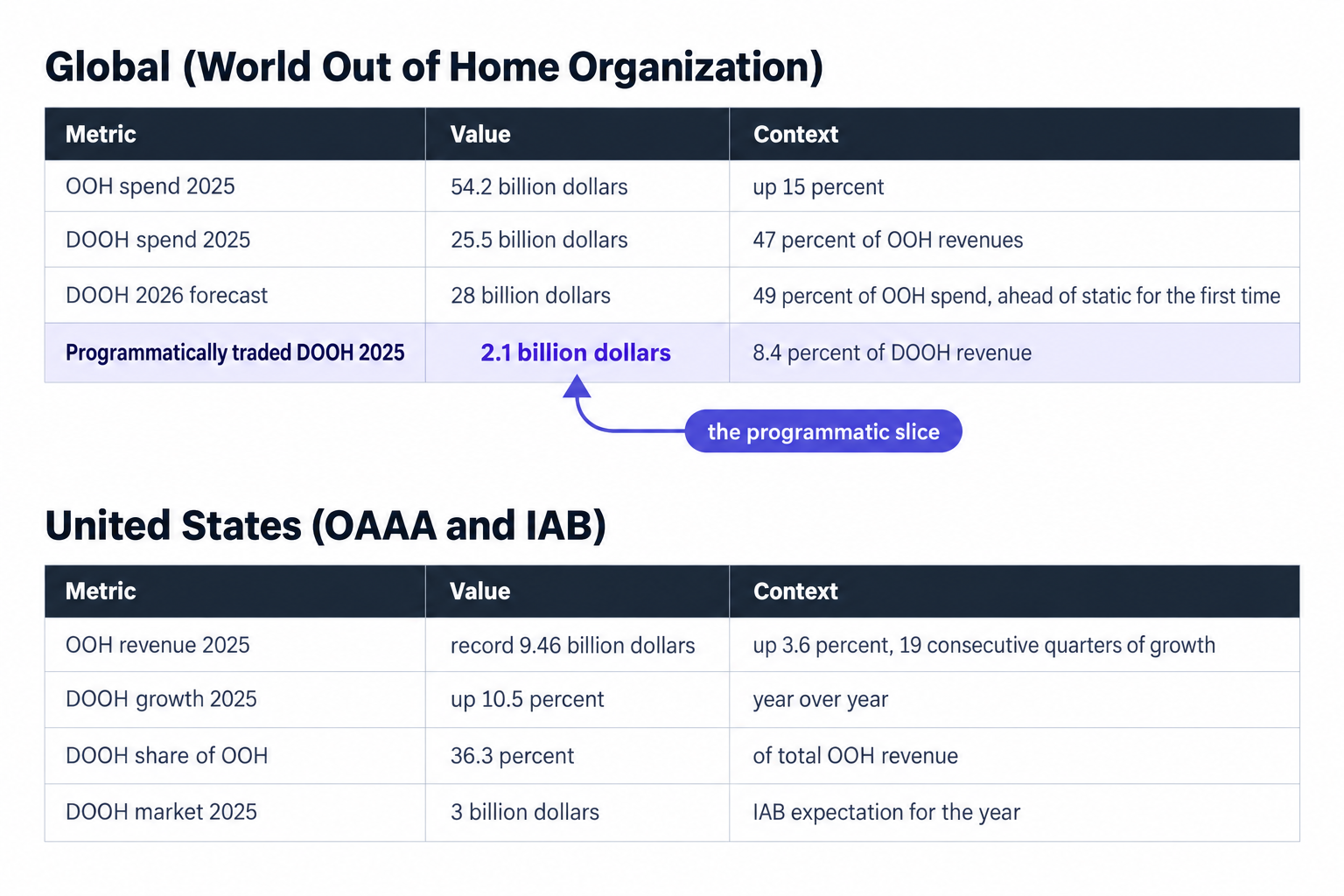
Programmatically traded digital out-of-home reached a reported 2.1 billion dollars in 2025, against 25.5 billion dollars of DOOH spend worldwide. That works out to 8.4 percent of the channel clearing through OpenRTB pipes, while the remainder still moves on rate cards, emails, and insertion orders. The screens digitized years before the transaction layer did, and that lag is the operational story worth understanding before the gap closes.
The headline numbers move quickly. The World Out of Home Organization put global OOH spend at 54.2 billion dollars in 2025, up 15 percent, with DOOH expenditure at 25.5 billion dollars, 47 percent of all OOH revenues. The same organization forecasts DOOH at 49 percent of OOH spend in 2026, 28 billion dollars, poised to overtake static formats for the first time. In the United States, OAAA's 2025 revenue report shows out-of-home advertising at a record 9.46 billion dollars, up 3.6 percent year over year and extending growth to 19 consecutive quarters, with digital out-of-home up 10.5 percent and holding 36.3 percent of total OOH revenue. IAB calls DOOH one of the fastest-growing channels in digital media and expects the United States market to hit 3 billion dollars in 2025.
Read those figures as an operations person, not as a market analyst. Nearly half of a 54 billion dollar channel runs on screens, yet under a tenth of the screen spend clears through standardized programmatic infrastructure. Every point of that 8.4 percent that converts to OpenRTB-based trading adds seats, deal IDs, and reporting obligations that look exactly like the ones you already manage for display and video.
What the dooh object actually specifies
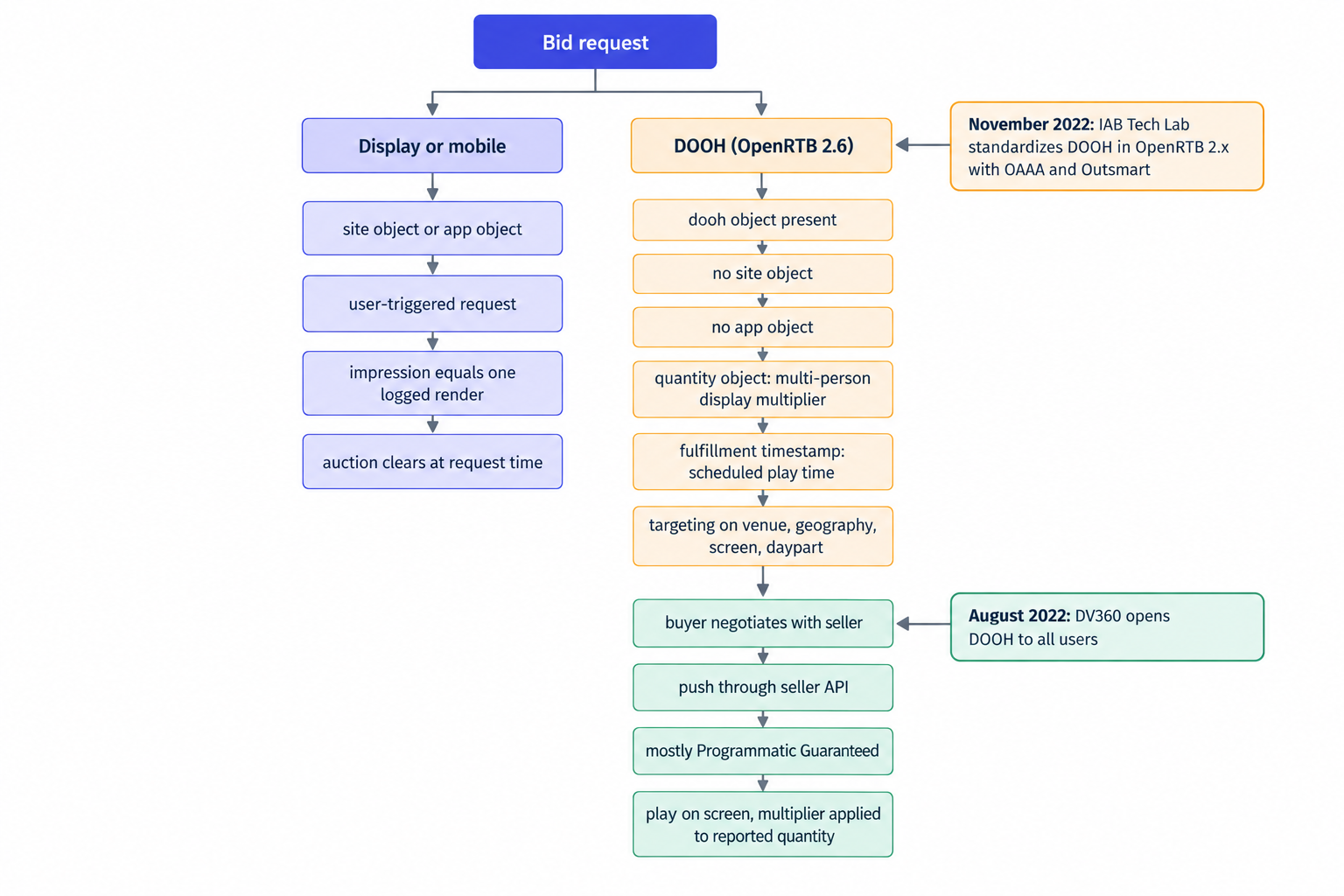
Standardization arrived late, and for a specific reason. In November 2022, IAB Tech Lab released an addition to the OpenRTB 2.x specification that standardizes the programmatic handling of digital out-of-home inventory, and the body developed it with OAAA and Outsmart after earlier efforts produced many custom implementations. Before that addition, each screen network spoke its own dialect, so a buyer integrating multiple sellers handled a bespoke payload schema per integration. That is precisely what kills scale in programmatic, and it is why the OpenRTB DOOH announcement matters more as plumbing than as news: one request schema across sellers, parseable by any 2.6-compliant seat.
OpenRTB 2.6 defines the dooh object, and three of its properties change how an ad ops team reads a bid request. The object is small, and its consequences are not.
- The exclusion rule. The request should include the dooh object when the ad supported content is a digital out-of-home screen, and a bid request carrying a dooh object must not contain a site or app object. That single rule carries the conceptual shift: display and mobile requests key on a page or a bundle, while DOOH requests key on a physical placement. Targeting moves from content signals to venue, geography, screen attributes, and time.
- The quantity object. The spec includes it for multi-person display multipliers. One play on a screen in a rail terminal does not equal one impression; the seller models the plausible audience and transmits it as a quantity. Billing math therefore reconciles multiplied quantities, not raw plays.
- The fulfillment timestamp. The ad runs at a scheduled moment on a calendar rather than at the millisecond a user triggers a request. Inventory management behaves like guaranteed direct sales: forecast availability forward, commit it, and deliver against the schedule, because no traffic spike manufactures extra 9 a.m. Monday slots.
The debugging implications are concrete. A request with no site or app object will trip instincts trained on display, so seat logs need classification by dooh presence rather than by media type alone. Supply path verification shifts as well: you confirm that a screen exists, where it sits, and what its play log says, a different audit from display's invalid traffic checks.
The request describes a place and a moment rather than a person. Exposure estimation runs on venue models, sensor counts, and location panels operating at aggregate levels, which is one structural reason the channel travels well through the privacy transitions now reshaping display identity. For sellers, that also changes the data product: the valuable signals are venue metadata and footfall patterns, not third-party identifiers.
What standardization enables on the supply path is consolidation. A single 2.6 seat can now represent screen inventory alongside display and video, which means one deal ID namespace, one reporting schema, and one billing reconciliation process across media types. Buyers stop building per-seller integrations, and sellers stop maintaining parallel custom APIs for each demand partner. The economics of long tail supply improve for the same reason header bidding improved them for display: integration cost drops, so inventory that never justified bespoke engineering reaches the market.
Measurement is the bottleneck, not delivery
Delivery on a screen is trivial to verify: the screen played the creative or it did not. Measurement is where DOOH departs from everything a display ops team knows. A display impression is a logged render tied to a device and a timestamp; a DOOH play carries no click, no per-user render log, and no client-side beacon.
IAB addressed this directly. Its DOOH Measurement Guide, dated July 8, 2025, covers how the channel is measured from data collection to attribution, and it sets out the key buying strategies, including audience targeting and programmatic models. For an ops lead the short version: exposure estimation and attribution run on modeled data rather than pixels, so reporting cycles run in weeks, not the near-real-time loop of display dashboards.
The impression multiplier is the piece finance will ask about. DV360, which made digital out-of-home ads available to all users in August 2022, documents the mechanism plainly: sellers provide an impression multiplier estimating how many people may have seen the ad. That multiplier flows into reporting as the impression quantity, which means two sellers with identical screens can report materially different volumes on methodology alone.
When you audit a DOOH line item, request the multiplier's data source, refresh cadence, and any venue-level adjustments in writing, then hold that documentation against the invoice. Display reporting leans on shared standards for viewability and invalid traffic; DOOH reporting leans on seller-specific methodology, so documentation beats dashboards. Attributed conversions follow the same discipline: expect matched studies with exposure windows rather than conversion pixels, and set client reporting expectations before launch rather than after the first discrepancy call.
Contract terms should carry the measurement burden explicitly. Put the multiplier methodology, its update schedule, and the discrepancy resolution path into the deal terms before the first campaign, because retroactive disputes over estimated audiences rarely end well for the party holding the invoice. Define what counts as delivered: a played slot on schedule, verified against the seller's play log, with the multiplier applied at reporting rather than at delivery.
How DOOH deals execute today
Here is the part that surprises display-native teams. DOOH on a major DSP is not open auction inventory. DV360 requires buyers to negotiate each DOOH deal with the seller, push it through the seller API, and run it mostly as Programmatic Guaranteed: a human agrees price and volume, the system records the deal, and the auction mechanics you know from display barely engage.
Compare that with the stack most readers of this blog operate. Header bidding surfaces parallel demand; first-price logic with bid shading and reserve prices governs clearing; expected-value ranking decides which line item wins. We document those auction mechanics and bid shading, including expected-value ranking and reserve price strategy, in depth, because DOOH will borrow them eventually: dynamic pricing on dayparts arrives as soon as demand density justifies price discovery, and sellers who learn auction logic early will price their calendars better than sellers who wait.
Until then, run DOOH yield like direct-sold display yield. A screen plays a loop, sellers sell shares of that loop across dayparts, and the scarce goods are position, share of voice, and calendar slots. Under-delivery triggers make-goods, not auction re-clears, so forecast accuracy rather than bidding strategy drives revenue. That is familiar terrain for anyone who has managed a guaranteed roadblock in a display ad server.
Daypart economics reward the direct-sold mindset. A morning commuter window and a 2 a.m. window on the same screen are different products with different clearing prices, exactly as a homepage takeover differs from a low-visibility placement in display. Sellers who price dayparts from observed demand, rather than from a flat rate card, capture the spread, and buyers who understand the calendar negotiate it. Programmatic Guaranteed is simply the mechanism that records those negotiated prices in a system both sides can audit.
Why web publishers and their agencies should care
Two reasons, one immediate and one structural. The immediate one is budget competition: the same advertisers who fund display inventory allocate through the same DSP seats, and when a brand shifts spend into Programmatic Guaranteed DOOH, open exchange CPMs absorb the loss quietly, a few cents at a time. Watching DOOH deal flow on your demand partners gives you an early read on budget movement that will surface in your own reports a quarter later.
The structural reason is skill transfer, and it runs both directions. Agencies that learn calendar-based forecasting, multiplier validation, and venue audience modeling on DOOH bring sharper negotiation back to display PMPs, and DOOH lines now appear in brand briefs that once ran display-only. Publishers above one million monthly pageviews who already sell guaranteed inventory against forecast hold the exact mental model DOOH buying requires: commitments, delivery windows, and make-goods rather than real-time auctions.
For agencies, three questions will cover most DOOH proposals. What data sources feed the audience estimate, and how fresh are they? What multiplier applies, and who validated it? What does attribution claim, and over what window? A seller who answers all three with documentation deserves the brief; a seller who answers with adjectives does not. That filter alone will save more budget than any rate negotiation.
Running both channels through one stack
We read the crossover from a specific position. OnlyMedia operates as an ad network, an SSP, and an agency in one company, and we integrate OpenRTB 2.6 seats and Prebid for header and server-side demand. The dooh object arrives inside the same 2.6 payloads our seats already parse, so DOOH demand rides the same seat plumbing, deal ID handling, and reporting pipelines as display and video. Nothing about the screen channel requires a parallel stack; it requires fields your 2.6 parser already knows.
On the demand side, advertisers buy verified audiences over curated supply paths through OpenRTB 2.6 seats, and DOOH screens now qualify for those paths on the same terms as any other 2.6 inventory. The measurement studies that close DOOH budgets, from exposure estimation to attribution, run through our partner integrations: DSP seats, SSP pathways, agency direct lines, and the study vendors themselves. Partner breadth decides what you can measure, and measurement decides what you can bill.
On the reporting side, we filter multiplied quantities into their own reconciliation line so estimated audience never mixes with verified plays. The distinction sounds pedantic until a campaign's invoiced impressions exceed its played slots by a wide margin, which is normal in DOOH and alarming everywhere else.
The commercial base stays deliberately boring. We pay publishers Net 30, CPM based, no chasing, no sliding terms, and we work with thousands of publishers, each above one million monthly pageviews, through our curated demand network. The reason to state that in a DOOH article: screen deals introduce new reconciliation cycles, multiplier questions, and study timelines into revenue operations, and payout terms that drift are the last thing you want layered on top of them.
A working checklist for 2026
If you monetize a site above one million monthly pageviews, or you advise teams that do, these six steps make DOOH legible rather than loud. Each one maps to a decision you will make within the next four quarters, with or without a dedicated DOOH budget.
- Audit your DSP partners for DOOH availability. Confirm which sellers clear through their marketplace and which deal types they support, because most volume runs as Programmatic Guaranteed.
- Request multiplier documentation before the first invoice: data source, refresh cadence, and venue-level adjustments, in writing.
- Reconcile multiplied quantities separately from raw plays. Build the report distinction before a discrepancy lands mid-campaign, not after it.
- Model screen inventory on a calendar. Daypart availability, share of voice, and loop position behave like guaranteed direct, so forecast them with direct-sold discipline.
- Learn the dooh object fields in your seat logs. When a request arrives without a site or app object, display-trained instincts misfire unless you expect the shape.
- Plan attribution as studies, not pixels. Match exposure windows to conversion windows early, and set reporting expectations to weeks.
None of this requires new infrastructure. It requires treating a new object in an old payload with the seriousness you already apply to a malformed bid request.
The 2026 crossover
The forecast line matters as much as the totals. DOOH at 49 percent of OOH spend in 2026, 28 billion dollars, ahead of static for the first time, marks the point where out-of-home planning starts digital by default. Pair that with the 8.4 percent programmatic share and the direction is unambiguous: incremental growth after the crossover will clear mostly through standardized pipes, because the buyers holding the largest budgets already sit there.
The 2.1 billion dollar programmatic figure also sets the baseline to watch. If programmatic DOOH grows faster than the channel's march from 47 percent to 49 percent, the pipes absorb the growth; if it lags, the crossover happens while most revenue still bypasses the programmatic stack entirely, and the operational advantage moves to whoever owns the direct relationships.
The industry has already built the load-bearing layers: the specification work of November 2022, the measurement framework dated July 8, 2025, and the guaranteed deal flows live on the buy side today. Teams that learn them now will experience the crossover as routine operations. Teams that wait will meet it as someone else's rate card, negotiated without them.