The Hidden Impact of Site Speed on Programmatic Ad Revenue
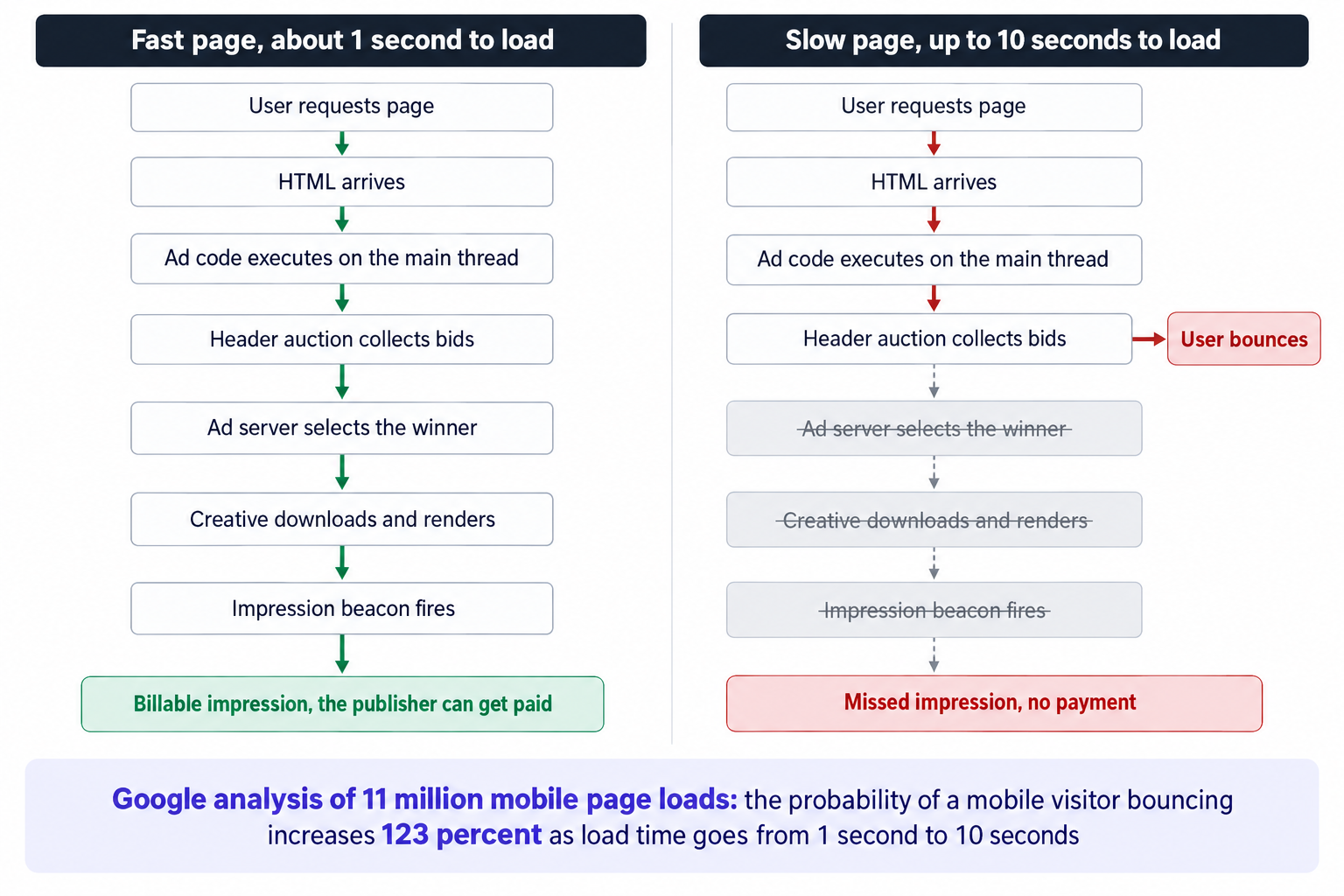
As page load time goes from one second to ten seconds, the probability of a mobile site visitor bouncing increases 123 percent, according to Google's analysis of 11 million mobile page loads. That comparison compresses the economics of programmatic publishing into one sentence: the visitor who leaves at second three takes with them every auction the page had not yet settled, every creative that had not yet rendered, every beacon that had not yet fired. A slow page does not deliver fewer clicks. It deletes inventory before the auction can price it.
Ad operations teams audit the metrics that reach their reports: fill rate, viewability, CTR, CPM by device and geography. Speed sits upstream of every one of them. It decides how many auctions complete, how many creatives render, and how many rendered ads a human actually sees. When a publisher tells us revenue fell after a redesign or a new demand integration, the first number to check is impressions per pageview, because latency shows up there long before it moves CPM.
None of the loss registers as a loss. Delivered impressions, fill rate and CPM describe the auctions that completed, while the ones the user abandoned before render leave no line in any report. That is the whole reason speed reads as a user experience topic rather than a revenue topic, and the reason the problem survives quarter after quarter at sites well past one million monthly pageviews.
The impression you never bill
An impression becomes billable when the creative loads and the tracking call registers. Google's developer documentation states the failure mode plainly: if ads don't finish loading before the user leaves the page, you get missed impressions, and publishers may not get paid. The web.dev guide to correlating Core Web Vitals with ad revenue walks through the tooling for joining the two datasets and explains why slow pages mean unpaid impressions. The mechanism is a chain, and every link sits on the critical path of the first slot: the browser parses the document, executes the ad code, collects header bids, calls the ad server, downloads the creative, renders it, fires the beacon. A bounce anywhere before render produces zero billable inventory, even though the session consumed the bandwidth, the CPU cycles and the reader's patience.
Abandonment does not hit the chain evenly. It concentrates exactly where ad code lives: after first paint, while JavaScript parses and executes on the main thread, while the wrapper waits on bidders. The bounced session also never produces its second pageview, its mid-article slot or its footer refresh, so the loss compounds per visit rather than per page. Mobile compounds it again, because mobile readers arrive on the devices with the least CPU and the networks with the most variability, which is where the bounce curve is steepest.
Viewability adds a second tax. A growing share of demand bills on viewable impressions, so an ad that renders after the reader has scrolled past it, or that never enters the viewport before the session ends, counts as delivered in your ad server and earns nothing on the buyer's ledger. Slow pages therefore cut revenue twice: fewer completed renders, then weaker viewability among the renders that complete. Buyers watch their own viewability reports and bid less on inventory that underdelivers, which is how a speed problem surfaces months later as a CPM problem.
Layout shifts take back revenue you already won
Time is only half the damage. Cumulative Layout Shift measures whether the page moves under the reader's hands, and unreserved ad containers are the leading cause, because a slot without declared dimensions expands the instant a creative injects. The recipe site iCook improved CLS by 15 percent and achieved 10 percent more ad revenue, one of the documented results in web.dev's business impact case studies. A 15 percent stability improvement buying a 10 percent revenue lift is a trade most monetization teams would sign immediately, especially since the fix is CSS, not infrastructure.
A shifting page monetizes badly in three specific ways. First, content reflow pushes a slot down just as it enters the viewport, delaying the moment the ad starts counting toward viewability. Second, the reader taps the wrong element when the page jumps mid-tap, which poisons engagement metrics and invites penalties for accidental clicks. Third, shifts interact with lazy loading: a lazy container that expands as it fills triggers a reflow on every scroll, multiplying the browser's work at the exact moment the reader is moving fastest.
The remedy costs bytes, not milliseconds. Give every ad container a reserved height in CSS, matching the sizes declared to the ad server, and keep that reservation on lazy slots as well. If a demand partner pushes creative sizes outside your slot configuration, either reject those sizes at the ad server or reserve the largest size you accept. Stability work is among the few monetization changes with no latency penalty, which makes it the natural first move in any speed program.
The median page keeps getting heavier
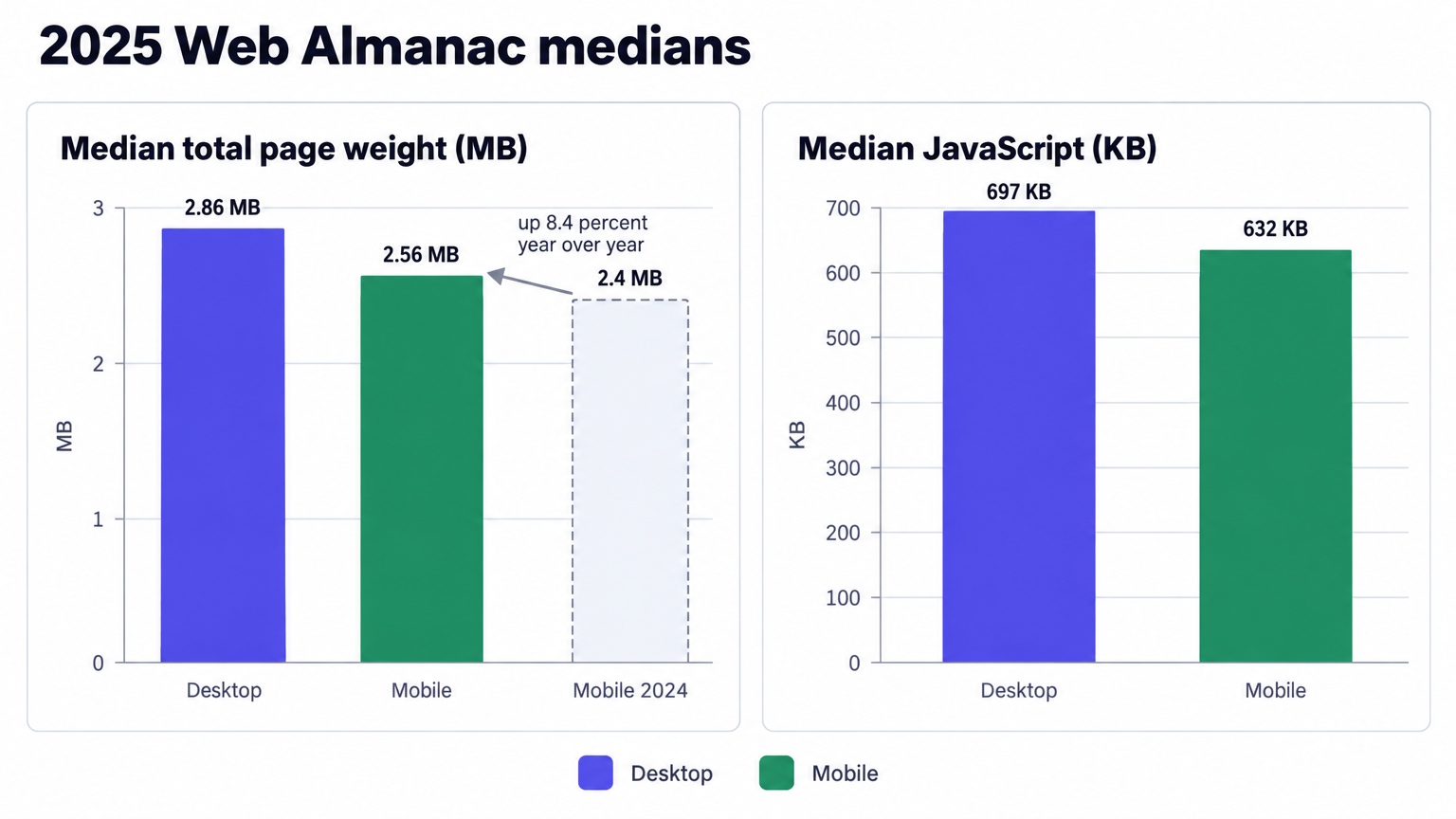
The 2025 Web Almanac put the median page at 2.86 MB on desktop and 2.56 MB on mobile, with the mobile median up 8.4 percent from 2.4 MB in 2024. Median JavaScript reached 697 KB on desktop and 632 KB on mobile. The full 2025 page weight census carries the distribution across percentiles, but the medians alone make the operational point: pages gained the most weight on the devices and networks where abandonment risk is highest.
JavaScript deserves that emphasis. Bytes cost time on slow connections, and script bytes cost main-thread time on every device, because a mid-range phone parses and executes code far more slowly than a development laptop. Ad code is overwhelmingly JavaScript. The 2021 Web Almanac, the edition that last broke out the category this way, found ad third parties made up 25.7 percent of desktop third parties and 29.1 percent of mobile third parties, and measured Google Ads main-thread time at 1,429 milliseconds at the 90th percentile. Treat those figures as dated 2021 data; the structural fact still holds. The monetization stack is one of the heaviest and most main-thread-hungry codebases on your page, and unlike your content, you control it only in partnership with your vendors.
That split dictates the order of work. Your markup, images and fonts are yours to optimize directly. The ad stack is a shared cost between you and your demand partners, which is why demand consolidation, wrapper configuration and container hygiene usually beat hero-image compression once the content side is clean.
Header bidding put the auction on the critical path
Header bidding moved the programmatic auction into the browser. Every bidder the wrapper calls, and every millisecond of timeout it allows, delays the first creative. The timeout is a straight trade: wait longer and you collect more bids; wait past the abandonment window and the extra bids compete for a slot the reader has already left. Teams tune this setting constantly, but few can see abandoned auctions in reporting, because delivered impressions are the only thing most pipelines record.
At OnlyMedia, we integrate OpenRTB 2.6 seats and Prebid for header and server-side demand, and the split matters for speed. Server-side seats run the auction off the device, so the page executes one consolidated negotiation instead of a dozen parallel JavaScript requests, and each partner that moves server-side drops its client bundle from the page entirely. That cuts JavaScript weight and main-thread blocking while holding bid density. It also shortens the timeout argument, because the wrapper no longer waits on the slowest bidder inside the reader's remaining patience.
Latency moves bids, not just impressions. Buyers bid expected value, and predicted viewability, historical delivery reliability and slot stability all feed the models that price your inventory. Under first-price auctions and bid shading, buyers discount for uncertainty, and inventory that renders late and erratically is uncertain by definition. Stabilize that inventory and it can clear at a better price, which is the second channel through which speed work pays: more impressions first, then a better price on the impressions you keep. Reserve prices set against unstable delivery tend to miss both.
What Google's guidance permits below the fold
Google's developer guidance is more permissive than most publishers assume: unlike above-the-fold placements, below-the-fold ads may not need to load immediately, and lazy loading fetches ads dynamically just before they enter the viewport, reducing initial load time. That single sentence sanctions most of the optimization opportunity, because on a typical article template the majority of slots sit below the first viewport, loading on every pageview for the minority of sessions that ever scroll that far.
Implementation decides whether lazy loading earns or costs revenue. Four rules govern it:
- Fetch before the viewport, not at it. Configure the observer so the ad call fires while the slot is still below the visible area; a creative that arrives after the reader has passed the empty container delivers late and views poorly.
- Reserve the container height. Lazy slots need their declared dimensions in CSS so filling them never shifts the layout, protecting CLS and the reader's scroll position.
- Keep the first view on the standard path. Slots visible on load stay immediate; lazy loading them saves nothing and puts your highest-value impressions at risk.
- Measure per slot. A lazy slot whose fill or viewability drops after rollout is telling you its fetch window is too tight; widen it before you conclude the slot is worthless.
Footer slots deserve a separate decision. On pages where many sessions never scroll, a footer ad has negative expected value: it costs an ad call on every pageview and delivers to a small share of them. Lazy loading is the minimal fix. Removing or repositioning the slot is the honest one, and per-slot reporting makes that case for you.
Measuring the loss on your own traffic
Aggregate reporting hides this problem well, because the revenue you lost never existed as a line item. The measurement plan has to join two datasets that usually live in different tools: field performance data and revenue data. On the performance side, segment Core Web Vitals field data by device and pull lab traces for the templates that carry the most slots. On the revenue side, track impressions per pageview, viewable impressions per slot, scroll depth and revenue per thousand pageviews, then bucket sessions by load time and compare the buckets.
Refresh cadence decides whether you can trust the readout. Our ten minute reporting console refreshes every metric every ten minutes and exposes the same data over API, and that cadence matters here: a lazy loading rollout or a server-side migration needs a same-day readout, before dayparting and flight changes muddy the comparison. Weekly exports cannot separate a speed improvement from a campaign change. Agencies advising publishers should put one pair of numbers in every monthly review: impressions per pageview alongside mobile field data for the heaviest template.
Run the arithmetic on a hypothetical site to see the shape of the loss. Assume 40 million monthly pageviews and four slots, all rendering on 90 percent of pageviews when the stack behaves: 360 delivered impressions per 100 pageviews. Suppose slow ad code cuts render completion to 70 percent on the two below-the-fold slots; those slots drop from 180 to 140 impressions per 100 pageviews, taking the page total from 360 to 320. That is an 11 percent loss in delivered inventory before any viewability or CPM effect. At 40 million pageviews, the 40-impression gap per hundred pageviews equals 16 million lost renders a month, and not one of them appears in any report as a loss.
A speed budget for the monetization stack
A budget makes trade-offs explicit. Every tag on the page spends milliseconds of reader patience, and monetization code spends the most, so it should justify itself with the same discipline you apply to floors. Six items cover the ground:
- Reserve dimensions for every ad container, lazy slots included.
- Lazy load everything below the first viewport, with the fetch window tuned per slot rather than globally.
- Consolidate header demand and move partners server-side where the economics hold; a partner whose incremental net revenue does not cover its client-side latency is a net cost.
- Audit main-thread blocking from ad code specifically, not just total script weight.
- Cap synchronous third parties; verification tags, audience pixels and analytics each owe you a justification.
- Compress and defer your own content assets last, because once ad code is lean, content fixes are the cheapest remaining wins.
Change one thing at a time and re-measure at the highest resolution your reporting offers. Lazy loading shows its effect on impressions per pageview within the day. Server-side migrations take longer to read, because bid density shifts as buyers adjust to the new path.
The payment side of the same discipline
We run an ad network, an SSP and an agency in one company, and we work with thousands of publishers, each above one million monthly pageviews. We pay them Net 30 on a CPM basis: no chasing, no sliding terms. Across our curated programmatic demand network, the publishers who grow revenue year over year share one habit: they treat the ad stack as a performance surface, with the same instrumentation and change discipline they apply to their content. They measure impressions per pageview before and after adding a demand partner, and they read per-slot numbers the same day they enable lazy loading.
The publisher monetization and Net 30 terms page details how the console, the curated demand and the payment schedule fit together. Speed work earns that cadence. The difference between a one-second page and a ten-second page is 123 percent more visitors gone before your first creative renders, with every one of those sessions still consuming your bytes, your CPU and your auction time. Speed is not adjacent to programmatic revenue. It is an input the auction prices, and the publishers who manage it that way are the ones whose consoles show impressions where slow pages show only bounce.