Programmatic Audio: Tapping into the Podcast Monetization Boom
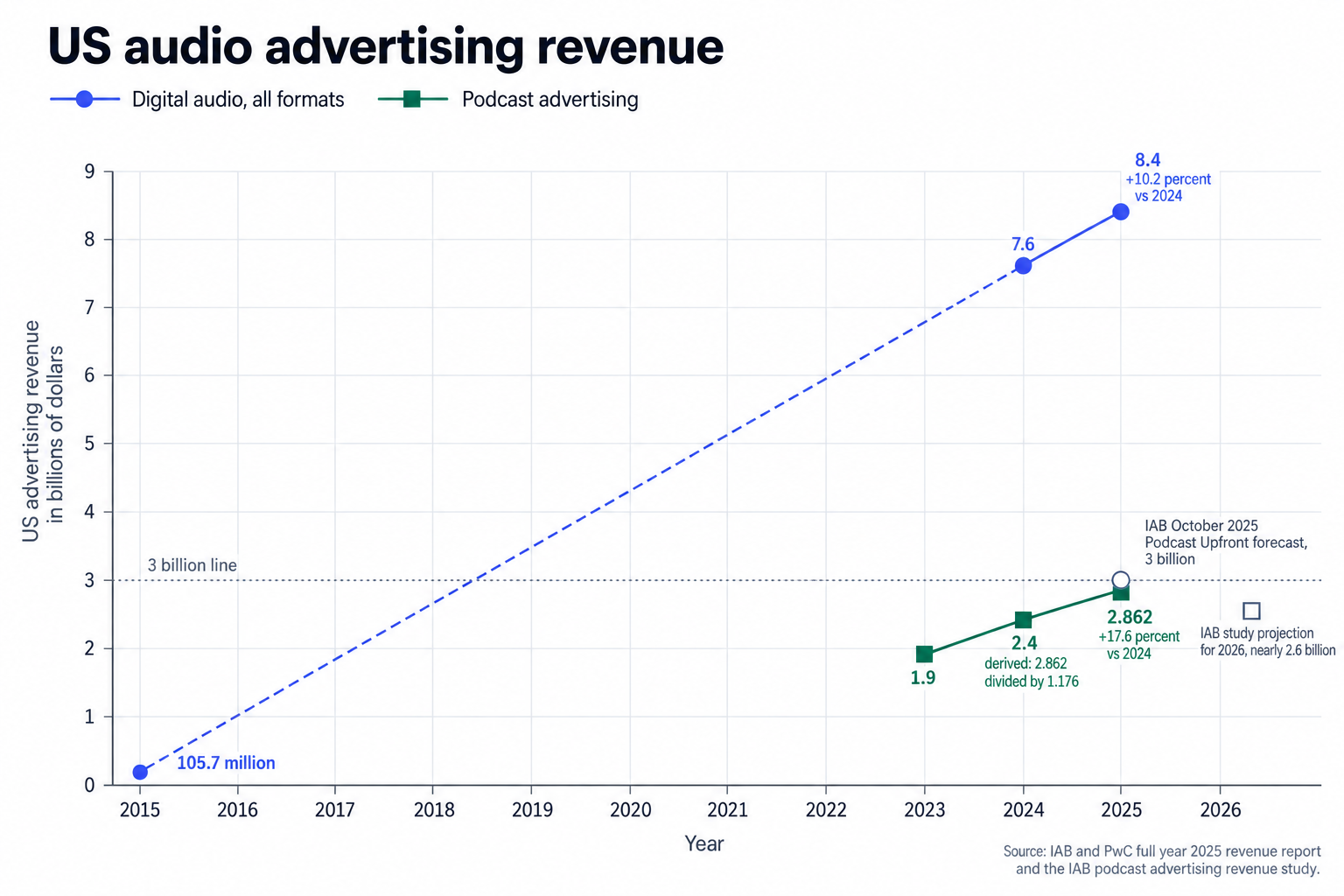
At its October 2025 Podcast Upfront, the IAB projected that podcast advertising would top 3 billion dollars in a single year for the first time. The final 2025 actual came in at 2.862 billion dollars, up 17.6 percent year over year, according to the IAB and PwC full year 2025 revenue report. The projection overshot the actual by roughly 140 million dollars, and the growth rate underneath it still beat digital advertising overall, which rose 13.9 percent to nearly 300 billion dollars. For ad operations teams, the topline matters less than the mechanism behind it: podcast impressions now travel through the same OpenRTB plumbing that carries display and video.
Audio joined the protocol as a native impression type in OpenRTB 2.4 in March 2016, and the current object definition, section 3.2.8 of OpenRTB 2.6, maps onto workflows an ad server already runs. A publisher above one million monthly pageviews can therefore add audio supply without building a parallel stack. The revenue follows only when the measurement basis, the bid request fields and the reserve prices are set deliberately, and the gaps between the three account for most failed audio launches.
The revenue line, 2015 to 2025
Digital audio overall reached 8.4 billion dollars in 2025, a 10.2 percent gain from 7.6 billion dollars in 2024. The figure extends a decade-long run for the category, which earned 105.7 million dollars in 2015. Podcast advertising grew faster still: 17.6 percent, to 2.862 billion dollars. Divide the 2025 actual by 1.176 and the implied 2024 base sits near 2.4 billion dollars, which clears every bar the IAB set in its earlier projections.
Those earlier projections now read as conservative. The IAB podcast advertising revenue study, covering the United States market, recorded 1.9 billion dollars for 2023, up 5 percent, then projected 12 percent growth to over 2 billion dollars in 2024 and nearly 2.6 billion dollars by 2026. The same study listed the evolution of programmatic selling among the growth drivers, and that attribution matters for planning: the incremental dollars arrived through protocols like OpenRTB, not through bigger host-read sponsorship checks. When a market beats its own forecast curve, look on the supply side for the mechanism, because inventory that once demanded a sponsor negotiation became an auctionable, data-carrying impression.
How an audio impression moves through OpenRTB
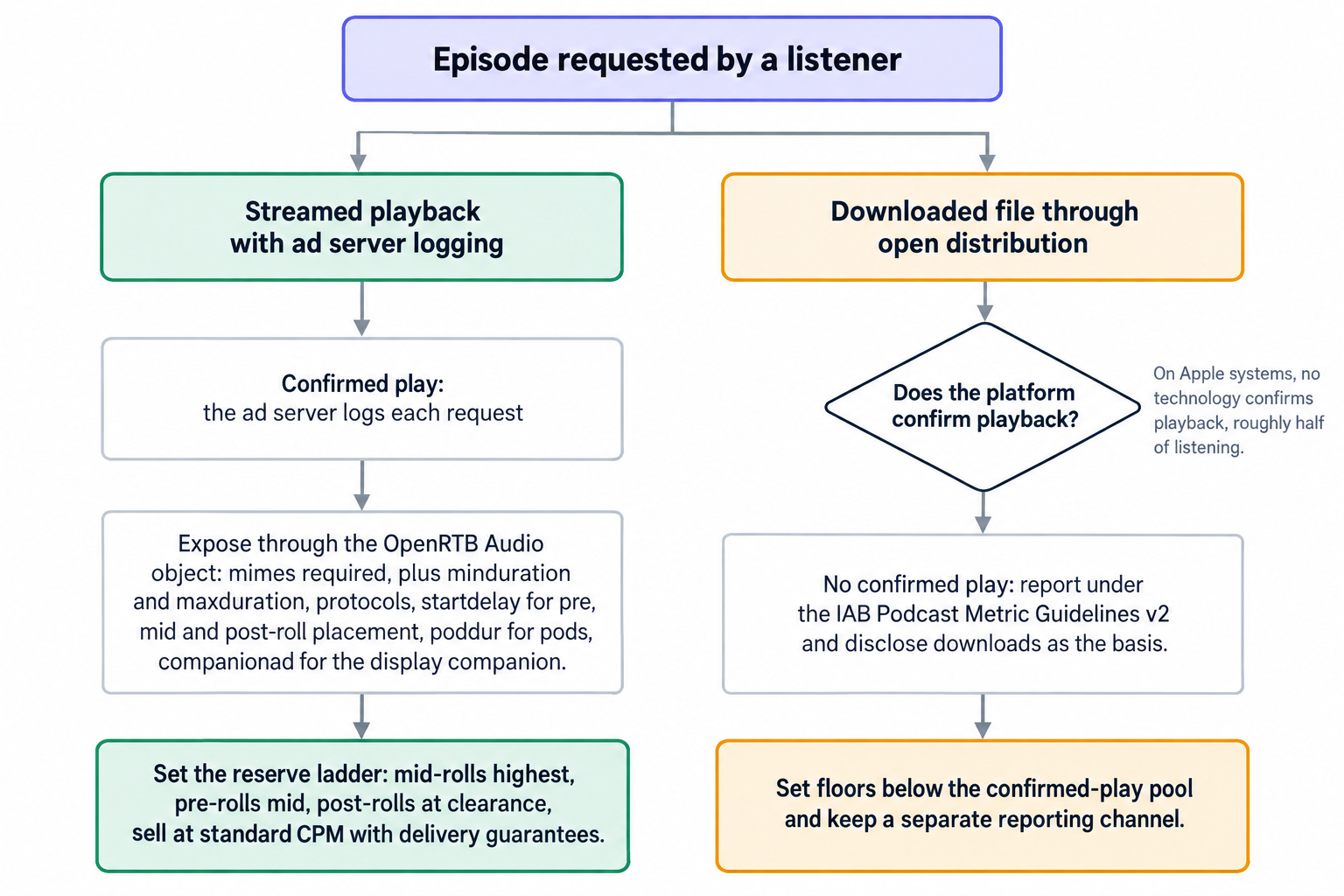
The Audio object, section 3.2.8 of OpenRTB 2.6, represents an audio type impression, and the specification keeps it deliberately thin. mimes, the accepted content type list, stands as the only required field. Everything else arrives through optional attributes, which shifts the signaling burden onto the sell side: whoever configures the seat decides how much the buyer knows, and bids follow the information. Two sellers exposing the same episode can therefore pull very different bid density from identical inventory.
An ops team configuring audio supply works through six fields, in rough order of operational impact:
- mimes: the only required field, declaring the audio content types the slot accepts.
- minduration and maxduration: the creative duration bounds a slot accepts; set them wide enough for standard spot lengths, or the seat silently sheds demand.
- protocols: the delivery protocols the player supports; audio in OpenRTB generally assumes VAST compliance, so a stack that cannot parse VAST responses cuts itself off from the demand that follows the standard.
- startdelay: the placement signal across pre, mid and post-roll, and the first field buyers read when deciding what they are buying.
- poddur: the declared duration of a dynamic audio ad pod, the block of consecutive slots inside a single break.
- companionad: the display unit attached to the audio impression, which turns a solo slot into a bundled package.
Treat the object as a checklist to complete, not a form to satisfy. The DSP prices what the request tells it, and incomplete optional fields read as risk, which buyers discount.
On our side, the plumbing looks the same as it does for display. OnlyMedia integrates OpenRTB 2.6 seats and Prebid for header and server-side demand, and audio demand reaches us through those OpenRTB seats rather than through a browser header auction. The reason is mechanical: the ad decision happens when a player requests the file or when a stitcher inserts the ad, so audio resolves server-side, never in the page header. The server-side path also shapes the logs: a confirmed-play stream records the ad request, the winning bid and the rendered insertion in one report, while a downloaded file yields distribution numbers instead. Design the logging schema before the first campaign, not after the first discrepancy report.
The measurement ceiling on downloaded files
IAB Europe released its digital audio buyer guide in November 2020, and the document still states the two facts that shape every audio deal. First, buying audio inventory uses the OpenRTB framework, the same one as display. Second, uniform metrics come from the IAB Podcast Metric Guidelines v2, because platforms disagree on what counts as a play. The guide also records the structural problem behind that second fact: roughly half of podcast listening happens on Apple systems that offer no technology confirming a podcast file was played.
A downloaded file is not a verified play, and no bid request can claim a listener heard the ad. A download basis therefore trades below ad-server-confirmed delivery, not because the audience differs but because the guarantee does. The operational response is disclosure and separation: keep confirmed-play streaming in one reporting pool and downloaded distribution in another, tag the inventory accordingly, and set floors that reflect the difference. Buyers accept a download basis when the deal states it plainly, and they punish ambiguity by shading bids or avoiding the supply.
Agencies advising publishers should ask which metric a podcast report uses before quoting any CPM, because v2 compliance decides what the number means. At the scale this audience operates, audio is usually the weakest guarantee in a portfolio that includes display, video and newsletter inventory. Reconcile the two pools monthly and publish the split in the same report the buyer sees. Fix the reporting basis first, then negotiate price.
Companion ads tie audio to the display business
companionad is the field that connects an audio strategy to inventory a publisher already sells. An audio impression can carry a display companion, the unit that renders in the player surface, so one sale covers the ear and the eye. Publishers already running IAB display and video formats, every standard size plus in-stream, out-stream, interstitial and CTV video, can bundle a companion into audio deals without building anything new. The episode page itself stays a display surface, and the audio file stays a separate supply pool that happens to carry display along.
The bundle also changes the pitch. An audio campaign with a display companion delivers frequency on two surfaces and produces a click signal the audio file alone cannot provide. Expose the companion through companionad, and price it into the audio floor instead of giving it away.
Pricing audio under first-price rules
Audio inherits the auction economics a display team already argues about daily. In first-price auctions, buyers shade bids below true value, reserves force that shading to surface, and expected-value ranking rather than nominal CPM decides which demand wins. We break down first-price mechanics and reserve prices, including bid shading behavior, in our guide to programmatic auctions, and every mechanism transfers to audio slots. The one audio-specific rule: never let confirmed-play inventory and download-based inventory share a floor, because a uniform floor either leaves money on the verified side or overprices the unverified side into zero fill.
Placement drives the reserve ladder within each pool. Set the highest floors on mid-rolls inside long episodes, where listeners have already committed, and lower the pre-roll floor, where drop-off concentrates. Price post-rolls at the clearance tier. Use poddur to package pods, and quote the block above the sum of its single slots, because a pod hands the buyer the entire break.
Monitor bid density by placement weekly. Audio campaigns book in tight windows, so a floor that clears no bids costs a full flight rather than a single impression. Treat floor changes as experiments with a short review cycle, and keep the two inventory pools on separate ladders so the results stay readable.
The buy side and the seats that reach it
Audio demand concentrates in the DSPs that already buy display and video: The Trade Desk, DV360, Amazon DSP and Criteo all evaluate audio supply through OpenRTB, with the same audience and context machinery they apply elsewhere. A publisher's job is to make the inventory legible to that machinery: complete the Audio object, state the measurement basis, and expose the supply through a path the buyers already use. Because we operate an ad network, an SSP and an agency in one company, we see both sides: what buyers request in an audio brief and what a publisher's stack can actually deliver. In the briefs we review on the agency side, buyers ask for show-level control before they ask for price, so package inventory by show and expose the packages through the seats.
We sell through curated supply paths with verified audiences, with OpenRTB 2.6 seats as the interface, and audio flows through those seats on the same terms as display. That symmetry is the whole opportunity: one integration, two sensory channels.
A build sequence for an existing stack
A publisher above one million monthly pageviews already owns most of what audio needs: an ad server, a VAST-capable video path and a reporting layer. The build is mostly configuration. The sequence below follows the order that minimizes rework.
- Confirm the hosting path supports dynamic ad insertion and VAST responses. OpenRTB audio generally assumes VAST compliance, and a host that cannot return VAST cuts off the programmatic channel at step one.
- Split the catalog into a confirmed-play pool and a download-based pool, and keep separate channels so floors and reporting never mix them.
- Configure the seat with the full Audio object: mimes, minduration and maxduration, protocols, startdelay for pre, mid and post-roll placement, poddur for pods, companionad for the display companion.
- Set the reserve ladder by placement: mid-rolls highest, pre-rolls mid, post-rolls at clearance.
- Attach the companion display unit and price it into the audio floor.
- Report against the IAB Podcast Metric Guidelines v2, and state the basis, plays or downloads, on every insertion order and invoice.
- Fold audio into the same expected-value ranking and payout cadence as the rest of the inventory, so audio never becomes a side ledger.
Step two decides everything downstream, and teams that skip it usually discover the fact during a billing dispute. The rest is field configuration and pricing discipline, both of which an experienced ops team can handle in an afternoon.
Payout terms when CPMs ride on the metric
A CPM based payout turns the measurement question into a payment question. If the invoice says CPM and the metric underneath is a raw download, buyer and publisher are pricing two different events, and someone absorbs the gap. Fix the basis contractually and technically: agree the metric at the IAB Podcast Metric Guidelines v2 level, log it the same way every month, and pay against the logged number. Audio makes this discipline visible because its two inventory pools sit far apart in guarantee strength.
OnlyMedia pays publishers Net 30, CPM based, no chasing, no sliding terms, and audio follows the same rule as display: we pay the number the report supports. We work with thousands of publishers, each above one million monthly pageviews, and our curated programmatic demand network holds audio CPMs to the same Net 30 cadence as banners. The cadence only holds when the metric is fixed first, which is why the reporting step comes before any pricing conversation.
The forecast curve versus the actuals
Stack the projections against the actuals and the direction is unambiguous. The 2023 study projected nearly 2.6 billion dollars by 2026, and the market delivered 2.862 billion dollars in 2025, a year early and roughly 260 million dollars above the bar. The October 2025 Upfront projection missed its first year by about 140 million dollars, and the same 17.6 percent growth applied to the 2025 base clears 3 billion dollars the following year. A forecast that undershoots while the market compounds describes supply that cannot expand as fast as demand, which is the situation every sellable podcast back catalog currently sits in.
The operational read matters more than the forecast math. Podcast audio now runs on OpenRTB 2.6 seats, prices under first-price rules a display team already operates, and pays on CPM terms an accounting team already reconciles. The measurement gap is the one genuine constraint, and separated pools plus plain disclosure keep it from capping revenue. For a publisher with a display stack and a back catalog, the marginal cost of listing audio supply is configuration, and the market grew 17.6 percent while that configuration waited.