MCM Manage Account vs. Manage Inventory: Which Partner Setup Maximizes Yield?
One child publisher can hold a single Manage Account parent and up to 15 Manage Inventory parents at the same time, yet each individual piece of its inventory can only be managed, represented or sold by one parent under the Partner Guidelines. That asymmetry, not preference, decides where the auction runs, where the reporting lives and which company signs the payout terms. The wrong delegation type costs you either control of the auction or the data that proves your yield. Above one million monthly pageviews, where a single mispriced floor on a top slot compounds every day, that trade deserves the same scrutiny as the demand partnership itself.
What delegation actually changes
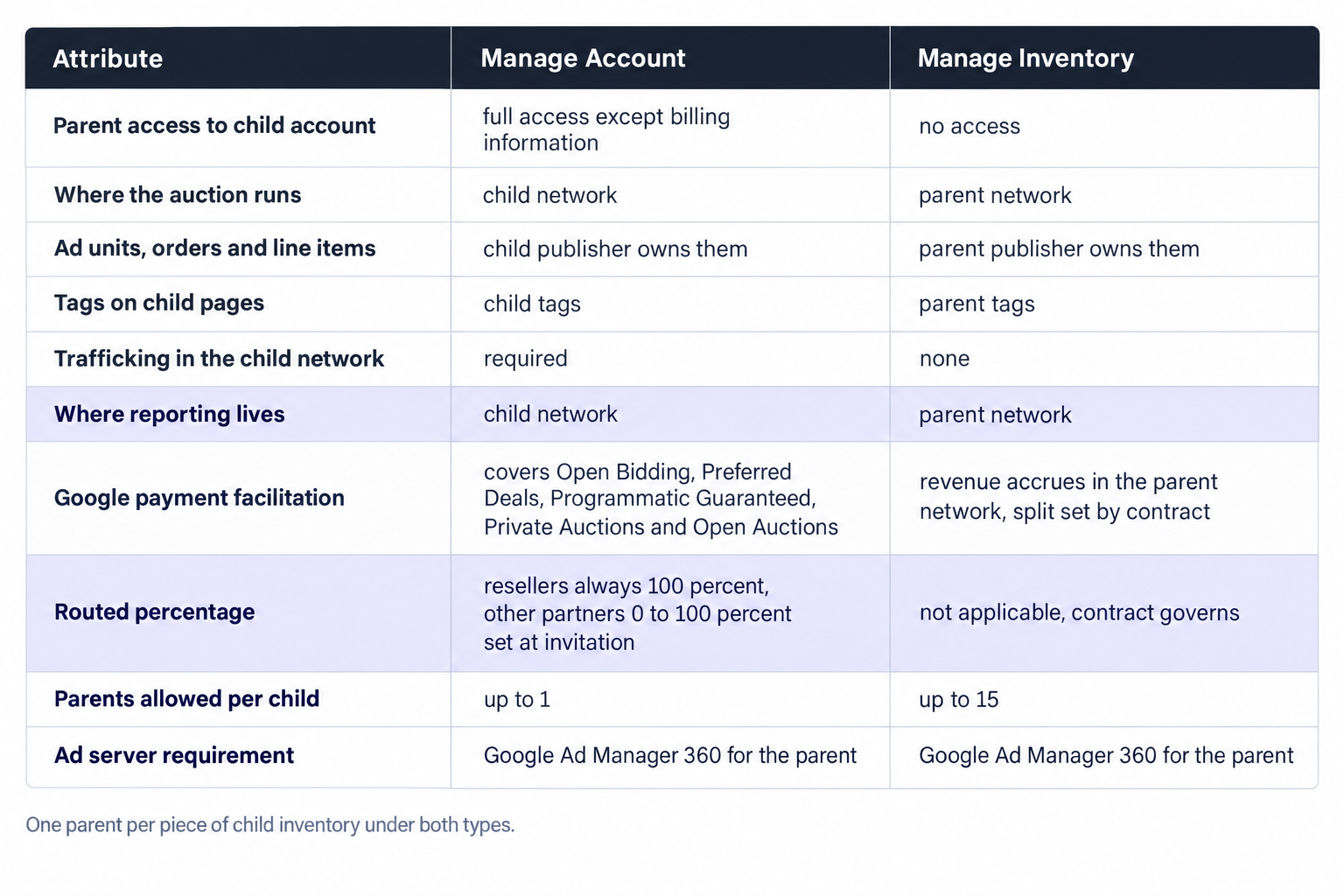
MCM delegation exists only in Google Ad Manager 360, and the requirement sits on the managing publisher. A publisher on standard Ad Manager can join as a child but can never act as a parent, so a site without a 360 license reaches premium AdX demand through a partner that holds one. The delegation itself follows an invitation flow: the parent sends the invite, the child accepts, and the child's inventory enters the parent's operational scope under one of two types. Google's official delegation comparison spells out the four differences that drive every operational decision: access boundaries, limits, reporting locations and payment routing.
Both types connect the child to AdX. Everything else flips: who traffics, who reports, who pays and who can change a floor without asking.
The child's own network survives both types. Under Manage Account it remains the production ad server with the parent looking over its shoulder. Under Manage Inventory it goes quiet for the delegated inventory, and its value drops to whatever non-delegated inventory remains inside it.
Access boundaries point in opposite directions
Under Manage Account, the parent publisher has access to the child account, except for billing information. Under Manage Inventory, the parent publisher has no access to the child's account. Two sentences carry most of the operational weight of the entire decision.
The Manage Account parent can open the child network, audit line items, debug targeting, fix key-values and build orders alongside the child's team. That access cuts both ways. The parent can improve the stack, and the parent can also change it, so the contract needs change control: who edits floors, who pauses line items, who approves new ad units, and what the audit trail shows afterward. Under Manage Inventory none of that applies, because the parent works entirely inside its own network and never sees the child's account. If a tagged page breaks, the child cannot show the parent anything directly, and the parent cannot inspect the child's setup; the child must describe the problem, export evidence from its own analytics and rely on the parent's internal view.
Reporting follows the same split. Under Manage Account, all reporting shows directly in the child's network. Under Manage Inventory, the reporting data lives in the parent network, and the child network holds none of it. A publisher that delegates inventory as Manage Inventory must therefore treat reporting as a contractual deliverable, not a courtesy: granular to the ad unit, refreshed daily at minimum, exportable, and paired with the parent's floor and demand configuration history.
Manage Account: the child keeps the auction
Under Manage Account the child network stays the ad server of record. The child keeps its ad units, its order and line item architecture, its key-values, its frequency caps, its Prebid container and its floor logic. The parent gains account access minus billing, which makes it a collaborator inside the child's stack rather than a replacement for it.
Google's payment facilitation under this delegation covers Open Bidding, Preferred Deals, Programmatic Guaranteed, Private Auctions and Open Auctions, with one carve out: Open Bidding revenue stays inside facilitation except where the third-party demand partner directly pays the child, or pays a third party on the child's behalf. Google's Manage Account documentation details that transaction list and the payment mechanics around it.
The routed percentage governs the money split. Reseller partners always carry a routed percentage of 100 percent. For other partner types the invitation sets the percentage anywhere from 0 to 100 percent, and that number decides how much revenue travels through the parent before it reaches the child. Negotiate it before accepting the invitation, because payment changes take up to 24 hours to take effect, and because that percentage anchors every future revenue conversation with the parent.
Yield mechanics under this model reward operational strength. The child configures the Prebid wrapper, the bidder set and the timeouts, and AdX competes against those bids inside the auction the child owns. Floor changes, header bid weights, direct deal priority and viewability fixes all land in production the same day, with no external queue. The parent contributes AdX depth and, depending on the contract, managed demand or deal packaging. The model maximizes yield when the child's ad operations can exploit the control; it caps yield when they cannot, because the parent fills the auction but never restructures it.
Manage Inventory: the parent traffics everything
Under Manage Inventory, parents manage third-party child inventory directly within their own account, using their own ad units, orders and line items. The parent tags the child's sites with the parent's tags, and no trafficking or ad serving needs to happen in the child network. Google's Manage Inventory documentation walks through exactly this parent side setup.
The consequences run deep. The child's slot naming, targeting model and line item architecture stop mattering from the moment the parent tags go live. The parent must traffic any direct campaign the child sells, into parent line items, so a task that took minutes inside the child's network becomes a handoff with an external queue and a latency cost on every start date. House campaigns, sponsorship bookings and seasonal promotions all inherit that queue. Ownership of refresh intervals, lazy loading and viewability targets also moves to the parent, which places page performance inside someone else's pipeline.
Treat the migration as a tag replacement project. The parent builds ad units that mirror the child's slot grid, writes its own key-values, maps its own targeting, then swaps tags page by page. QA matters here: mismatched slot sizes and lost key-values depress yield silently, and the child's own reporting will not surface the damage because it no longer records the delegated impressions.
Yield mechanics under this model reduce to the parent's stack. AdX, header and server-side Prebid, OpenRTB seats and private deals all compete in the parent's auction, and the parent manages floors against demand data the child never sees. A publisher without a 360 license and without a trafficking team gains an entire programmatic operation overnight. The same publisher loses the ability to verify any of it, because the child can see auction depth, bid variance and floor decisions only through what the parent chooses to share.
One inventory piece, one parent, 15 possible parents
The limits define the architecture options. A child can hold at most one Manage Account parent and up to 15 Manage Inventory parents. Any single piece of child inventory answers to exactly one parent, so multiple Manage Inventory parents never stack competing auctions on one ad unit; they split inventory.
The 15 parent ceiling has practical uses. Delegate site A to one specialist and site B to another. Run a test slice with a new partner while the core property keeps its incumbent. Assign a regional edition to a partner with local demand. The Manage Account slot, by contrast, is singular: payment routing, account access and the AdX connection all hang off one invitation, and switching later means a new delegation, a fresh routed percentage and a gap in continuity. Vet that parent before you delegate, not after.
Hybrids work because the one parent rule applies per inventory piece, not per publisher. A common pattern keeps core inventory under Manage Account with a partner that extends AdX while the in-house team keeps trafficking, and delegates one vertical or subsite as Manage Inventory to a partner whose demand matches that audience. Each slice answers to exactly one parent, so the arrangement stays clean and you can move a single slice without touching the rest.
Money: routing, timing and the terms worth negotiating
Under Manage Account the payment conversation centers on the routed percentage: always 100 percent for resellers, anywhere from 0 to 100 percent for other partner types, set in the invitation. Google has payment information ready around the 15th of each month, or the next business day after the previous month's closure, and payment changes take up to 24 hours to take effect. That cadence sets the reconciliation rhythm: schedule the reporting pull for the middle of the month, not the first, and your numbers will line up with Google's own summary.
Under Manage Inventory, revenue accrues inside the parent network, because serving and reporting both happen there. The child's economics then rest entirely on the commercial contract with the parent: payout basis, net terms, floor policy and measurement. Google documents no split as policy for Manage Inventory, so treat the contract, not the platform, as the source of truth. Insist on CPM based payouts with fixed net terms, and reject any share calculation you cannot recompute from raw delivery data.
Reconcile with arithmetic, not trust. Divide the payout by delivered impressions, compare the result against your own analytics on the same period, and investigate any gap beyond rounding before it compounds into a quarter.
Which setup maximizes yield, scenario by scenario
Yield in MCM decomposes into three factors: auction depth per impression, the latency of your control over that auction, and the transparency of the take rate. The delegation type determines all three, so match it to the publisher's actual profile rather than to a partner's default.
Profile one: the publisher holds Ad Manager 360 and runs in-house ad ops. Choose Manage Account. The team keeps floors, demand weights and trafficking under its own control, reporting stays native to the child network, and the routed percentage gets negotiated once, in daylight, before acceptance. The parent supplies AdX and whatever demand it packages. The yield ceiling here is the quality of the publisher's own operations, which the publisher can hire and tool for.
Profile two: the publisher lacks 360 or lacks an ad ops function. Choose Manage Inventory, and buy transparency with it. The parent's stack, floors and auction management replace an entire team, and timelines compress: our onboarding runs two to five days, and we evaluate new inventory from a traffic report in about two weeks. The yield ceiling here is the parent's stack quality and honesty, so the reporting clause outweighs the rate card. Ask for bid-level data, floor change logs and ad unit level delivery before signing anything.
Profile three: the portfolio publisher with mixed properties. Use the hybrid. Keep the flagship under Manage Account where the internal team earns its keep, delegate long tail subsites as Manage Inventory to a partner with matching demand, and use the 15 parent ceiling to test specialists on slices without touching the core.
These profiles are not permanent. A publisher can start under Manage Inventory while its operations mature, then bring the flagship into a Manage Account delegation slice by slice, since both delegation types can coexist on different inventory within the same child.
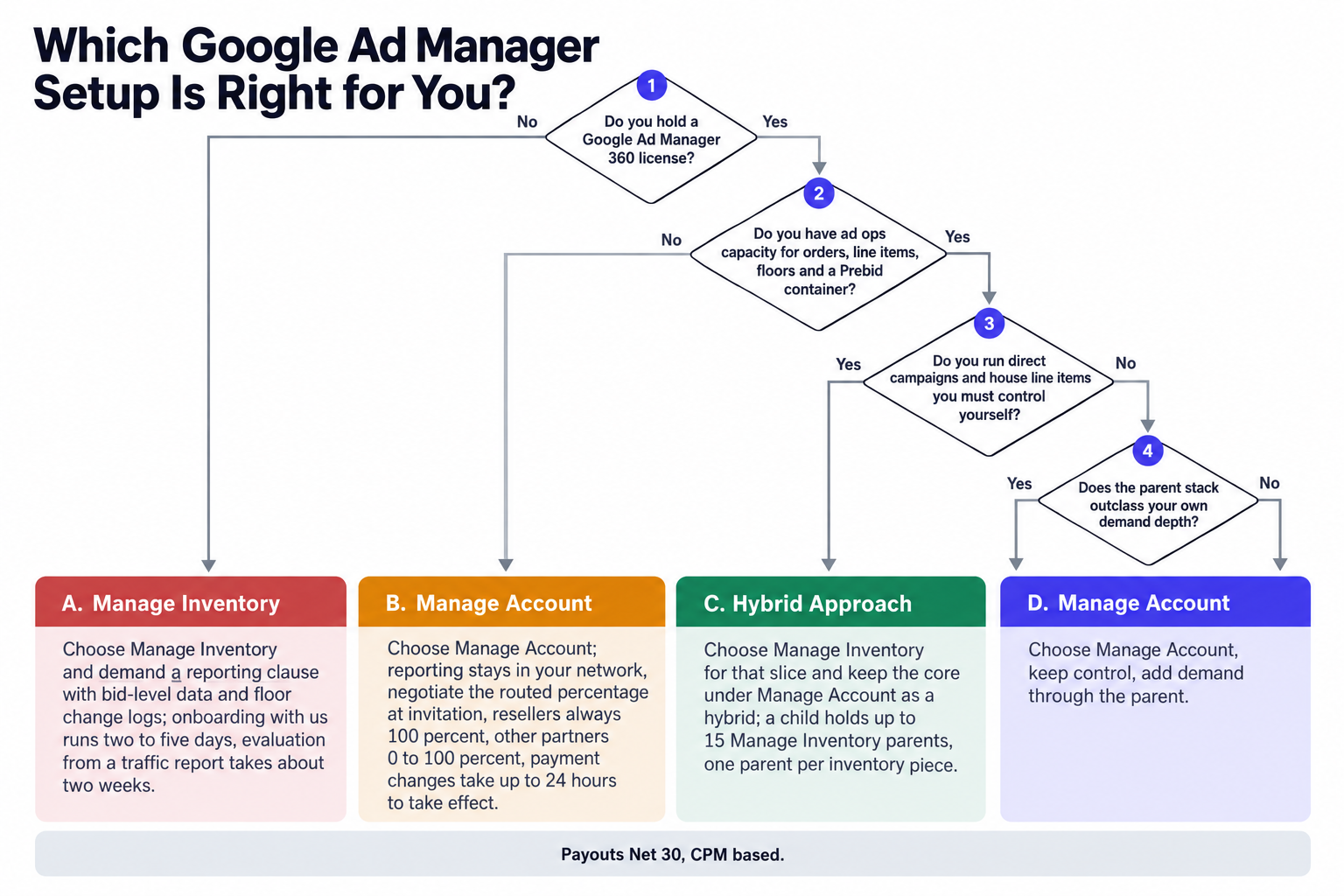
Agencies advising publishers should audit in a fixed order regardless of profile: confirm 360 license status, inventory the trafficking burden, map direct deal exposure, then price reporting access. Publishers rarely lose yield on the delegation type itself. They lose it on the reporting and payment clauses signed alongside it.
How we run both models
We are an ad network, an SSP and an agency in one company, and we work with thousands of publishers above one million pageviews. Supply side, at OnlyMedia, we run Google Ad Manager, AdX and MCM for our publisher partners, and we integrate OpenRTB 2.6 seats and Prebid for header and server-side demand. On the buy side, those impressions reach DSP seats and agency direct lines alongside SSP pathways, so demand depth never depends on one route.
Our SSP runs one unified auction per impression, with AdX via MCM, Prebid and OpenRTB seats competing in a single decision and managed floors holding the reserve. The unified auction matters most under Manage Inventory, because a single decision point means the delegated inventory competes all demand at once instead of chaining sequential hops that leak value. We pay Net 30, CPM based, no chasing, no sliding terms. And because a Manage Inventory child without fast reporting negotiates everything blind, delivery on delegated inventory shows in a ten-minute reporting console rather than a monthly export.
Questions to ask before you delegate
Eight questions, answered in writing, predict the yield outcome better than any rate sheet:
- Where does the auction physically run for each of my ad units, and which tags load on my pages?
- Who owns slot naming, targeting and viewability configuration under the proposed setup?
- Which demand sources compete per impression, and will I see bid-level data for each?
- What routed percentage applies, and who has authority to change it?
- What payout basis and net terms apply, and how quickly do payment changes take effect?
- Who maintains the ads.txt entries for the relationship, and on whose file?
- How do direct campaigns and house line items migrate, and at what trafficking latency?
- What reporting latency and granularity does the contract guarantee, and can I export raw data?
A parent that answers all eight in specifics will probably run the inventory well. Vague answers on questions four, five and eight predict the failure mode: payment drift, slow floors and a reporting gap discovered at the end of the quarter.
The yield bottom line
Neither delegation type wins in the abstract. Manage Account maximizes yield where the publisher's operations can exploit control: fast floors, an owned demand stack, native reporting, protected direct deals. Manage Inventory maximizes yield where the parent's stack outclasses what the publisher could build: deeper auction, managed floors, zero trafficking burden, with a transparency contract as the price of admission. The limits frame the strategy: one Manage Account parent, up to 15 Manage Inventory parents, one parent per inventory piece. Choose the parent as carefully as the type, because under both models the parent's demand quality, reporting honesty and payment discipline end up inside the publisher's CPM.