Interactive and Playable Ads for Mobile Web: Evaluating the CPMs
Playable ads exist to answer one question before anyone installs anything: does this app deserve the tap? The pricing model follows from that origin. The buyer pays for the interaction because the interaction predicts the install, and the install carries the value. Mobile web removes the install from the end of that chain, and the CPM consequences follow directly.
State a second fact up front: no authoritative, non-vendor source publishes a CPM comparison between interactive or playable formats and standard display on mobile web. The numbers that circulate come from vendor media kits and agency case studies with unnamed inventory pools, and they do not survive a methodology check. This evaluation therefore stands on three legs: delivery mechanics, policy constraints, and buyer logic. Those legs settle whether the format deserves a slot in your inventory, and how to price it once it has one.
We are an ad network, an SSP and an agency in one company, and that shape matters for what follows. At OnlyMedia we integrate OpenRTB 2.6 seats and Prebid for header and server-side demand, and we work with thousands of publishers, each above one million monthly pageviews. From that seat, we watch the distance between how buyers talk about interactive formats and what they bid for them on mobile web. This article maps that distance and hands you a method for pricing across it.
What the format is, and where it runs
Interactive ads are rich media units the user manipulates: tap to reveal, drag, swipe, spin, scratch, vote. Playables are the subset with a working preview inside, a self-contained HTML5 bundle that lets the user try a slice of the product, usually an app's core loop, before any commitment. Both descend from rich media, and both inherit rich media's core dependency: the ad container has to cooperate.
In-app, that cooperation comes from MRAID, the Mobile Rich Media Ad Interface Definitions, the IAB Tech Lab standard that lets rich media ads, including interactive and expandable formats, communicate with mobile apps through a common API. MRAID 3.0 is the current generation. The standard hands the creative a set of events and controls: when the ad enters view, when it expands, when the app moves it to the background.
On mobile web, interactive formats run as HTML5 in the browser, without MRAID. There is no container API, so the creative manages its own state and its own expansion inside the page's layout rules. No app attests to anything, so measurement falls back on browser viewability APIs and in-creative tracking. The host page's scroll behavior, viewport, and render budget bound what the unit can do. The creative files look alike across the two environments; the products do not.
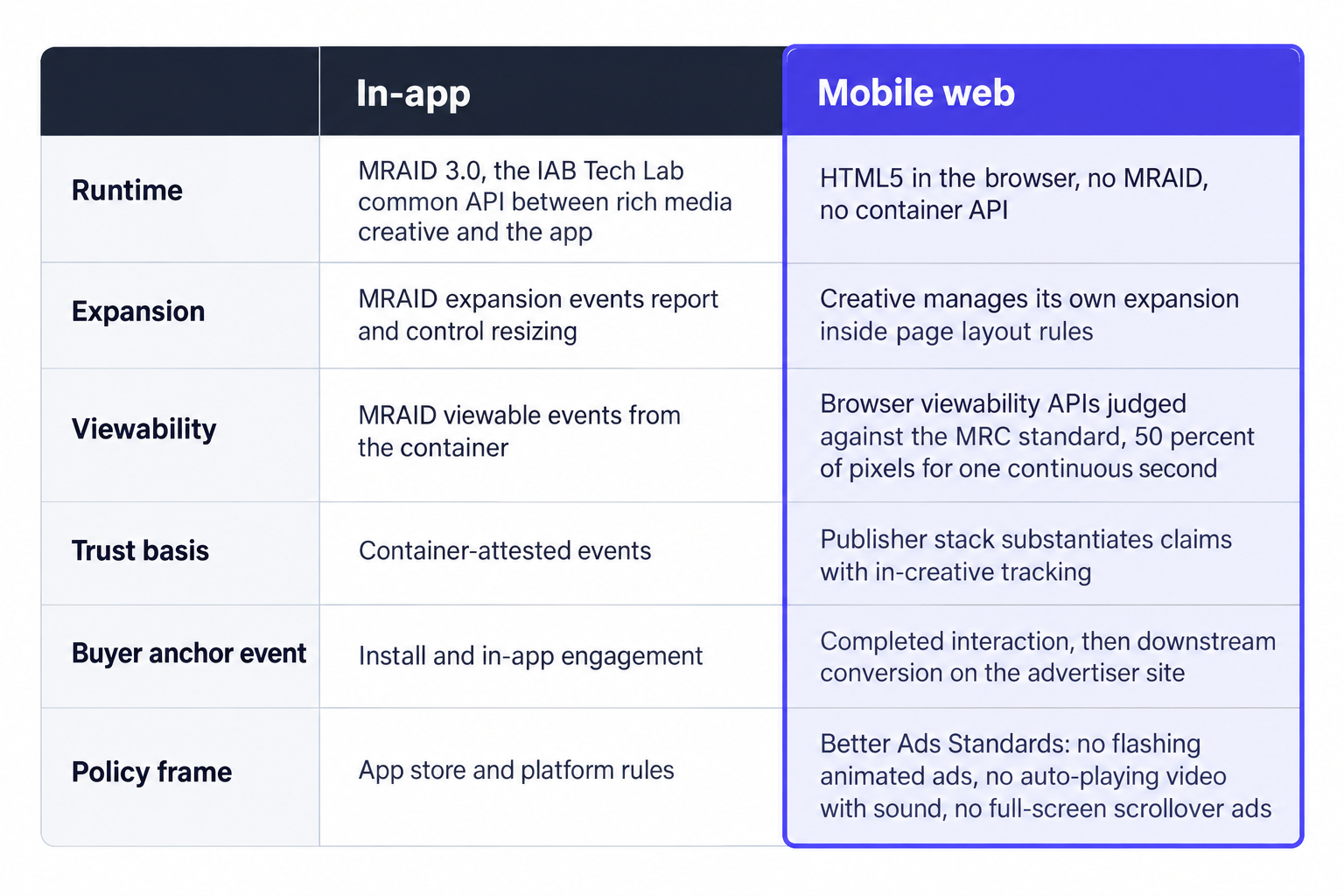
That difference is the first thing to price. An in-app interactive unit ships with container-attested events, which supports buyer confidence and stronger bids. A mobile web interactive unit ships with claims that your stack has to substantiate. Closing that trust gap with measurement is the publisher's job, and most of the format's economics sit inside it.
The CPM data gap, stated plainly
The gap persists for structural reasons, not because nobody got around to measuring. First, definitions blur: interactive, playable, rewarded, expandable, and gamified overlap heavily in vendor taxonomy, so any sample mixes units with different interaction models and different anchor events. Second, most playable transaction volume concentrates in app-install campaigns priced on cost per install. The format's native buyer does not shop for mobile web impressions, so a mobile web CPM comparison barely exists as a standing trade.
Any CPM premium quoted for playables on mobile web deserves three questions before it informs a decision: measured against what control, on whose inventory, priced against which anchor event? When the answers are internal, unaudited, and install, the number does not transfer to your inventory. Benchmark against your own controlled test instead. This article quotes no premium for the same reason no auditable source will.
One framing point, because it changes how you read your own reporting: the auction prices impressions, while buyers manage outcomes. The CPM in your dashboard is a derived artifact of the buyer's outcome math, not their decision variable. To evaluate the format, reason at the level where the buyer decides.
How buyers actually price an interaction
A performance buyer with a target cost per completed interaction starts from a ceiling bid per impression: ceiling equals target cost per completed interaction times the predicted probability that this impression ends in a completed interaction. That probability folds in the placement's historical interaction rate, the chance the impression becomes viewable, the creative's policy fit, and audience and device signals. In a first-price header auction the buyer shades below the ceiling, and the shaded number lands in your reporting as a CPM.
The formula explains most of what publishers find counterintuitive about interactive pricing. Two placements with identical traffic can clear different CPMs for the same creative, because predicted interaction rate differs and the buyer's ceiling moves with it. A unit that renders late or below the fold suppresses the viewability term and takes the bid down with it. A placement with logged completion history raises the probability term and the bid together.
The demand that prices playables with the most confidence is app-install demand. Google's App campaigns accept HTML5 and playable assets because they capture attention by letting users interact before installing: the interaction pre-qualifies the install, so the buyer pays more per engaged user and still hits a target cost per install. Note the anchor event at the end of that chain: install. On mobile web, the same creative class serves brand and performance buyers whose anchor is engagement plus downstream conversion on the advertiser's own site. That anchor sits further from the ad, so the same interaction is worth less at bid time, and the bid reflects it.
Brand buyers run the same shape of math with different inputs: verified audiences, curated supply paths, and engagement quality as the gate. Buyers who work this way can find that inventory through our demand side reach, which pairs verified audiences with curated supply paths and OpenRTB 2.6 buying. For you as a publisher, the actionable version is short: your interaction and completion data is the asset buyers price. Sell with it visible.
The measurement contract: viewability, interaction, completion
In-app, interactive formats depend on the MRAID viewable and expansion events: the container reports when the ad entered view and when it expanded, and buyers treat those events as attested. On mobile web, the equivalents are browser viewability APIs and the MRC display standard, which counts an impression as viewable at 50 percent of pixels for one continuous second. IntersectionObserver is the browser primitive behind most implementations of that measurement.
The operational consequences follow directly. If your interactive unit lazy-renders or expands below the fold, buyer measurement will not credit the impression, and the next bid reflects the shortfall. If your stack cannot report interaction rate and completion rate, you are selling the format as an oddly heavy banner, and it will price like one.
The user opts into the interaction, and that is the core trade: the format gives up interruption and buys attention that chose to engage. This is why buyers value completed interactions over raw impressions, and why measurement for these formats centers on interaction and completion rates rather than CPM alone. The event set to log per impression is short and non-negotiable: viewable impression per the MRC definition, interaction start, interaction complete, engaged seconds, secondary click. Pipe every field into the reporting the buyer sees. Each one either raises the bid or explains a low one.
Policy boundaries that cap the design
The Better Ads Standards set hard edges on mobile web, and interactive formats must respect them. The standards prohibit flashing animated ads, auto-playing video ads with sound, and full-screen scrollover ads. Translate that into three QA rules: sound plays only after a user tap, nothing flashes or strobes, and no scroll event forces a full-screen takeover. Expansion follows the same logic as the rest of the format: the user initiates it, or it does not happen.
The opt-in constraint is not a performance ceiling. It is the product. Interruption formats buy reach; interactive formats buy attention that chose to engage. Rewarded-style placements on mobile web work on the same principle, an explicit reward for a chosen ad. Policy and product point in the same direction here, which is rare, and it means compliant creative and good creative converge on the same design.
The sound gate deserves special attention because playables want audio. A demo built to lead with sound does not port cleanly to mobile web, so the creative needs a silent opening that earns the tap: captions, visual cues, motion that signals what the interaction does. Buyers who solve this well separate themselves in the bid stream for exactly the reason the formula predicts, higher completed interaction probability, higher ceiling.
Price the session, not the slot
Interactive placements earn their keep at moments with low banner opportunity cost: the end of an article, between game levels, ahead of gated content. A lower CPM on such a slot can still lift session revenue when the slot previously earned close to nothing. The reverse also holds: an interactive unit planted mid-feed consumes attention that the following slots needed, and the damage appears as shallower scroll in the holdout, not in the slot's own CPM.
So run the accounting at session level. Revenue per mille sessions is the primary number, with scroll depth, pages per session, and return frequency as guardrails. Read the slot's CPM only after those figures settle the question of whether the format helps overall.
Frequency needs a cap because interaction is a scarce good. The same user completing the same demo five times is worth less each time, and the buyer's model knows that before you do. One interactive moment per session is a defensible starting cap to test. Density follows the same logic: value-exchange moments dilute fast, and a second one in the same session rarely pays for itself.
An evaluation you can run in one quarter
The format earns or loses its slot in a controlled test, and the test fits inside a quarter if the plumbing exists. The sequence below is the one we run with publishers in this situation. Adapt the window to your traffic, not the order of the steps.
- Fix definitions before anything renders. Interaction means a user-initiated gesture that opens the format's core experience. Completion means the creative's terminal event, such as demo finished or reward claimed. Write both down, because every later number depends on them.
- Gate creative at QA. The HTML5 bundle must render on real devices, manage its own expansion without MRAID, hold sound behind the first tap, avoid flashing, and avoid scroll-triggered full-screen takeovers. Track payload weight and render time as guardrails.
- Wire measurement. Fire the impression with viewability aligned to the MRC standard through browser viewability APIs, then log interaction start, completion, and engaged seconds, and expose all of it in buyer-facing reporting.
- Set the auction up for the format. Give it a dedicated ad unit and targeting key, set floors from engagement history rather than banner comparables, and start in private marketplace deals where the buyer can see your interaction reporting before you widen to the open exchange.
- Test at session level. Run a holdout by session or user for a fixed window of four to six weeks, and pre-register the metrics: revenue per session, interaction rate, completion rate, scroll depth, return visits.
- Decide on session revenue, not slot CPM. Scale if revenue per session rises and the guardrails hold. Re-place or kill if the CPM looks healthy while the session does not.
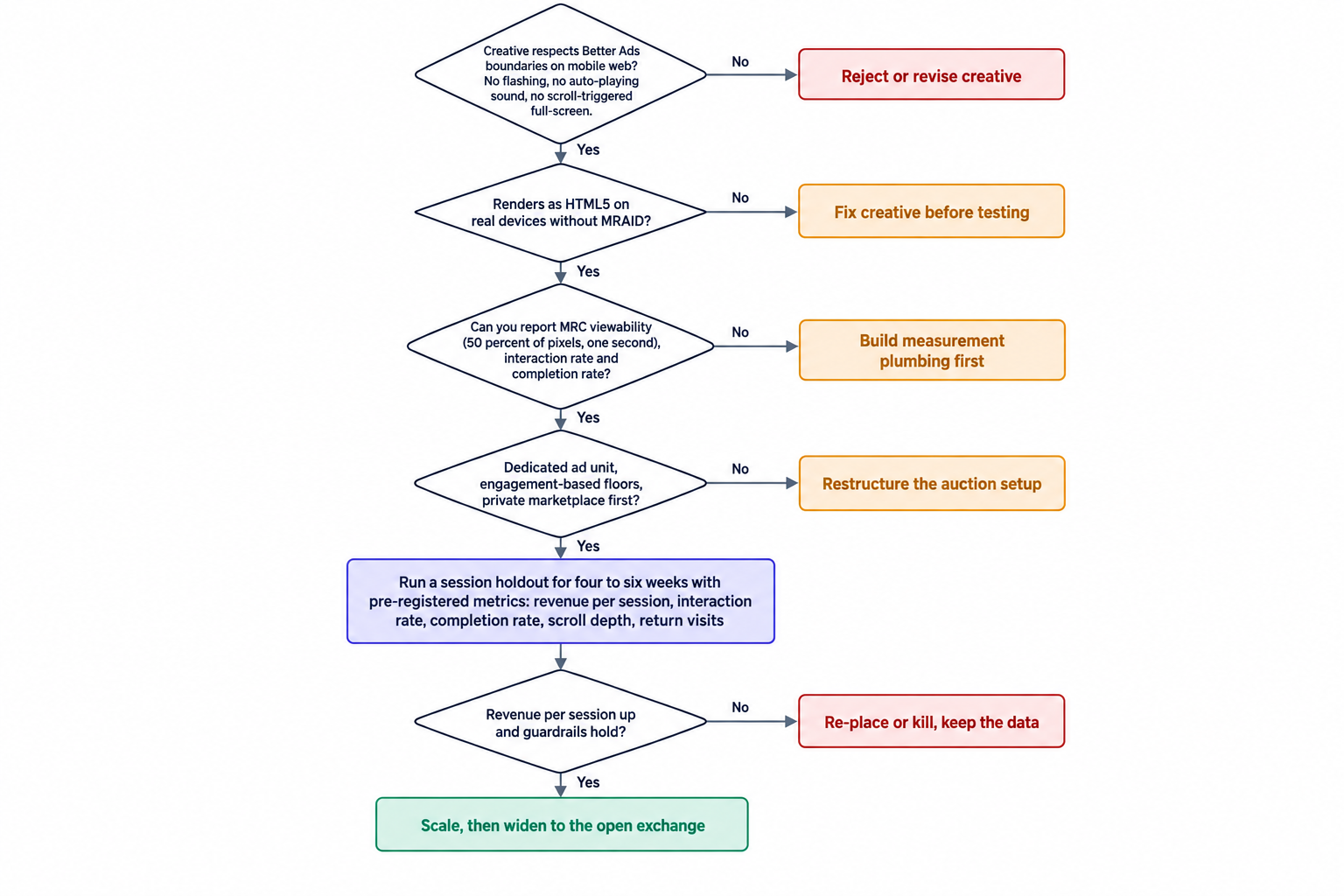
One caution on step four, from repeated experience: floors lifted from banner comparables systematically underprice interactive inventory, because the banner comp carries no interaction term. Derive the floor from what a completed interaction is worth to the buyer, then let the open market argue with it.
Where the format belongs in the portfolio
Interactive units are a complement, not a replacement. The base portfolio still needs every IAB display size plus in-stream, out-stream, interstitial and CTV video, and interactive placements should earn their slots against that base rather than instead of it. Publishers who operate both environments should also split the evaluation: mobile web interactive is HTML5 in the browser, in-app interactive rides MRAID 3.0 with container-attested events. Our mobile web and in-app format coverage, from interstitials and rewarded video to device-level reporting, tells you which environment should carry the format before you commit inventory to it.
Two operational notes on running the test. First, the evaluation has a cost, so track who carries it: creative QA time, measurement plumbing, and a holdout that deliberately withholds a monetization moment. Second, payout terms should not be the variable you watch while you test. OnlyMedia pays Net 30, CPM based, no chasing and no sliding terms, through our curated demand network.
The honest answer on CPMs for interactive and playable formats on mobile web is a method, not a number, because no auditable number exists. Ask any quoted premium for its denominator, its inventory pool, and its anchor event. Then run the session holdout, and let revenue per session settle the question. The format can outperform a banner comparison on mobile web where measurement, policy and placement line up, and the only proof that matters is the one your own inventory produces.