How to Rapidly Recover from a Google Publisher Policy Violation
Disabled ad serving stops every advertisement on the affected property, not only the page Google cited, and the fix-by date attached to a Policy Center warning starts counting the moment the enforcement lands. At one million monthly pageviews and above, a week of blocked serving takes a full week of revenue with it, and the recovery clock rarely respects your release schedule. Handle a policy violation the way you handle a production incident: classify the enforcement within the hour, audit the whole property, fix everything, request a review per site, and then harden the stack so the same trigger does not fire twice.
Read the enforcement before you touch anything
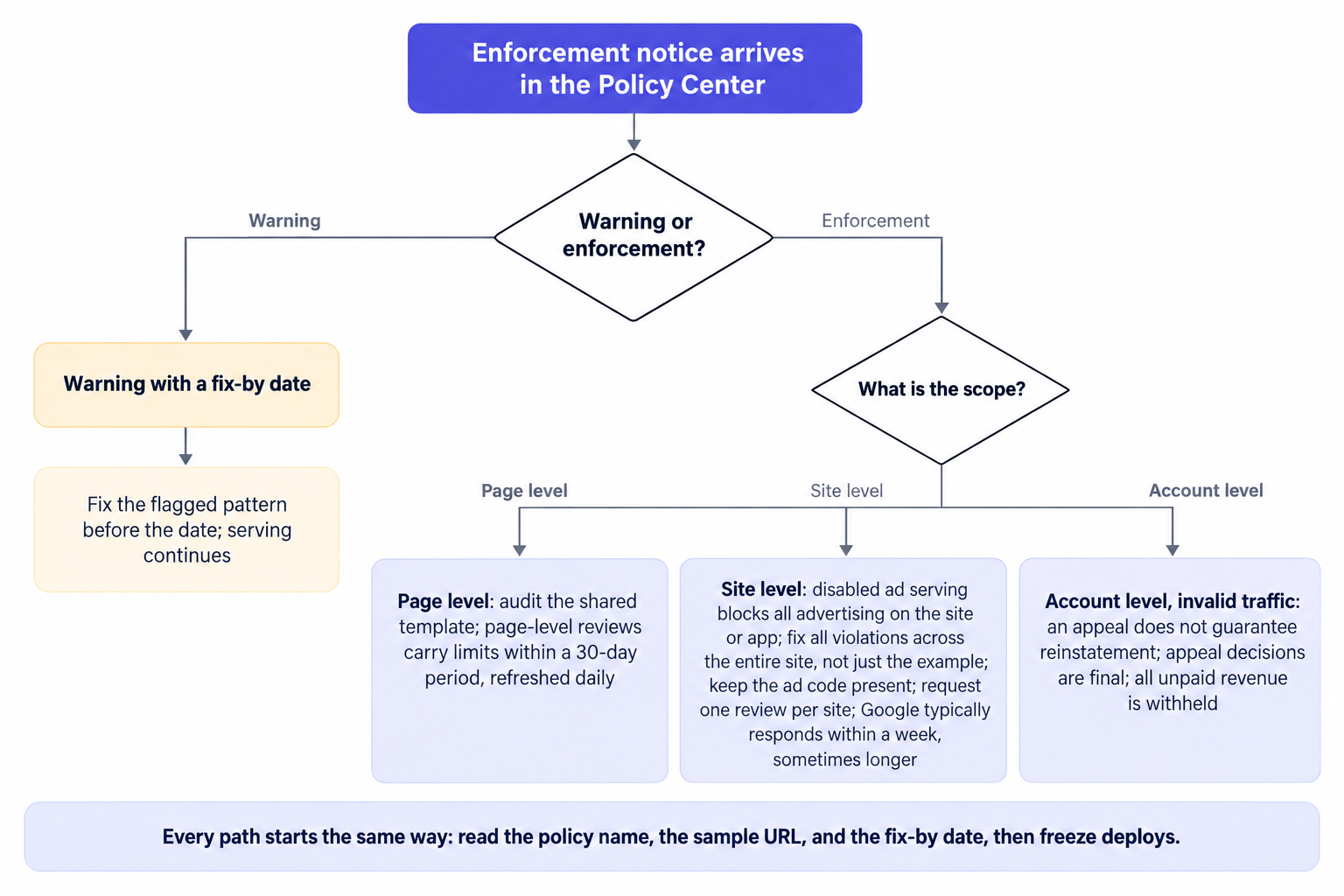
A violation of Google's program policies can result in ad serving restrictions, disabled ad serving, account suspension, or account termination. For policy issues, enforcement takes one of two serving states: either disabled ad serving or restricted ad serving. Restricted serving keeps ads flowing but narrows what can serve, so it often surfaces first as an unexplained revenue dip before anyone opens the Policy Center. Disabled ad serving blocks all advertising on the site or app, so it announces itself in that day's reporting immediately.
The Policy Center also lists regulatory issues separately from policy issues, and both can affect serving, so read the issue type before you assume a cause. Google's reference on policy and ad serving statuses covers the full set of enforcement states, and everyone on the monetization team should know it cold.
Warnings behave differently from full enforcement. A Policy Center warning carries a fix-by date: resolve the flagged issue before that date and serving continues; miss it and enforcement follows. Treat the fix-by date as a hard release deadline, because the difference between a warning and disabled ad serving is the difference between a maintenance task and a revenue outage.
Triage in the first hour
Resist the impulse to start deleting pages the moment the notification arrives. A misdiagnosis at hour zero costs days later: you fix the wrong thing, request a review, and burn one of a limited number of attempts. Spend the first hour on five actions.
- Read the exact policy name, the sample URL, and the fix-by date in the Policy Center.
- Establish the scope: page level, site level, or account level.
- Classify the category: content policy, ad placement policy, invalid traffic, or regulatory.
- Freeze deploys on content and ad configuration so nobody widens the violation or overwrites evidence while you investigate.
- Pull 30 days of traffic and revenue by page template, and flag every template that shares structure with the sample URL.
The sample URL is an example, not a boundary. Google selects one representative page, and the same defect almost always lives across an entire template, section, or content source. Your audit scope follows the pattern, not the link.
Where violations actually come from at scale
Above one million monthly pageviews, violations rarely come from deliberate fraud. They come from scale: a UGC section that outgrew its moderation, a syndication partner that quietly changed output quality, a redesign that pushed ad density past the content, a growth campaign that bought low quality traffic. Five categories cover most enforcement actions we see across the publishers we work with.
- Content policy hits: adult, violent, or dangerous material appearing in comments, forums, user uploads, or syndicated feeds that publish without editorial review.
- Made for advertising signals: pages where ads outweigh content, thin articles wrapped in aggressive layouts, galleries that paginate a single image, tag pages with no editorial value.
- Ad placement violations: ads on error, login, or exit pages; units adjacent to buttons and menus that invite accidental clicks; sticky ad implementations outside policy limits; auto-refresh without a defensible cadence.
- Invalid traffic: bot sessions, incentivized clicks, and purchased traffic that inflates impressions or interactions without human intent.
- Regulatory issues: missing or broken consent flows for regions that require them, which the Policy Center tracks separately from policy issues.
We work with thousands of publishers, each above one million monthly pageviews, and the pattern holds at every size: the violation traces back to a pipeline that grew faster than its controls. The problem is rarely malicious; it is structural.
Each category also has a different owner, and part of triage is routing the fix to the right desk. Content policy hits belong to editorial. Placement violations belong to ad operations, and they usually enter through a redesign or an A/B test that nobody ran past a policy check. Invalid traffic belongs to whoever buys traffic, which at many publishers means the growth team, a group that rarely opens the Policy Center. Regulatory issues belong to legal or privacy engineering. When the violation lands on ad ops by default, ad ops becomes the coordinator rather than the fixer, and the recovery moves only as fast as the slowest owner.
That mapping tells you where to audit first. Rank your content sources by growth rate and by editorial oversight, and start where growth runs high and oversight runs thin.
Audit the property, not the example
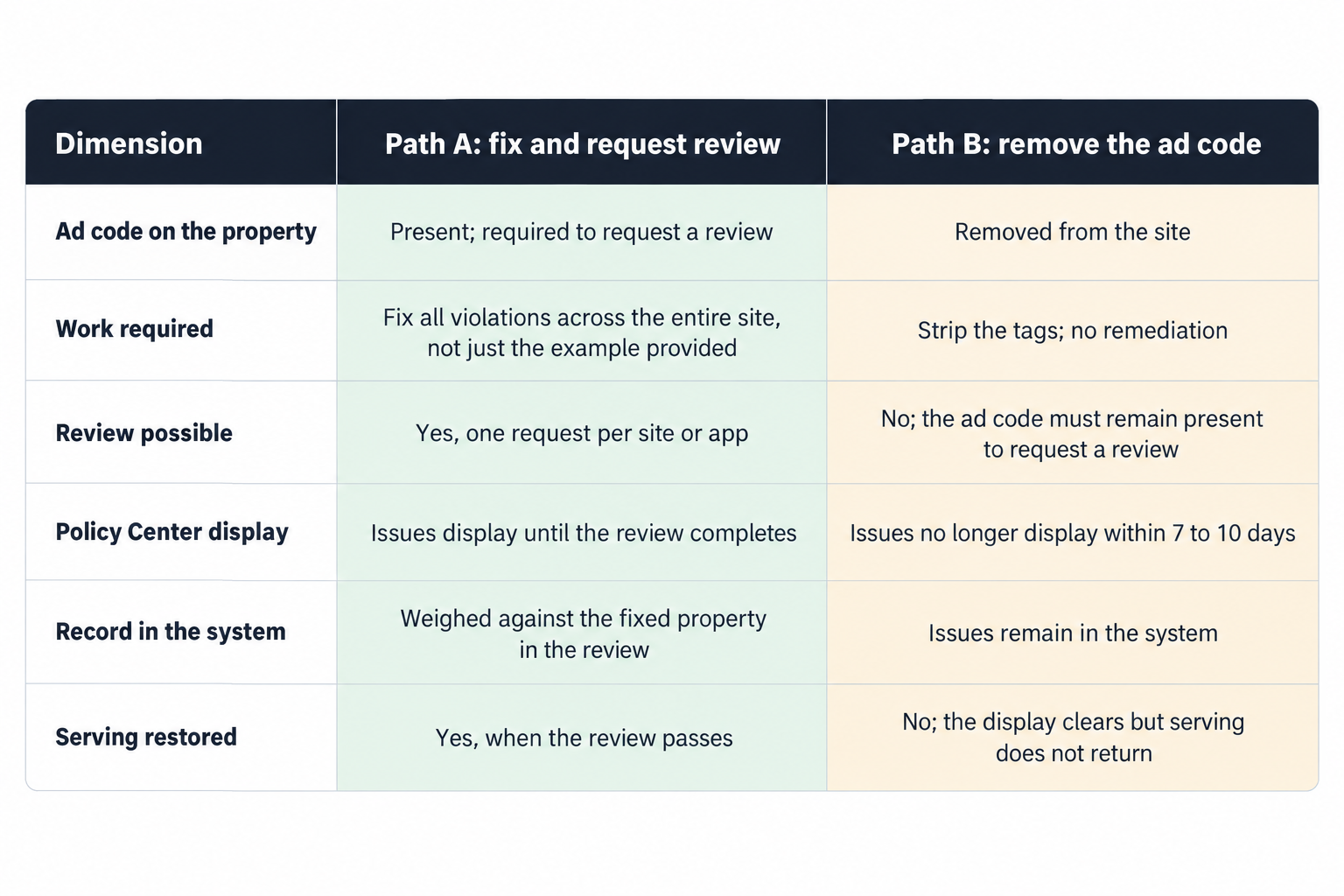
The single most common recovery mistake: fixing only the sample URL. Google's guidance for disabled ad serving is explicit on this point: you must address and fix all violations across the entire site, not just the example provided, before requesting a review, and the ad code must remain present on the site when requesting the review. Both halves of that sentence carry operational weight.
The first half turns a single URL fix into a full property audit. Build a URL inventory from your sitemap and CMS, group it by template, then test the flagged defect against every group that shares the sample page's structure. When you find the defect in one section, fix or remove the whole section, because reviewers sample more than the original page before they approve.
Make the audit mechanical rather than subjective. Query the CMS for every page built on the flagged template, export the list, and diff it against the sitemap so nothing hides in orphaned sections. Search the content store for the specific signals named in the violation notice, from entity types to media formats to placement patterns. Check cached and syndicated copies, because a violation can persist on pages that no longer appear in navigation but still take traffic from search and social. Then re-run the same checks on any property that shares the CMS, the theme, or the syndication contracts, because Google reviews each site separately and the defect rarely respects property boundaries.
Document everything as you go. Log the URL, the issue, the fix, and a timestamp for every action; if the first review rejects, that log becomes the evidence pack for the next attempt.
The second half of Google's requirement catches teams off guard. Some publishers rip out the ad code while they remediate, on the theory that no ads means no new violations. The review process needs the code in place to verify the corrected state, so removing it stalls the recovery and wastes the fix-by window. Leave the tags where they are, fix around them, and request the review with the serving code intact.
Request the review: mechanics, limits, and pacing
Once the fixes are live, request the review through the Policy Center review workflow. You request reviews per site or per app, and the Policy Center shows the enforcement and the review action for each property. The mechanics matter as much as the fixes, so learn them before you submit anything.
- The review button goes inactive after several recent rejections. Every rejection is diagnostic data: read the stated reason, fix the gap it points to, and only then submit again.
- Page-level reviews carry limits within a 30-day period, and the allowance refreshes daily, so pace page-level submissions instead of firing them in a burst.
- Google typically responds to a review request within a week, but sometimes longer, so build the revenue plan around a window that can stretch past seven days.
There is a second path, and it is a trap in most cases. If you remove the ad code from the site instead of fixing and reviewing, policy issues no longer display in the Policy Center within 7 to 10 days, but they remain in the system. The console clears; the record does not. You also forfeit the review path entirely, because the ad code must remain present when you request a review. Removal only makes sense when you are decommissioning a property or re-platforming it from scratch. As a recovery strategy it is cosmetic, and cosmetics do not restore serving.
The waiting week is not dead time. Watch serving closely from the first hour after submission, because a shift from disabled to restricted serving tells you the review is moving. Keep the evidence log current, capture screenshots of the corrected pages, and hold the deploy freeze until the review closes, because a mid-review change to the flagged template can reset progress. If the window stretches past a week, as it sometimes does, wait it out; response time sits on Google's side, and impatience does not move it.
Invalid traffic at the account level: the terminal case
Account-level enforcement for invalid traffic follows different rules, and you should understand them before you ever need them. An appeal does not guarantee reinstatement. Appeal decisions are final. And when Google disables an account for invalid traffic, it withholds all unpaid revenue, which converts a traffic quality problem into a balance sheet event.
Prevention therefore pays better than any appeal. Watch click through rate (CTR) and session quality daily, because a CTR spike on flat sessions signals bots rather than engagement. Run detection that classifies traffic against the IAB Tech Lab categories for general invalid traffic (GIVT) and sophisticated invalid traffic (SIVT), and treat any sustained rise in either as an incident. Audit every traffic acquisition campaign for source transparency, and cut anything that cannot name its supply. If you run affiliate or incentivized mechanics anywhere near ad-supported pages, wall them off from the ad inventory. The publishers who survive invalid traffic enforcement caught the anomaly within days of it appearing, not weeks after the appeal deadline.
Cover the gap, then reduce the concentration
Enforcement exposes concentration risk more sharply than any quarterly review can. When one demand path pauses on a property with loyal, returning traffic, the traffic keeps arriving and the impressions keep existing; only the monetization stops. Two moves follow, in strict order.
First, fix the violation. No alternative demand path substitutes for compliance, and stacking new tags onto a property that still carries the defect invites the same enforcement on the new path. Second, once the property is clean, build so that no single enforcement decision can zero out revenue again. This is where we operate: at OnlyMedia, we run an ad network, an SSP and an agency in one company, we work with thousands of publishers above one million monthly pageviews, and we pay Net 30, CPM based, no chasing, no sliding terms. A curated programmatic demand network alongside your primary stack keeps impressions monetized when one path restricts, and it gives your agency a second, independent read on what the violation actually cost.
Agencies advising publishers through this should deliver three things in the first 48 hours: an independent audit of the flagged pattern across the property, a written fix log the publisher can attach to the review, and a revenue bridge that quantifies the gap while serving sits dark. The third item matters most in the board conversation, because it reframes the event from a policy embarrassment into a measurable operational loss with a recovery plan attached.
The arithmetic is blunt: a property with two independent demand paths keeps revenue flowing on the second when the first restricts. Recovery time then stops being the only variable that matters.
Prevention: the controls that keep you out of the Policy Center
The cheapest violation is the one that never triggers. Four controls carry most of the weight.
- Editorial gates on every unreviewed content source: moderation queues for UGC and comments, contractual quality clauses for syndication partners, and a human sign off before any new section goes live with ads.
- Ad placement audits on a fixed schedule: walk the top templates each quarter against current placement policies, and re-test after every redesign, because redesigns are where adjacency and density defects enter.
- A curation layer in front of the auction: the one we operate at OnlyMedia applies managed floors, demand mapping, whitelists, pre-bid brand safety filtering and MFA filtering aligned with the IAB Content Taxonomy, which keeps curated campaigns away from the page types that attract enforcement. Our pre-bid screening on every impression page details how the MFA filtering works.
- Monitoring that catches anomalies before Google does: a reporting surface you check daily, with alerts on CTR, session quality, and the ratio of impressions to sessions.
On monitoring, speed decides the outcome. Our publisher monetization stack includes a ten-minute reporting console with curated demand and Net 30 payments, and that console exists for exactly this failure mode: you see an invalid traffic pattern in the morning report and cut its source the same day, long before it hardens into an account-level case. For EEA traffic, test the consent flow directly on every release rather than trusting tag defaults, because a broken consent string is a common regulatory trigger and one of the cheapest to catch.
When an enforcement notice does land, escalate it the same day through publisher and partner support on every channel you have, ours included. Support teams have seen your exact violation before, and they can tell you which fix pattern reviewers accepted on properties shaped like yours.
The runbook, compressed
A clean recovery follows a fixed timeline. Print it, adapt the day numbers to your fix-by date, and assign each line an owner before the next enforcement lands.
- Hour 0 to 1: triage the enforcement, freeze deploys, snapshot the ad configuration, and pull template-level reporting.
- Day 0: run the full property audit against the flagged pattern; fix or remove every affected template; log every action.
- Day 1: verify the fixes in production, confirm the ad code remains present, and assemble the evidence log.
- Day 2: request the review per site in the Policy Center, once, with the complete fix behind it.
- Day 3 to 10: Google typically responds within a week, sometimes longer; monitor serving daily and plan revenue around the stretch.
- On rejection: read the stated reason, fix the specific gap, and resubmit with care, because the review button goes inactive after several recent rejections and page-level reviews stay limited within a 30-day period, refreshed daily.
The publishers who recover fastest share one habit: they treat the Policy Center as a monitored surface, not a mailbox. The fix-by date, the review button, the 30-day limits, and the 7 to 10 day display window all sit in plain sight before enforcement ever lands, and a team that knows those mechanics in advance never spends its first day discovering them.