How Bid Shading Impacts Header Bidding Revenue (And How to Fight Back)
In a first-price auction the winner pays its own bid, so every buyer running a serious algorithm bids below what your impression is actually worth to it, and your clearing price becomes that buyer's forecast of its nearest rival. That mechanic re-priced the open web in 2019, when Google announced that Ad Manager would move to a unified first-price auction by the end of that year. A Google executive described the old setup as a single ad passing through a mix of over 10 different auctions, each with different rules, before one winning price finally emerged. The consolidation simplified the stack and handed every buyer a new question: how little can I bid and still win? Header bidding revenue has been answering that question ever since.
What shading does to the price you collect
Under second-price rules, honesty costs a buyer nothing. Bid your full value, win, and you pay one increment above the runner-up, so the seller captures the strength of the second-highest bidder and the winner's private valuation never enters the price. That is why second-price auctions produced truthful bids, and why publishers could read the clearing price as a market signal.
First price reverses the incentive. The winner pays exactly what it bid, so the optimal bid equals the buyer's value discounted by its probability of winning. In practice, most shading engines estimate the highest competing bid from their own win and loss history, then bid a thin margin above that estimate. Your first-price clearing price is therefore not the value of the impression. It is the winning buyer's model of your other demand, plus a sliver.
Both failure modes of that model cost you money. A buyer that shades too little wins impressions for more than the competition justified and books the difference as waste. A buyer that shades too hard loses impressions it valued above the clearing price, and the impression drops to a cheaper demand source or goes unfilled. You cannot price your way out of someone else's estimation error. You can change what the error is measured against, and that is the entire logic of floor strategy.
The evidence: a lift that lasted about five weeks
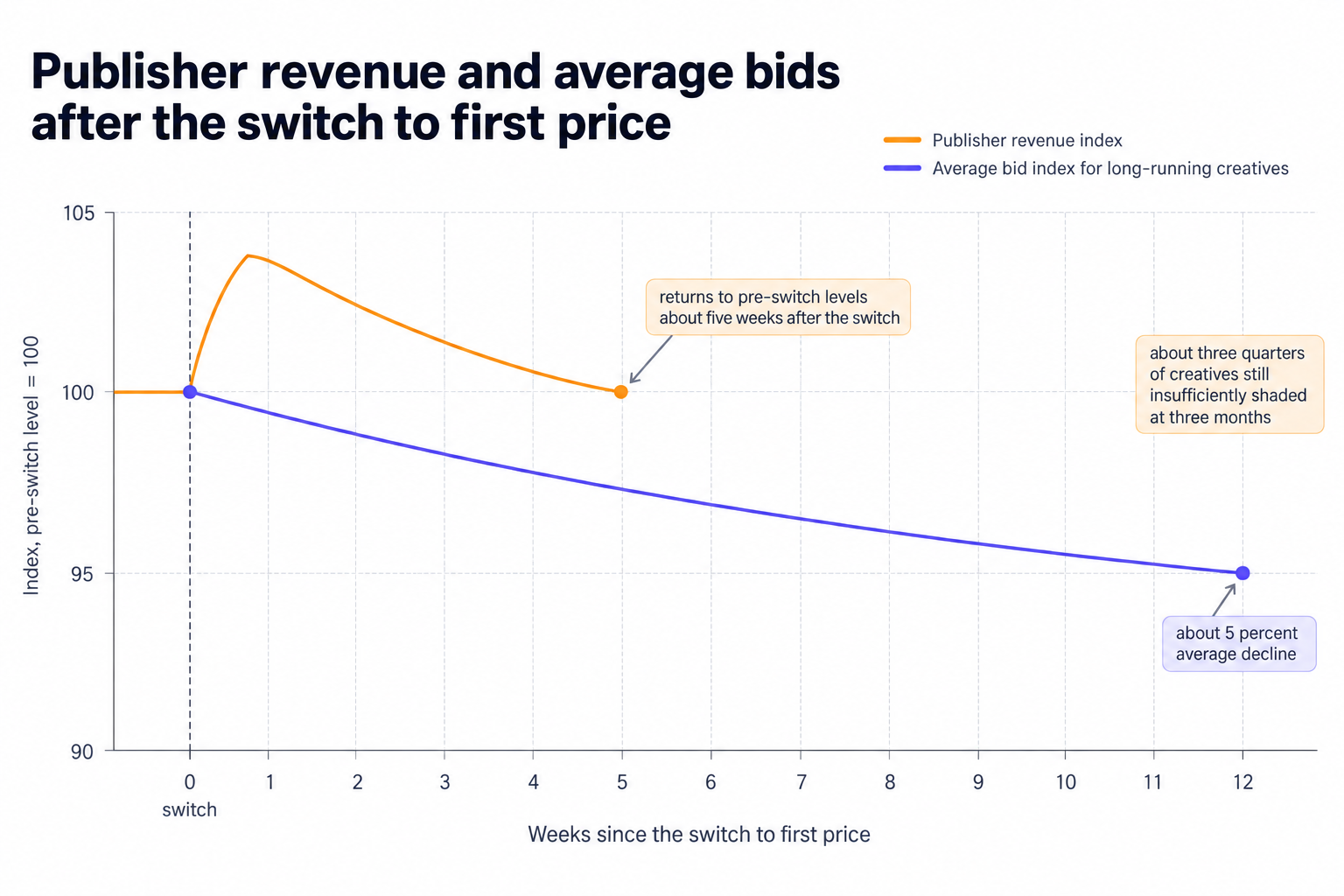
A large ad platform's early-2019 switch from second-price to first-price auctions gave researchers a natural experiment, and an academic study of the switch put numbers on what publishers felt. Publisher revenue and ad prices increased after the change, then returned to pre-switch levels about five weeks after the switch. Two bid-level findings explain the shape: bids declined for most long-running creatives, with an average decline of about 5 percent, and bids remained insufficiently shaded for about three quarters of creatives even three months after the switch.
The three findings form one story. At the moment of the switch, buyers still bid with second-price habits, close to their true values, so winners paid more than optimal first-price play requires and publisher revenue rose. As shading models retrained on live win and loss data, bids slid and the lift burned off inside roughly five weeks. And with bids for about three quarters of creatives still insufficiently shaded at the three-month mark, the learning curve had further to run, which means the downward drift continued after the study's window closed.
The operational reading matters more than the history. The post-switch lift was buyer inertia, not new demand, and any publisher that treated it as a new baseline baked a decline into the budget. The pattern repeats in miniature whenever an exchange or wrapper changes auction rules: a step change, a short windfall, then reversion as buyer models adapt.
The buyer's side of the same coin
A 2023 industry survey of 251 United States digital media buyers measured the mood on the other side of the table. The buyers estimated that bid shading will likely lead to 6.6 billion dollars in wasted advertising spend annually, 70 percent of them pay an extra fee for it, and 75 percent said the shift to first-price auctions served publishers more than advertisers. Treat those as survey estimates, not measurements: attitudes with dollar signs attached.
That sentiment predicts behavior. Buyers who believe the rules favored the seller keep funding better shading, from dedicated algorithm fees to in-house model updates, and every improvement moves the bid closer to the true second price, which is to say closer to what second-price dynamics used to pay you anyway. The five-week reversion is what that process looks like from the sell side, and the survey numbers suggest buyers still feel behind. Plan for continued drift in clearing prices, not stability.
Where header bidding fits, and where it leaks
Header bidding earned its place by fixing a visibility problem. A waterfall sold inventory to one demand source at a time, and early partners bought premium impressions at remnant prices because richer demand further down the chain never saw them. Header bidding exposes one impression to many buyers at once and sends the best bid into the ad server to compete with direct campaigns. More genuine competition raises the second-highest true value, which raises the number every shading model tries to estimate.
First-price dynamics changed what that competition is worth to you. Under first-price rules, every bidder in the header shades against its private estimate of the other header bids, and each estimate leans conservative. When several partners in one wrapper run cautious models at the same time, the winning bid can land well below the second-highest true value, and nothing in your standard reports shows the gap. Server-side header bidding moves the same competition into a server container, which helps latency but changes nothing about the shading math, because the estimates travel with the buyer. Header bidding still beats the waterfall on every metric that matters, but visible competition no longer guarantees a comparable clearing price.
Every auction layer between the buyer and your ad server compounds the discount. The buyer shades once for its own model, an intermediate platform can shave the price again inside its own auction, and the wrapper then forwards a number the market has already marked down before the ad server's unified pricing ranks it. Each layer estimates, each estimate favors the estimator, and the publisher collects what remains. That is why our SSP's unified auction runs one auction per impression, bringing AdX via MCM, Prebid and OpenRTB 2.6 seats to a single price formation point, with managed floors applied at that same point. A floor only works where the price actually forms.
Floors: the countermeasure and its trade
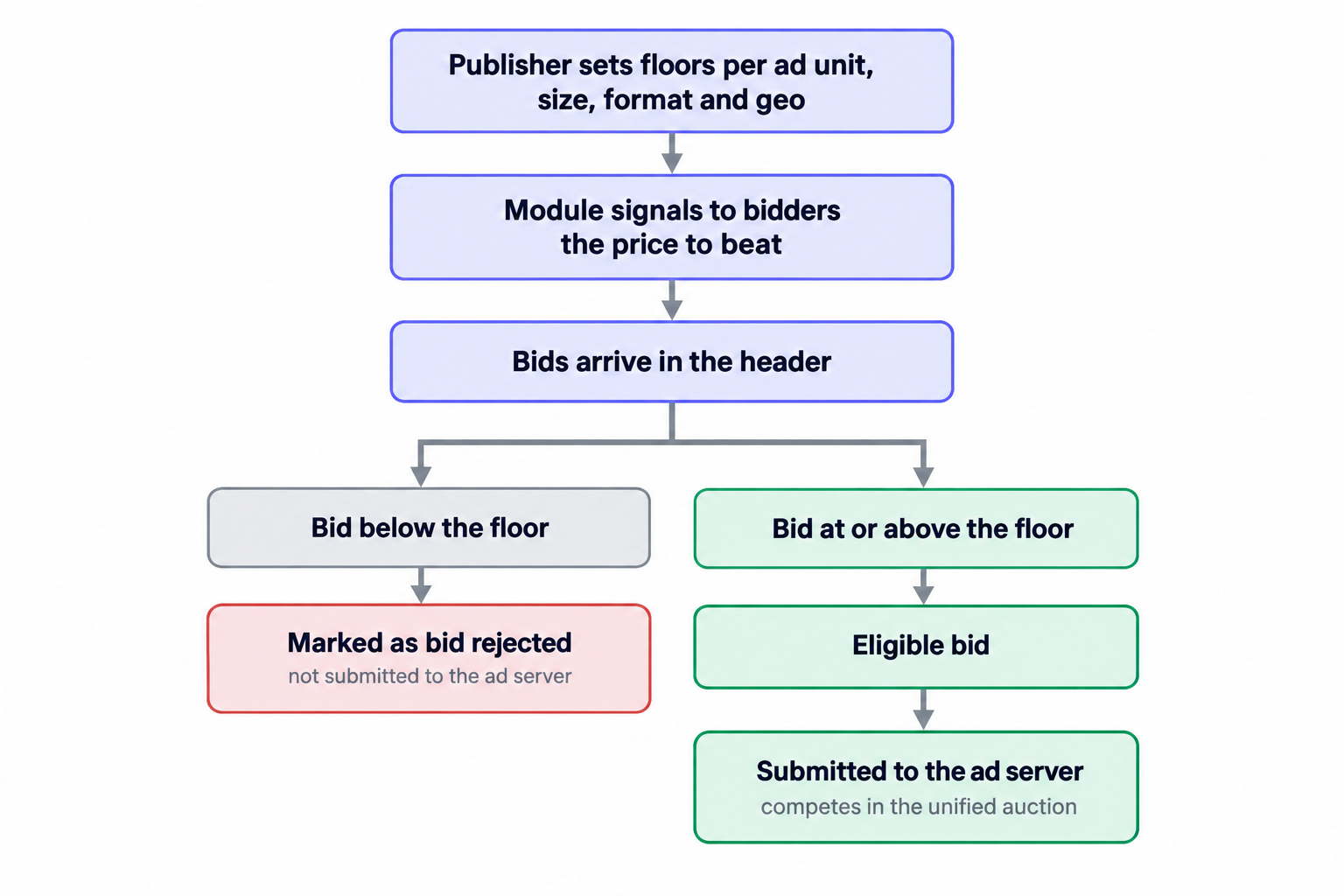
Floors are the one structural countermeasure in the sell-side toolkit, and Prebid's Price Floors Module is the documented implementation. The module signals to bidders the price to beat, which protects inventory value, and it enforces the line: it marks all bids below the floor as bids rejected while still submitting eligible bids to the ad server. Enforcement does not block the auction; it removes low estimates from the pool and lets the survivors compete normally.
Signaling changes the buyer's math in a way enforcement alone cannot. A buyer that knows your floor no longer needs a model of your other demand: it knows the minimum, and a rational buyer with value above that minimum bids near the floor and stops. Signaling converts price discovery into a published reserve, which stabilizes fill and caps the worst underbidding, at the cost of limiting what an eager buyer reveals. Enforcement without signaling keeps buyers guessing: their low estimates die at the floor and never clear. Neither mode wins everywhere, so signal where fill stability matters most, stay silent where value protection matters most, and measure each segment both ways before settling.
Once you signal, watch for the signature of anchoring. When one buyer's clearing prices cluster exactly at your floor across many impressions, that buyer has stopped estimating and started bidding to your number, which is the intended effect, but it also means the floor, not demand, now sets revenue for that segment. That is the moment to test the next increment: raise the floor where fill holds and watch whether clearing prices follow. Buyer models relearn on the scale the study measured, about five weeks, so the test cost stays low.
On the ad server side, Google's 2019 floor guidance still defines the rules of engagement. Price floor strategies created to influence the second-price closing stopped being relevant, and floors set through unified pricing rules apply to all partners equally, with an initial limit of 100 rules. Two consequences follow for floor architecture. First, retire any logic designed to manipulate a second-price close: under first price, a floor is a reserve price, nothing subtler. Second, 100 rules cannot cover every ad unit, size, geo and device combination on a large site, so spend the rule budget on the dimensions where clearing prices actually diverge.
A floor program that survives buyer learning
Floor programs fail in one predictable way: someone sets a number, revenue holds for a quarter, and the same number then quietly suppresses fill because buyer models moved underneath it. The study measured an average bid decline of about 5 percent within months of a rule change.
Buyer learning never stops, so treat floor management as a cycle rather than a setting. Run the cycle along these lines:
- Pull a month of clearing prices by ad unit, size, format, geo and buyer before changing anything. Averages hide drift at the 5 percent scale; segments expose it.
- Set floors per segment, never sitewide. One floor for an entire site either underprices the placements that carry revenue or prices the long tail out of the market.
- Decide signaling per segment. Signal where fill matters, stay silent where value matters, and give each configuration an observation window; the study's five-week reversion is a sensible minimum before judging a change.
- Refresh floors on the same cadence you refresh the baseline. Buyer models retrain continuously, and a static floor is a decaying floor.
- Watch fill, no-bid rates and rejected-bid counts after every change. Bids rejected at the floor need a landing zone, a next demand tier, a curated deal or house campaigns, so build the landing zone before raising the floor.
- Track average clearing price per buyer. A buyer whose clearing price slides month over month is retraining against your inventory, so re-floor its segments specifically instead of moving the whole book.
- Move premium packages out of the estimation game. Fixed-CPM private marketplace deals and programmatic guaranteed contracts price without reference to anyone's shading model, and they anchor the rest of the inventory.
The common thread is measurement speed. You can even reconstruct a buyer's shading curve from your own logs: bucket its bids, compute win rates per bucket, and the shape shows where its model believes your competition sits; a curve that flattens means the buyer sees a thin market for your inventory. Floors manage the downside of shading, and fast reporting decides whether you notice the downside before it compounds into a quarter's miss. On a site above one million monthly pageviews, any measurable drift in average clearing price is real money within weeks, which is why floor changes deserve same-day feedback rather than month-end reviews.
How we run it on our side of the auction
OnlyMedia is an ad network, an SSP and an agency in one company, which puts us on both sides of the shading question at once. We work with thousands of publishers, each above one million monthly pageviews, through a curated programmatic demand network, and we pay Net 30 on a CPM basis, with no chasing and no sliding terms. On the sell side, our auction ranks bids by expected value: first price with bid shading, reserve prices and goal-based pacing in a single ranking. We integrate OpenRTB 2.6 seats and Prebid for header and server-side demand, so the managed floors we apply act inside the same auction where prices form, not one hop downstream.
Because the agency side plans campaigns in the same first-price auctions, we see what shading does to clearing prices from both ends, and our ten minute reporting console shows the effect of a floor change fast enough to act on. If a raised floor starts rejecting more bids than the next tier absorbs, the console says so before the week closes, and the floor gets tuned instead of defended. That loop, set, observe, adjust, is the entire discipline.
The durable fix is the runner-up
Every shading algorithm, however sophisticated, estimates one number: the second-highest genuine willingness to pay for your impression. The countermeasures split into two families. Floors, signaling and deal types defend the minimum, putting a hard bottom under the estimate, while demand quality raises the estimate itself, because every additional genuine bidder lifts the second-highest value that buyers spend their fees guessing at. Floors bound the error; curated demand raises the number.
The study's convergence data sets the clock. Bids for about three quarters of creatives remained insufficiently shaded three months after the switch, which tells you buyer learning runs in quarters, not days. Audit your floor rules on that clock: pull clearing prices per buyer, find the segments where winning bids sit exactly at the floor, and test a higher one with the landing zone already built. Then keep adding real demand, because the only estimate no buyer can shade down is the one that keeps rising.