First-Party Data Strategy: Moving from Platform Reliance to Data Independence
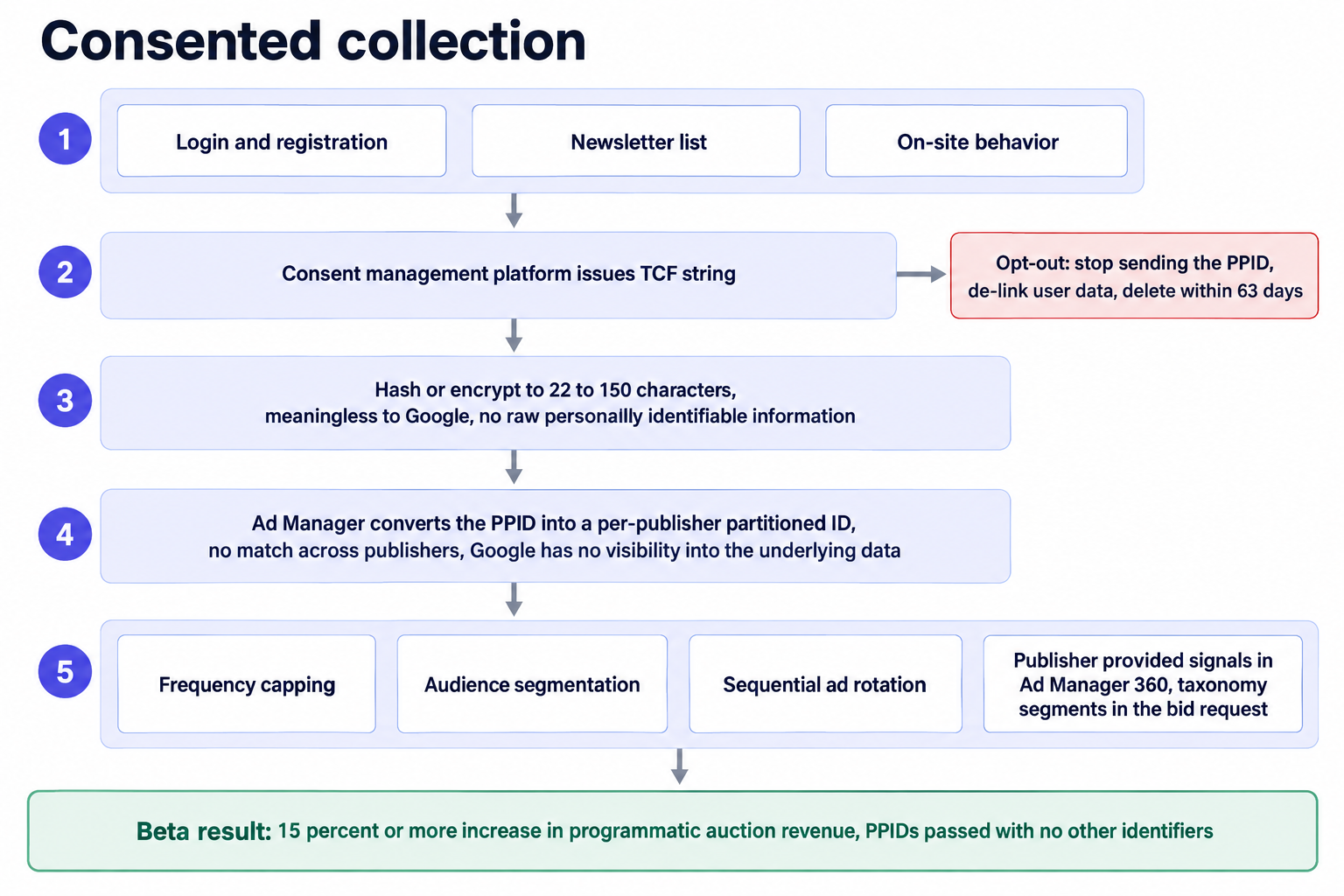
Google's beta partners recorded an increase of 15 percent or more in programmatic auction revenue when they passed publisher provided identifiers into inventory that carried no other identifiers. The programmatic first-party activation announcement that reported the figure dates from November 2021, and the mechanism behind it is unglamorous: the identifier did the work alone. A publisher above one million monthly pageviews already generates the raw material that result depends on, through logins, newsletter lists, subscription records and on-site behavior. Most of that material never reaches a bid request. The distance between the data a publisher holds and the data its auctions see is where the recoverable revenue sits.
Platform reliance is a specific technical condition, not a mood. The publisher sells inventory while a platform manufactures the audience: contextual labels, third-party segments and cookie-derived frequency data all live in the platform layer, and all of them decay as browsers restrict third-party cookies. Data independence inverts the arrangement. The publisher collects consented signals, hashes them into stable identifiers, and pushes them into every activation layer it operates: the ad server, header bidding, server-side seats and direct deals. The publisher owns the input, and every platform competes to price it.
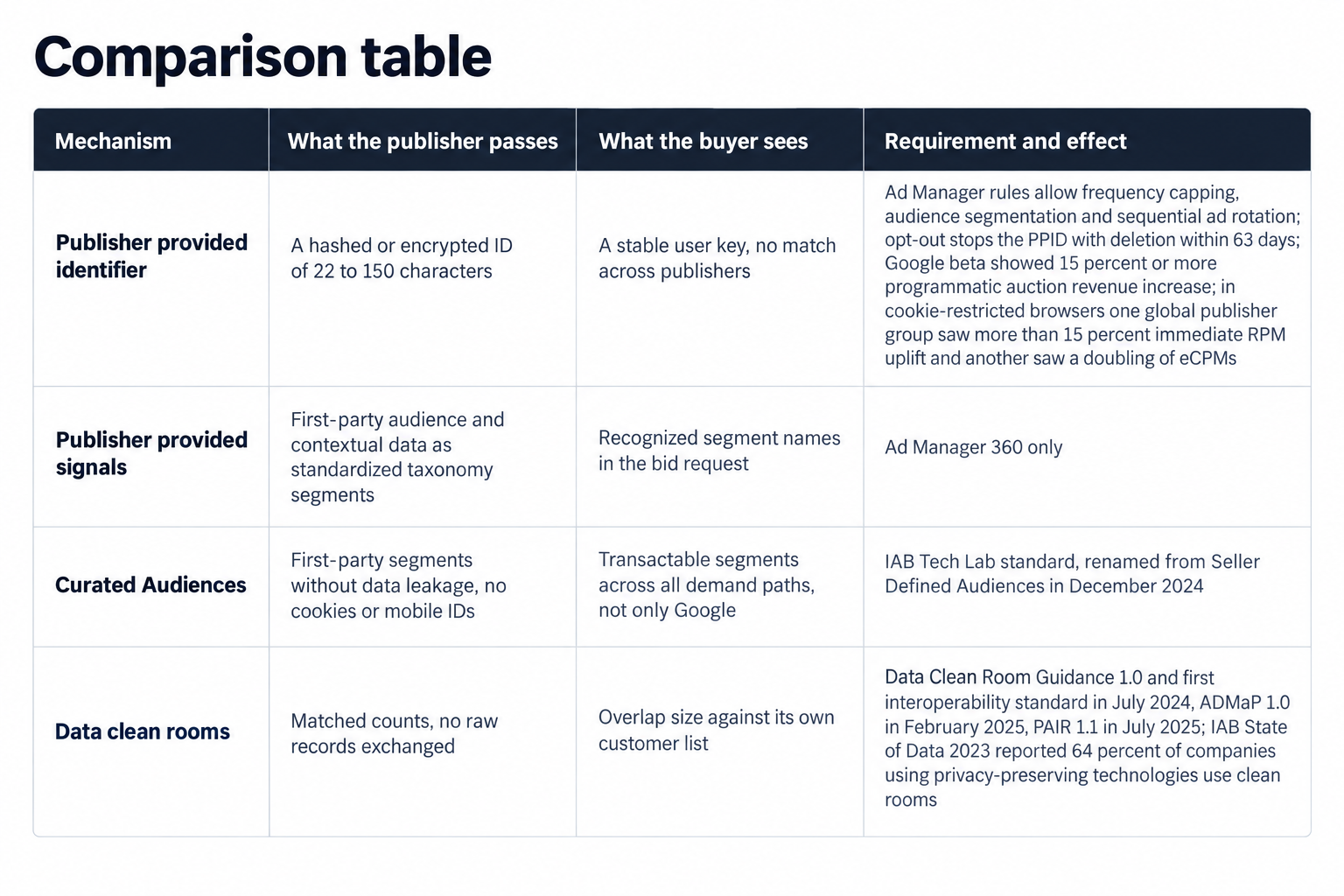
Four mechanisms carry that strategy today. Publisher provided identifiers give Google Ad Manager a user key that survives cookie loss. Publisher provided signals turn first-party audience and contextual data into standardized taxonomy segments inside bid requests, and Curated Audiences extends comparable segments across every demand path, not only Google's. Data clean rooms match a logged-in user base against a buyer's customer list without either side handing over raw records. Each mechanism has a different setup cost and a different buyer visibility, and all four leave ownership with the publisher.
The identifier layer: PPIDs done correctly
Google permits publisher provided identifiers for exactly three jobs: frequency capping, audience segmentation and sequential ad rotation. The format rules are strict and testable. A PPID runs 22 to 150 characters, and the publisher must hash or encrypt it so it reads as meaningless to Google. Raw personally identifiable information stays out of the field: no clear-text email addresses, no phone numbers, no device identifiers. The help pages on publisher provided identifiers state the allowed uses, the format and the privacy rules in plain terms, and an audit against them takes an afternoon.
The opt-out path is an operational requirement, not a policy footnote. When a user opts out, the publisher must stop sending the PPID and de-link the user's data, with deletion inside 63 days. That obligation connects three systems: the consent management platform, the ID generation service and the ad server key-values must share one kill switch, and the team must prove the 63 day window in an audit. Publishers who treat this as paperwork end up rebuilding the identifier pipeline under time pressure, with frequency caps broken in the meantime.
Choose the hash input for stability, not convenience. A keyed hash over the account ID keeps a returning user on the same PPID across sessions and password resets, which is exactly what frequency capping needs. A rotating salt or a per-session identifier resets every cap and shrinks every segment, so pin the salt and version the input, and log the version alongside the PPID so a future migration to a new hashing scheme stays measurable rather than silent.
Inside Ad Manager, the mechanics protect the publisher by design. Ad Manager turns each PPID into a per-publisher partitioned ID, so users cannot be identified across other publishers' sites, and Google has no visibility into the underlying data. You pass an opaque string, the auction gains a stable user key, and nothing about the user travels beyond your account boundary.
The pattern holds hardest where third-party cookies no longer exist. Google has reported publisher results in cookie-restricted browsers: one global publisher group saw an immediate RPM uplift of more than 15 percent, and another publisher saw a doubling of eCPMs when PPIDs activated. In those environments the PPID is not an incremental optimization. It is the last user-level signal standing, and pricing reflects the scarcity.
Scaling signals: publisher provided signals and Curated Audiences
A PPID gives the auction a user key. It says nothing about who the user is, and buyers price what they can describe. Publisher provided signals close that gap. The feature, available only in Ad Manager 360, scales first-party audience and contextual data into standardized taxonomy segments that travel in the bid request. A buyer sees a recognized segment name rather than an opaque key, which means the buyer can plan against it, bid for it and report on it. The constraint is real: standard Ad Manager accounts do not carry publisher provided signals, so publishers on those accounts should build the identifier layer first and migrate when volume justifies Ad Manager 360.
Outside the Google stack, the sell-side standard carries the same logic further. The IAB Tech Lab renamed Seller Defined Audiences to Curated Audiences in December 2024, and the standard lets publishers and data providers scale first-party data without data leakage and without reliance on deprecated IDs. Curated Audiences does not depend on cookies or mobile advertising IDs, which is the point: the standard outlived the identifier deprecations around it because it never leaned on them. For a publisher, this taxonomy makes segments legible to every demand path at once, Google, Prebid bidders and direct buyers included.
The plumbing decision is one of consistency. The same segment should reach every demand path under the same name: publisher provided signals carry it inside Google's auction, Prebid's first-party data module carries it to header bidders, and OpenRTB 2.6 seats carry it server-side. Build the segment dictionary once, in one sheet, with source, consent basis, refresh cadence and expected volume, and generate the key-value names from it. Teams that hand-write segment names per channel end up with three spellings of the same audience, and no bidder can plan against any of them.
Clean rooms: matching without sharing
Data clean rooms answer the highest-value question a publisher faces: how many of my logged-in users overlap with this brand's customer list, and what is that overlap worth per thousand impressions. The standards work has moved quickly. IAB Tech Lab's clean room guidance and standards timeline records the sequence: Version 1.0 of the Data Clean Room Guidance and the first interoperability standard for private audience arrived in July 2024, ADMaP 1.0 followed in February 2025, and PAIR version 1.1 closed the sequence in July 2025.
Adoption is past the pilot stage. IAB's State of Data 2023 reported that 64 percent of companies using privacy-preserving technologies use data clean rooms, which means the buy side already has the pipes. For publishers the discipline is scope control. Clean rooms succeed as deal infrastructure and fail as science projects, so anchor every pilot to one advertiser, one audience and one flight: measure the overlap, then price the unmatched remainder as a guaranteed segment. A publisher indulging curiosity does not need a clean room; a publisher selling an auto-intender audience to a manufacturer at a CPM premium does.
A build order that ships
The sequence below assumes a site above one million monthly pageviews, an existing Ad Manager setup and a consent management platform already issuing TCF strings. Agencies advising publishers should sell the audit first and the roadmap second: collection points, consent coverage, identifier stability and current activation, each benchmarked against the 15 percent band. Each step produces something billable before the next step starts.
- Inventory collection points. List every source of consented first-party data: logins, newsletter opens, subscription status, purchase history, on-site reading behavior. Tag each source with its consent basis and storage location.
- Stand up ID generation. Hash a stable input with a fixed salt into a string of 22 to 150 characters, and keep the salt under publisher control so the identifier stays stable across sessions.
- Wire the kill switch. Connect the consent platform, the ID service and Ad Manager key-values so an opt-out stops PPID transmission immediately and the 63 day deletion runs on schedule.
- Activate in Ad Manager. Pass the PPID, then build what it permits: frequency capping rules, first-party audience key-values, and sequential creative rotation for sponsorship packages.
- Add taxonomy signals. In Ad Manager 360, map first-party segments into publisher provided signals so bidders see standardized segment names in the bid request.
- Mirror the signals in Prebid. Push the same segment definitions through Prebid's first-party data module so OpenRTB user.data carries identical taxonomy values to every header bidder and server-side seat.
- Package for buyers. Attach segment names to PMPs and curated deals, with a one-page data card per segment covering source, refresh cadence, size, taxonomy and consent basis.
- Measure. Track segment RPM against non-segment RPM, the share of impressions carrying a PPID, and revenue splits between cookie-restricted and unrestricted browsers.
Consent belongs in the data dictionary, not in a footnote. The identifier pipeline should read the TC string before it emits anything: no matching consent, no PPID, no segment, and the auction falls back to contextual pricing with no privacy exposure. Encode the consent basis per data source in the same sheet as the segment definitions, so an auditor can trace a segment from collection point to bid request in one document.
Steps one through three take a first sprint and protect everything downstream. Steps four through six take a day each once the plumbing exists. Step seven is where revenue concentrates, because a bidder prices a segment attached to a deal with intent, while the same segment floating in open auction competes on context alone. Step eight is the discipline that keeps the budget: report segment RPM weekly, or the program quietly becomes a cost center.
The operational layer: what we run
At OnlyMedia we sit on both sides of the transaction as an ad network, an SSP and an agency in one company, and we run this stack daily for publisher partners: Google Ad Manager, AdX and MCM on the supply side, with OpenRTB 2.6 seats and Prebid covering header and server-side demand. We work with thousands of publishers, each above one million monthly pageviews, and we pay publishers Net 30, CPM based: no chasing, no sliding terms. Our curated programmatic demand network exists for exactly that publisher class, and fixed settlement belongs in the first-party data conversation for a concrete reason. Identifier programs change revenue shape, moving dollars from open auction into curated deals, and a payment schedule that floats undermines the quarterly math that justifies the engineering.
On the publisher side, the loop from test to read has to be short. The publisher monetization setup we run pairs curated demand and Net 30 payments with a ten minute reporting console, so a new segment shows its RPM the week you ship it, not after the next payment cycle clears. That cadence changes team behavior: publishers ship small, measure fast, and keep the segments that clear the bar.
The buy side matters just as much, because segments pay only when buyers can find and verify them. On the demand side, advertisers reach verified audiences over curated supply paths when they buy through our OpenRTB 2.6 seats, and verification removes the discount that uncertainty applies to premium CPMs. A buyer on The Trade Desk or DV360 plans against taxonomies it recognizes, and your Curated Audiences and publisher provided signals work lands directly in that planning layer.
If you want a number before committing engineering time, send the domain: we return a revenue estimate by email. Decide against your internal payback bar, not against a vendor pitch.
Failure modes that cost revenue
Most first-party data programs do not fail on strategy. They fail on plumbing, and the same handful of defects shows up across publishers of every size.
- Raw personally identifiable information in the PPID field. A clear-text email fails the meaningless-to-Google requirement and can suspend the activation. Test the field with a decoder before launch.
- Identifier churn. A rotating salt turns returning users into new users, which breaks frequency caps and shrinks every segment. Pin the salt and version the input.
- Consent drift between web and app. The opt-out obligation reaches every surface, so if the app passes PPIDs through a separate pipeline, the kill switch must reach that pipeline too.
- Segments without buyer legibility. A custom key-value named fv7 tells a bidder nothing, while the same audience priced with a standard taxonomy and a deal ID carries real bids. Name segments for buyers, not for internal dashboards.
- Clean room pilots with no deal attached. Overlap counts are not revenue. Attach a flight or cancel the pilot.
- No measurement split. Without a cookie-restricted browser report, the uplift story stays anecdotal and the budget dies in the next planning cycle.
None of these defects requires new technology. They require an owner, a checklist and a weekly report.
Measurement: three numbers that decide the budget
Run the program against three numbers. First, segment RPM against non-segment RPM on matched placements, measured weekly rather than monthly, because a weekly cadence catches a broken identifier inside the month it breaks. Second, the share of impressions carrying a first-party identifier, a number that should climb month over month as login and newsletter capture grow; a flat line here means the capture plan stalled, not the demand. Third, revenue in cookie-restricted browsers against revenue in unrestricted browsers, reported separately per demand path. The gap between those two lines is the direct cost of platform reliance, and the Google-reported results define the realistic prize: an immediate RPM uplift of more than 15 percent for one global publisher group and a doubling of eCPMs for another.
Set the payback test accordingly. An identifier program that clears the low end of that band within a quarter deserves more engineering time; one that misses usually fails on identifier stability or consent coverage rather than on demand. Fix the plumbing, then scale the segments that proved out.
Data independence is an operating posture, not a project with a completion date. Platforms will keep shipping new identity products and retiring old ones, and the publishers that own collection, consent, hashing and activation keep their position through every one of those changes. Start with the PPID, prove the uplift on a cookie-restricted split, then push the same signals into every layer where demand prices them. The identifier you control survives every platform decision you had no say in.