Combating MFA (Made For Advertising) Labeling: How to Prove Inventory Quality
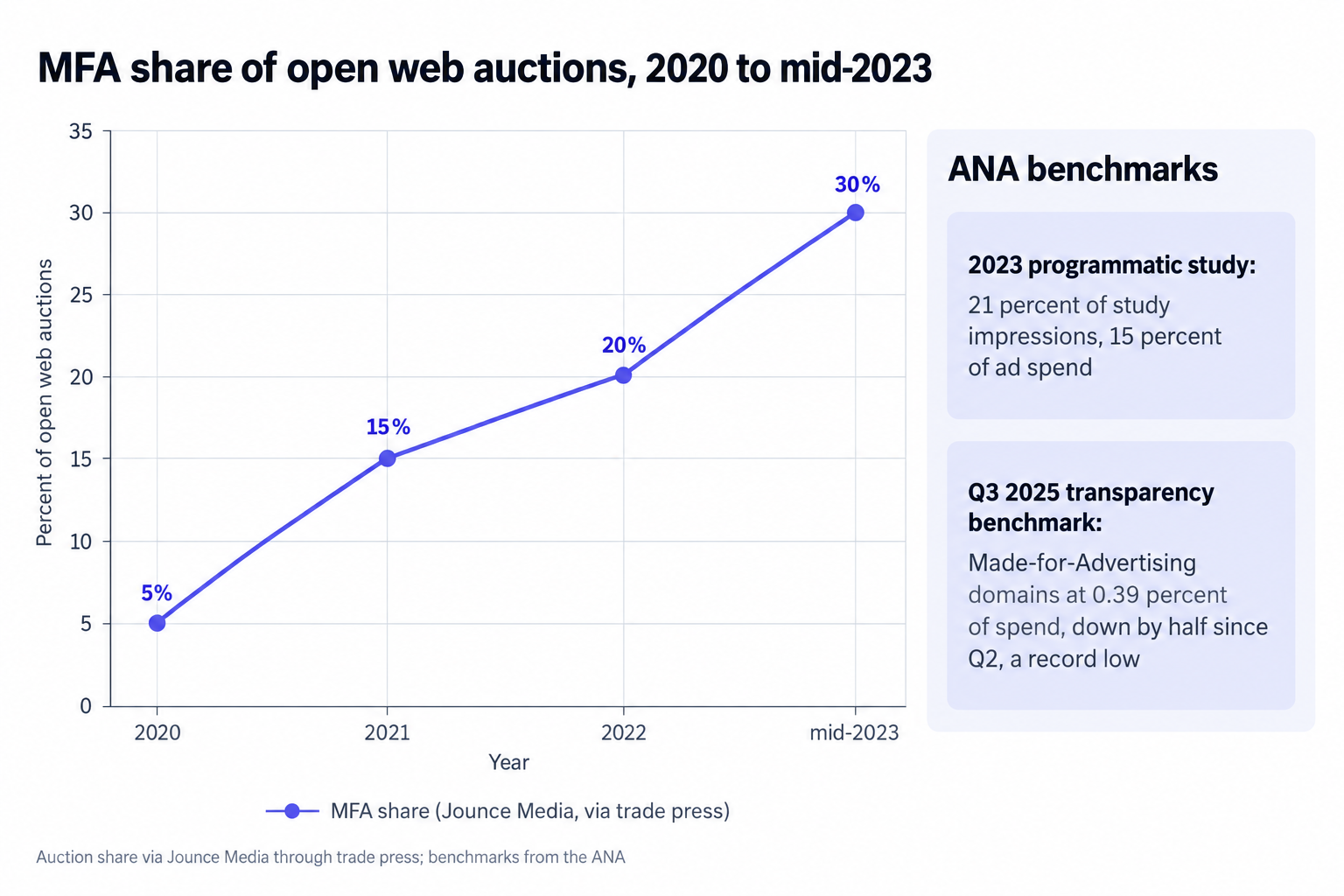
Made For Advertising websites carried 21 percent of the study impressions and 15 percent of the ad spend in the ANA's 2023 programmatic study, and the filters buyers built against that finding now price inventory they have never inspected, including yours. Trade analysis citing Jounce Media tracked MFA growth from about 5 percent of open web auctions in 2020 to 15 percent in 2021, 20 percent in 2022, and 30 percent by mid-2023. Agencies answered with exclusion lists, verification vendors added MFA flags to their category taxonomies, and curated marketplaces began screening supply before the bid. The screening worked: by the ANA's Q3 2025 transparency benchmark, Made-for-Advertising domains represented 0.39 percent of spend, down by half since Q2, a record low.
The filters that produced that record do not separate operators from honest mid-market publishers with much precision. They read price bands, domain age, category, traffic mix and on-page structure, and each input misfires on legitimate inventory: a new vertical publication, a domain migration, a seasonal paid campaign, a newsletter-first site with shallow sessions by design. When a filter catches you, nobody sends a rejection notice. Demand thins, floors stop clearing, and session revenue slides while your viewability and invalid traffic dashboards stay clean, which is exactly why inventory quality proof now belongs on the ad operations calendar beside viewability work itself.
The definition buyers apply to your domain
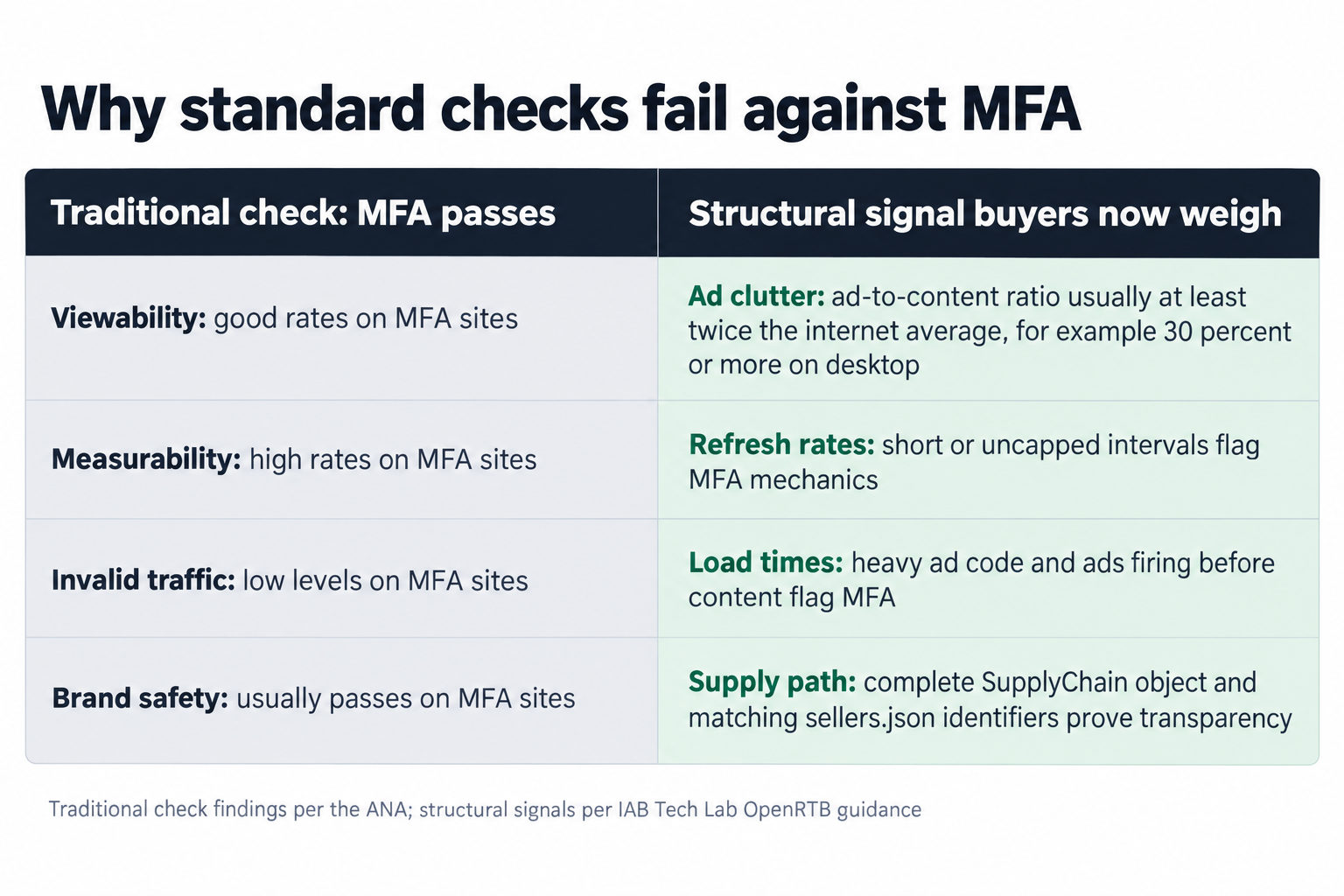
On September 26, 2023, the ANA issued the industry's definition of Made For Advertising together with the 4A's, the WFA and the ISBA. The joint industry definition targets websites created for the singular purpose of simultaneously buying and selling advertising inventory, with an ad-to-content ratio usually at least twice the internet average, for example 30 percent or more on desktop. The phrase "simultaneously buying and selling" describes the operating model: the site buys audiences cheaply on one end and resells them as impressions on the other, so the content exists mainly to carry the arbitrage. The ad-to-content ratio serves as the measurable fingerprint of that model.
Split the definition into what a buyer can actually test and the playbook writes itself. Purpose does not travel in a bid request, so detection models lean on the measurable proxy, the ad-to-content ratio, and treat the 30 percent desktop figure as the working example of twice the average. You cannot argue with a classifier about intent, but you can move every measurable feature it reads. That gap between intent and measurement is where a legitimate publisher proves quality.
The economics behind the definition explain the force of the buyer reaction. MFA sites took 15 percent of spend while delivering 21 percent of impressions, which puts their average CPM below the pool average, and buyers watched cheap impressions cluster in one recognizable pattern. Cheap plus recognizable is exactly what automated filters remove first, and every publisher selling into open auctions inherits that pattern-matching regardless of how their traffic actually behaves.
Why the standard checks do not catch MFA
The ANA's definition work surfaced an uncomfortable companion finding: MFA websites deliberately pass traditional checks. They exhibit high measurability rates, good viewability rates, low levels of invalid traffic, and usually brand-safe environments, because MFA operators optimize for the exact metrics verification tools score. A site engineered to pass verification beats an honest site on the same scorecard, and the scorecard cannot tell them apart.
That failure mode pushes buyers toward cruder discriminators, and crude discriminators over-block. When viewability and invalid traffic counts cannot separate MFA from quality, buyers fall back on price, domain age, traffic source mix and session depth, and each of those catches honest inventory. The false positive costs the buyer nothing and costs you the demand, so the filters run hot by design.
The burden of proof has therefore moved into signals buyers can read in the bid stream itself. IAB Tech Lab's guidance on OpenRTB signals names the biggest tells of MFA inventory: ad clutter, load times and refresh rates. The same guidance points buyers to the supply path, where they can review the SupplyChain object and verify identifiers within sellers.json files for supply path transparency. Those two threads, on-page structure and path documentation, define where your audit starts.
Read your supply path the way buyers do
The SupplyChain object records each seller in the path with its ad system identifier, its seller ID, and whether that node handles payment. A buyer reading your inventory sees your domain appear with the right account identifier, sees intermediaries declared as intermediaries, and can compare the chain against the sellers.json your partner publishes. Missing nodes, mismatched identifiers or a chain that starts mid-path read as arbitrage risk, and buyers route around them quietly.
Check three files this week. Pull your ads.txt and confirm every entry corresponds to a partner you actually use, because stale entries create shadow supply paths. Then pull each partner's sellers.json, find the entry for your account, and confirm the identifier and seller type match reality; an honest publisher marked as an intermediary invites questions you do not want.
Finally, ask each partner to send you the SupplyChain object your bid requests actually carry, because you should see what buyers see. Count the hops between your ad server and the DSP bid. Every hop you cannot explain costs you a quality presumption, and presumptions decide pre-bid filter outcomes.
Audit your inventory against the classifier
Run the audit in the order detection vendors weight their features, and fix findings in the same order. Everything below is measurable from your own stack inside a week, and every item maps to a signal buyers observe from their side. Agencies advising publishers should request this audit before recommending any supply partner, because the findings predict how curated paths will treat the inventory.
- Ad density. Measure the share of above-the-fold pixels covered by ad units, on desktop and mobile, across your five highest-traffic page types. Buyers quote the definition's example of 30 percent or more on desktop, so treat anything approaching that number as urgent and anything above it as a fire.
- Refresh behavior. Pull interval settings and cap rules per slot, plus the distribution of refreshes per session. Long intervals with caps read as standard practice; short or uncapped refresh reads as MFA mechanics.
- Load sequence and speed. Record when ad calls fire relative to content render, and capture layout shift and page weight attributable to ad code. Ads firing before content paint, or heavy wrapper and verification code, match the profile buyers filter on.
- Traffic acquisition mix. Review channel splits month by month, not lifetime, because arbitrage arrives in bursts. A spike in paid or redirected traffic alongside thin engaged time is the classic MFA signature.
- Content depth. Sample your newest articles and record word count, engaged time and return visitor share. Classifiers read production patterns, and a volume of thin pages per day looks like content farming even when the writing is good.
- Supply path length. Count every intermediary between your ad server and the winning bid, then confirm each partner appears in your ads.txt, lists you in its sellers.json with the correct identifier and seller type, and passes a complete SupplyChain object downstream.
Re-run the audit quarterly and after any redesign, traffic push or partner change. A single unmeasured variable, one new interstitial format, one refresh test, can move a domain across a classification line. A schedule beats an investigation, because investigations start after the revenue has already left.
Fix findings in the order that moves demand
Cut density first because it anchors both the definition and the classifiers. Removing slots reduces impression counts, so judge the change on revenue per session rather than impressions per session: fewer, cleaner impressions face less pre-bid filtering, clear higher floors, and recover in CPM what they lose in volume. Track revenue per session for a full cycle before you judge the cut, because classification effects lag impression effects. Where density sits near the 30 percent desktop example, the fix belongs in this sprint, not this year.
Refresh discipline comes second. Set a long interval, cap refreshes per slot per session, and never refresh out-of-view slots. Refreshing out-of-view impressions inflates measured supply and reads as MFA mechanics to any buyer running refresh analysis on your domain.
Third, sequence and weight: render content first, call ads asynchronously, lazy load below-the-fold units on viewport proximity, and strip redundant wrapper and verification code. These changes also improve Core Web Vitals, which protects the organic traffic that separates your site from the arbitrage pattern in the first place. Speed work compounds, because organic depth is the cheapest proof of purpose a classifier can find.
Fourth, traffic hygiene. Paid acquisition can belong in a growth plan, but it must convert into return visitors and engaged sessions, or it trains every model on your domain the wrong way. Kill arbitrage experiments entirely; no short-term RPM gain survives a label.
Fifth, content standards. Set a minimum depth for new articles and a cadence your team can genuinely sustain, because classifiers read production patterns, not journalism quality. A site that publishes fewer, longer pieces with real engaged time looks nothing like the MFA content profile, and the numbers prove it without an argument.
Measure the fixes the way buyers will measure them. Watch pre-bid filtering rates where a partner exposes them, track clear rates and cleared CPM by slot, and keep one template as a holdout so you can attribute movement to the change. A density cut that trades impression volume for higher floors shows up in revenue per session within the cycle. If it does not, density was not the problem, and the audit tells you where to look next.
Package proof that agencies can verify
An audit inside a spreadsheet changes nothing until demand partners can see it. Build a supply dossier your reps can hand to agencies and keep it current: your ads.txt, a supply path diagram with every hop and identifier, the matching sellers.json entries, ad density measurements with screenshots by template, refresh settings, viewability by placement, the monthly traffic mix, and the content production stats from your audit. Agencies review a complete dossier in minutes, and completeness separates a curated path from a suspect one. An incomplete dossier reads as concealment, which is worse than any single finding.
We sit on all three sides of this market as an ad network, an SSP and an agency in one company, and that position shapes our answer to the label. At OnlyMedia, we run a curation layer in front of the auction: managed floors, demand mapping, whitelists, pre-bid brand safety filtering and MFA filtering aligned with the IAB Content Taxonomy. The filtering runs as pre-bid screening on every impression, before a request reaches demand, because post-bid blocking leaves the publisher holding a dead impression and the buyer holding a wasted decision. Filtering at the front of the path also gives publishers a clean record to point to when a buyer questions the domain.
On the buy side, our agency teams plan campaigns with verified audiences against curated supply paths, buying over OpenRTB 2.6, so we see which evidence moves traders. Documented paths with complete SupplyChain objects clear curation; undocumented hops do not. Build the dossier before anyone asks for it, because the request that never arrives is the bid you never see.
What to demand from monetization partners
Your SSP or network either helps you prove quality or hides the problem from you, and five questions separate the two quickly. Ask them at your next partner review and treat vague answers as data:
- Do you filter MFA before the bid, and against which taxonomy?
- Show me the supply path you pass downstream, including the complete SupplyChain object and your sellers.json entries for my account.
- Which domains or categories in my account have buyers questioned, and what changed as a result?
- How fast does reporting reflect a change like a density cut, at the placement level?
- What are the payment terms, and do they hold when a buyer disputes a label?
Then hold partners to the standards you would accept anywhere else in your operation. We pay publishers Net 30 on CPM terms, no chasing, no sliding terms, and we work with thousands of publishers, each above one million monthly pageviews, through a curated programmatic demand network. OnlyMedia's publisher console refreshes reporting every ten minutes, so a density cut shows its effect on clear rates the same day you ship it. When a buyer disputes a label, the timeline from finding to fix to proof is what restores the spend.
The record low, and what it means for you
The 0.39 percent figure says the wholesale MFA problem has collapsed under sustained pressure, and the residual risk has shifted from detection to misclassification. Buyers will keep the filters that produced the record because those filters cost almost nothing to run, and the false positives land on publishers who cannot see them. Your defense is operational, not rhetorical: measure the features classifiers read, keep the supply path short and documented, and put evidence in front of demand before anyone asks.
Audit this quarter, fix density first, then refresh, then load sequence, and rebuild the dossier after every material change. At one million monthly pageviews and above, you generate enough sessions to watch each fix move clear rates within a pay cycle. That feedback speed is the difference between proving quality and arguing about it after the demand has already gone.